By Felipe Morales, CEO of ESBUENISIMO LINKS
SEO vs. SEM: the difference, which one your company needs and how to split the budget
The difference between SEO and SEM for marketing and ecommerce teams: real cost-per-click data from Chile, when Google Ads makes sense, when SEO with link building does, and why ads do not show up in AI answers.
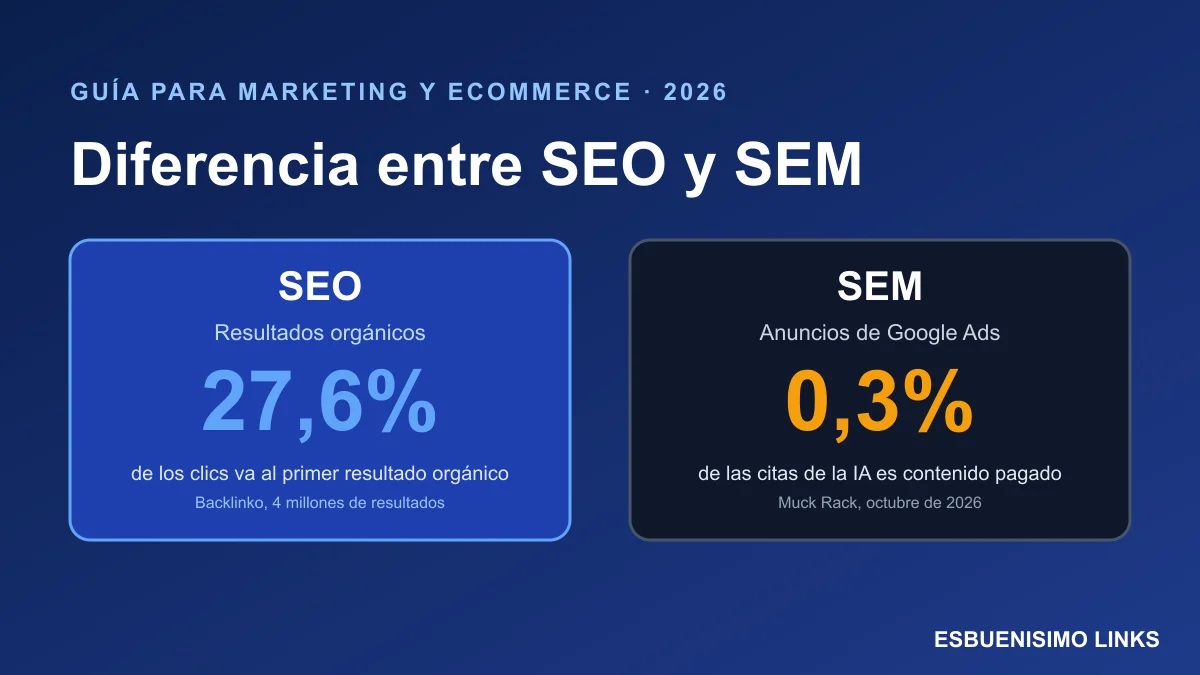
Almost every marketing budget meeting ends up at the same question: do we put the money into Google Ads or into SEO? The difference between SEO and SEM is not just technical. It changes when sales arrive, how much each visit costs and what happens the day the budget is cut. It also changes something new: whether your brand shows up when a customer asks ChatGPT.
This guide is written for marketing, communications and ecommerce managers who have to decide where to invest, with figures from public studies and real cost-per-click data from Chile.
The difference between SEO and SEM in one sentence
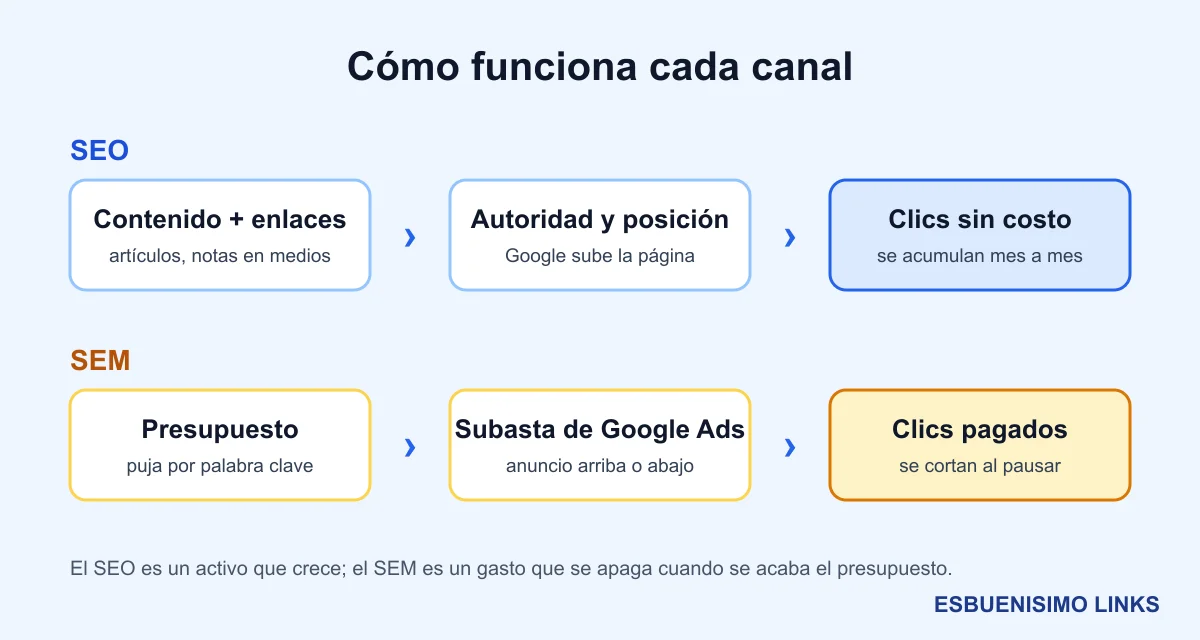
SEO (search engine optimization) is the work of getting a page into Google's organic results, the ones nobody pays for. SEM (search engine marketing) is, in common usage, buying ads on search engines, mainly on Google Ads: the brand bids on a keyword and pays every time someone clicks its ad.
Put another way: with SEM you rent visibility; with SEO you build it. When a Google Ads campaign is paused, the clicks stop that same day. When a page earns organic rankings, it keeps getting visits for as long as it stays relevant and keeps its authority.
That authority depends largely on the links a site receives from other websites, especially from news outlets and recognized sites in its industry. That work is called link building, and it is the SEO lever that is hardest to pull without outside help.
SEO vs. SEM: a side-by-side comparison with data
The table sums up the differences that matter most in a budget decision. The figures come from public studies; the source and date of each one are listed below.
| Criterion | SEO (organic) | SEM (Google Ads) |
|---|---|---|
| How you pay | Content, technical improvements and links | Cost per click (CPC) set in an auction |
| When results arrive | From 3 to 6 months onward | From day one |
| What happens when you stop investing | Traffic declines gradually | Traffic stops immediately |
| Clicks captured by the top spot | 27.6% of clicks (organic position 1) | Variable; depends on the auction |
| Share of all Google clicks | 360 of every 1,000 US searches end in a click to the open web | About 1% of clicks |
| Weight in AI answers | High: more than 84% of citations come from earned and third-party sources | 0.3% of citations are paid content |
Sources: the 27.6% figure comes from Backlinko's analysis of 4 million Google results (updated in April 2025), which also found that the first organic result is ten times more likely to get a click than the tenth. Open-web clicks and the 1% of paid clicks come from SparkToro's zero-click search study (July 2024, using Datos panel data): 58.5% of US searches and 59.7% of European Union searches ended without any click.
That 1% needs context, and SparkToro provides it: Google said in 2023 that fewer than 20% of searches show ads, so when an ad does appear, its click-through rate is at least around 5%. SEM works very well on commercial searches where ads appear; what it does not do is cover everything else.
🚀 Digital PR & Link Building
Rank #1 on Google and Get Mentioned by AI
1,400+ media outlets in 8 countries. Backlinks that Google and ChatGPT recognize as trusted authority sources.
See plans and pricing →How much a Google Ads click costs in Chile
The auction sets the price of SEM. To show orders of magnitude, we looked at the average cost per click (CPC) reported by Google Ads keyword data for a few searches in our own industry in Chile. These are examples, not an industry ranking.
| Google search (Chile, in Spanish) | Average CPC (USD) |
|---|---|
| share of voice | 18.23 |
| posicionar pagina web en google (rank a website on Google) | 15.01 |
| como aparecer en google (how to appear on Google) | 5.92 |
| auditoria seo (SEO audit) | 3.12 |
| estrategia seo (SEO strategy) | 2.84 |
| cuanto cuesta google ads (how much Google Ads costs) | 1.13 |
Source: DataForSEO, Google Ads data for Chile, retrieved November 2, 2026. For reference, in Mexico "cuanto cuesta google ads" shows USD 2.71 per click.
The takeaway for a manager is simple: if a search in your category costs USD 15 per click and converts at 2%, each customer arriving through that ad costs roughly USD 750 in media alone. If the same page reaches the top organic spot, those clicks stop being paid one by one. That is why it makes sense to calculate the return of each channel with the same yardstick; our guide to measuring link building ROI explains how to do it for the organic side.
When SEM makes sense, when SEO does, and when you need both
This is not a choice between camps. In practice, companies that grow in search use both channels in different roles:
- SEM for what is urgent: a launch, a dated promotion (Cyber Day, Black Friday), testing which keywords convert before investing in content, or capturing demand while the site still lacks authority.
- SEO for what is steady: categories searched all year, the questions customers ask before buying and terms where the CPC is so high that paying for every click does not add up.
- Both when the keyword is critical: ads cover the gap while the page climbs organically, and then the bid can be lowered.
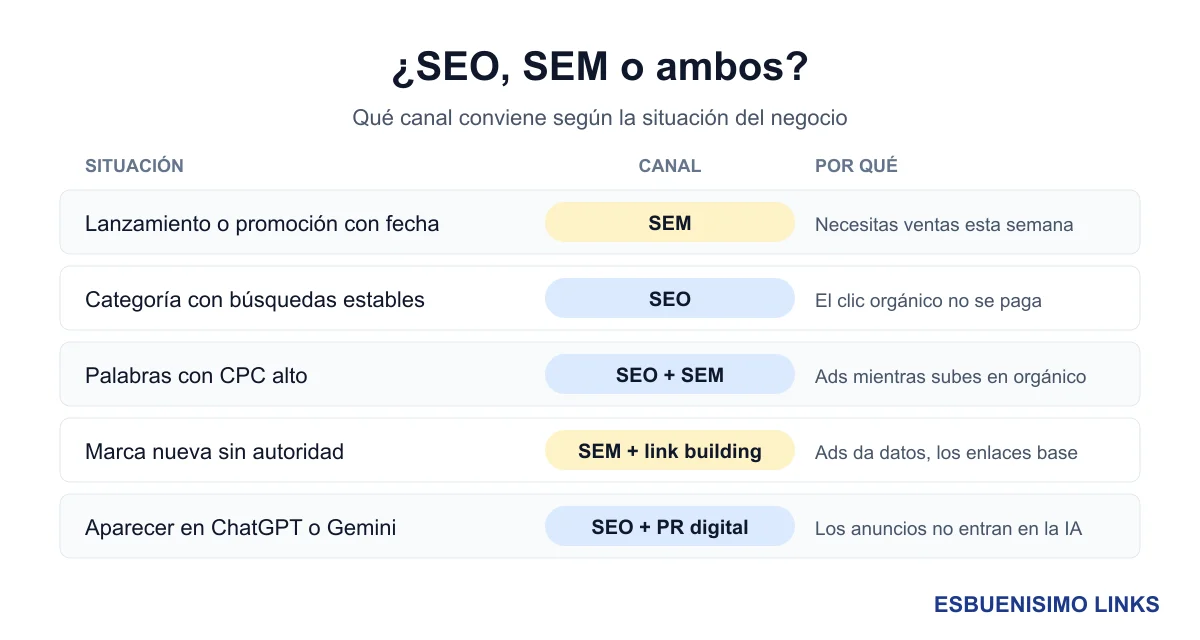
| Situation | Main channel | Time horizon |
|---|---|---|
| Dated promotion or launch | SEM | Days or weeks |
| Ecommerce with steady categories | SEO, with SEM on peak dates | 6 to 12 months |
| B2B services with CPC above USD 10 | SEO and link building | 6 to 12 months |
| New brand with no links | SEM to sell, link building to grow | 3 to 6 months to see the first changes |
| Appearing in ChatGPT, Gemini or Perplexity | SEO and digital PR | 3 to 6 months |
The horizons are working references, not promises: they depend on how competitive each keyword is and on where the site starts.
The difference between SEO and SEM in AI: the channel ads cannot buy
There is a contrast that did not exist two years ago. More and more people ask ChatGPT, Gemini or Perplexity which brand to choose, and those answers have no slot for Google Ads. They are built from what others publish about the brand.
Muck Rack's What Is AI Reading? study (October 2026) found that paid or advertorial content makes up just 0.3% of what assistants cite, while more than 84% comes from earned and third-party sources: press, comparison sites, forums and specialized sites. What moves the needle in AI is the same thing that sustains long-term SEO: articles in real media outlets, mentions and links. We explain it step by step in how to get mentioned by AI.
How to split the budget between SEO and SEM
There is no correct percentage for every company, but there is a method:
- Measure the cost per customer of each channel. For SEM it is direct (spend divided by sales). For SEO, divide your investment in content and links by organic sales over the last 12 months.
- Separate the urgent from the structural. What has to sell this month goes to SEM; what has to sell every month goes to SEO.
- Review your most expensive keywords. If a term costs you more than USD 5 per click and is searched all year, it is a candidate to win organically.
- Look at what your competitors do. The link building benchmarks for Chile help size the organic effort.
- Recalculate every quarter. As organic rankings rise, part of the ad spend can shift to content and press.
If the decision is to strengthen the organic side, the bottleneck is almost always domain authority, meaning links from trusted sites. At ESBUENISIMO LINKS we handle link building in Chile with articles in real Chilean media outlets, and we help define which keywords are worth winning organically and which ones to keep buying on Google Ads.
Frequently Asked Questions
What is the difference between SEO and SEM?+
SEO aims to get a page into Google's organic results, which are not paid per click; SEM buys ads on search engines, mainly on Google Ads, and pays for every click. SEO takes months but keeps paying off; SEM brings visits from day one but stops when you stop paying.
Which is better, SEO or SEM?+
It depends on the goal. SEM suits launches, dated promotions and testing which keywords convert. SEO suits steady searches and keywords with a high cost per click. Most companies that grow on Google combine both.
How much does a Google Ads click cost in Chile?+
It depends on the auction for each keyword. As an example, on November 2, 2026 DataForSEO reported an average CPC in Chile of USD 1.13 for 'cuanto cuesta google ads', USD 5.92 for 'como aparecer en google' and USD 15.01 for 'posicionar pagina web en google'.
How long does SEO take to show results?+
The first changes usually appear three to six months after starting, with more solid results between six and twelve months. It depends on keyword competition and on the authority the site starts with.
Do Google Ads help a brand appear in ChatGPT?+
Barely. According to Muck Rack's What Is AI Reading? study (October 2026), paid or advertorial content makes up 0.3% of AI assistant citations. What matters are earned and third-party sources, such as media articles, comparison sites and forums.
Ready to rank #1 and get mentioned by AI?
Digital PR & Link Building in 1,400+ media outlets across 8 countries. Google and ChatGPT recognize you as an authority source.
See plans and pricing