By Felipe Morales, CEO of ESBUENISIMO LINKS
What is a publinota? Sponsored articles in Latin America explained (2026)
What a publinota is, how it differs from a press release and a banner, what it costs in Argentina and Latin America, which formats exist and how to publish one that helps SEO, brand and AI visibility.

"Publinota" is one of those words everyone in Argentine media understands and that confuses people outside the industry. According to DataForSEO, "publinota" is searched around 110 times a month on Google Argentina, more than five times the volume in Mexico. This guide explains what a publinota is, what it costs in general terms, which formats exist and how to publish one so it pays off in SEO, brand and AI visibility.
What is a publinota?
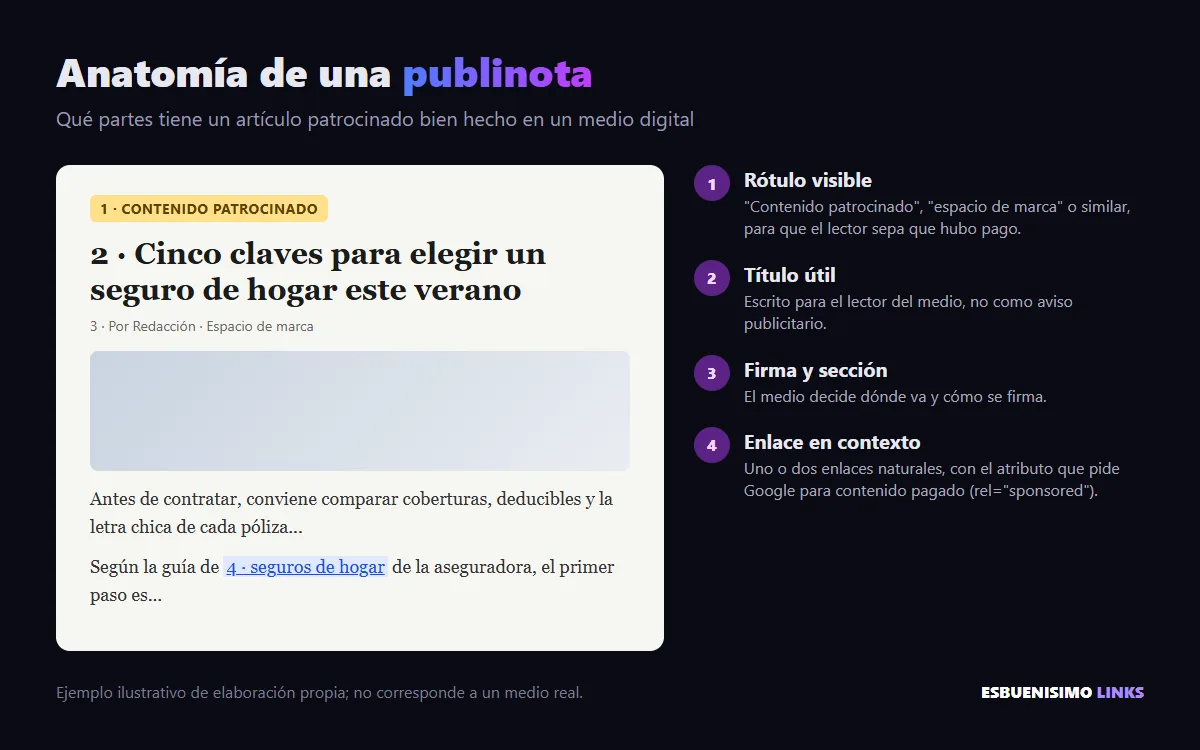
A publinota is an article paid for by a brand that an outlet publishes in news format: headline, subheading, body, images and, almost always, a link to the company's website. The difference from regular news is that money changed hands, so it should carry a label such as "sponsored content", "brand content" or "commercial note".
In other countries it is called a sponsored article, advertorial, paid feature or "publirreportaje". In SEO circles people also talk about paid guest posts. They all point to the same thing: using an outlet's audience and authority to tell something about your brand.
Publinota, press release and banner: the differences
For a communications manager, the key question is what each format gains and gives up.
| Format | Paid? | Guaranteed publication? | Message control | Link to your site |
|---|---|---|---|---|
| Publinota | Yes | Yes | High | Almost always |
| Press release | No | No: the journalist decides | Low | Sometimes |
| Banner or display ad | Yes | Yes, by impressions or days | High | Yes, but no SEO value |
| Earned editorial coverage | No | No | None | Depends on the outlet |
The publinota sits in the middle: it has the permanence and format of a news story (it stays indexed in Google for years) with the guaranteed publication of advertising. If you are interested in the free side, our guide to press releases for SEO shows how to get value from them.
🚀 Digital PR & Link Building
Rank #1 on Google and Get Mentioned by AI
1,400+ media outlets in 8 countries. Backlinks that Google and ChatGPT recognize as trusted authority sources.
See plans and pricing →How much a publinota costs in Argentina
There is no standard rate. Each outlet sets its price and adjusts it to demand. As an order of magnitude, a publinota in Argentina can cost from under USD 100 on small or niche sites to several thousand dollars on the largest national portals. What drives the price:
| Factor | Effect on price |
|---|---|
| Outlet audience and traffic | The biggest factor |
| Domain authority (DR) | More authority, higher price; what SEO teams look at most |
| Section and topic | Finance, health and gambling tend to cost more or carry restrictions |
| Writing included | Some outlets charge extra if their team writes it |
| Extra promotion | Homepage, newsletter or social media are billed as add-ons |
| Link type | Some outlets charge differently depending on the link attribute |
As an international reference, in Reporter Outreach's State of Link Building 2026 survey (500 SEO professionals, mostly from English-speaking markets), 76% said they would pay USD 300 or more for a quality link. Many Latin American outlets charge less than that, which makes the region attractive for brands selling in several countries.
Publinota examples: which formats exist
A publinota does not have to be a disguised ad. The formats that work best are the ones a reader would read even without a brand behind them:
- Practical guide: "Five keys to choosing home insurance", signed by an insurer.
- Proprietary data or study: a company survey or statistic that the outlet presents as information.
- Interview with a brand executive or specialist about an industry topic.
- Launch of a product, store opening or expansion into a new province.
- Use case: how a real customer solved a problem, with their permission.

Publinotas across Latin America
The word is very Argentine. According to DataForSEO, in November 2026 "publinota" gets about 110 monthly searches in Argentina, 20 in Mexico and around 10 in Chile, Colombia and Peru. In those countries the same format is better known as publirreportaje, paid note, sponsored content or sponsored article.
The name changes but the product is the same, which opens an opportunity for brands selling in several countries: one well-written piece can be adapted and published on outlets in different markets, each with its own label and link. For an ecommerce or service company with regional presence, coordinating publinotas in two or three countries often costs less than a single campaign on a big portal in a pricier market. The key is adapting the copy to the local reader: idioms, examples and data from the country where it runs.
What a publinota is for: SEO, brand and AI
For the SEO team, the value lies in the backlink (the link from the outlet to your site), which adds authority and helps specific pages rank. Google asks for paid links to be marked with rel="sponsored", as explained in its guide to qualifying outbound links. The difference between attributes is covered in our guide to dofollow, nofollow, sponsored and ugc links.
For marketing and communications, the value lies in the mention: your brand appears on an outlet your customers recognize. And there is a third, growing benefit: AI assistants such as ChatGPT, Gemini or Perplexity lean on authoritative outlets to answer. A brand that appears on several outlets in its country has better odds of being named by AI when someone asks about its category. That is why publinotas are now also funded from press budgets and AI visibility budgets.
How to publish a publinota in Argentina, step by step
- Define the goal: rank a page, launch a product or get the brand into outlets in a region.
- Pick outlets by audience and topic, not just authority. Our guide to link building in Argentina reviews the country's main digital outlets.
- Write for the outlet's reader. Informative headline, concrete data, one or two links in context.
- Confirm conditions before paying: label, link type, how long the article stays up and whether it appears on the homepage or social media.
- Measure: referral traffic, rankings of the linked page and brand mentions.
If you would rather not negotiate outlet by outlet, at ESBUENISIMO LINKS we manage publinotas on Argentine and other Latin American outlets from a single platform. See how our link building service in Argentina works (page in Spanish).
Common publinota mistakes
- Writing an ad instead of an article: nobody reads it and the outlet loses trust.
- Stuffing the text with links using the same exact anchor, the visible link text. One or two are enough.
- Choosing only by authority without checking whether the outlet covers your industry.
- Not saving the URL or checking that the article is still live months later.
- Publishing once and stopping. A single article rarely moves rankings or AI mentions; results come from a steady presence across several outlets over months.
Before buying, ask the outlet for a recent example of a sponsored article it has published. It shows you the label it uses, how it handles links and whether its sponsored content looks like real journalism or like an ad. Used well, a publinota is one of the most versatile tools in digital marketing: it serves SEO, brand reputation and AI presence with a single piece of content.
Cover photo: newspaper kiosk at Castro Barros station on Line A, Buenos Aires. Cristian O. Arone, Wikimedia Commons, CC BY-SA 4.0.
Frequently Asked Questions
What is a publinota?+
It is an article paid for by a brand and published on a media outlet in the format of a news story, labeled as sponsored content or brand content. It combines the outlet's reach and credibility with the company's message. The term is used mainly in Argentina.
How much does a publinota cost in Argentina?+
It varies widely by outlet. As an order of magnitude, it can range from under USD 100 on small or niche sites to several thousand dollars on the largest national portals. Audience, site authority, section and whether writing or social promotion is included all affect the price.
What is the difference between a publinota and a press release?+
A publinota is paid and the outlet guarantees publication. A press release is sent for free and the journalist decides whether and how to use it. The publinota gives control; the press release gives editorial credibility when it gets published.
Does a publinota help SEO?+
Yes, if it runs on an authoritative outlet in a related topic and includes a link to your site. Google asks for paid links to carry rel="sponsored"; even so, the placement brings traffic, brand mentions and signals that AI assistants also take into account.
Does a publinota have to say it is advertising?+
Yes. Serious outlets label it as sponsored content, brand content or similar. Hiding it damages the trust of readers and of the outlet itself, and Google requires paid links to be identified as such.
Ready to rank #1 and get mentioned by AI?
Digital PR & Link Building in 1,400+ media outlets across 8 countries. Google and ChatGPT recognize you as an authority source.
See plans and pricing