By Felipe Morales, CEO of ESBUENISIMO LINKS
Advertorial: what it is, examples and when it pays off for SEO and AI
What an advertorial is, how it differs from sponsored posts, earned press coverage and branded content, how it must be labeled under Chile's advertising code and Google's rules, and when it pays off for SEO and AI visibility.
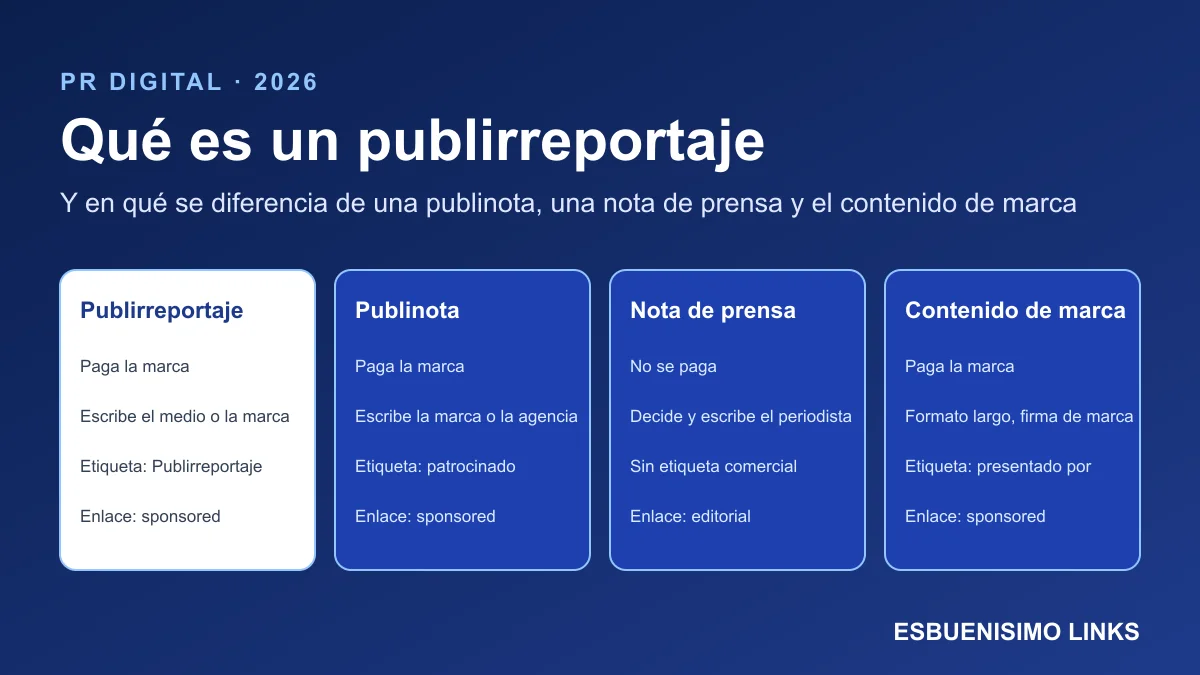
If you work in marketing or communications, you have probably been offered an advertorial: space in a media outlet, formatted like a news story, that your brand pays for. It is one of the oldest formats in the press, and it is back in the conversation for two new reasons: the links it leaves behind for SEO, and the question of whether it helps ChatGPT, Gemini or Perplexity mention the brand. This guide explains what an advertorial is, how it differs from other formats, what the rules say and when it is worth paying for, with a focus on Chile and Latin America, where the format is known as a publirreportaje.
What is an advertorial
An advertorial is advertising dressed as reporting. The brand pays, the outlet publishes, and the text comes with a headline, a standfirst, photos and the structure of a news piece. The word blends "advertisement" and "editorial", and demand for the term is steady: "advertorial" gets about 2,900 monthly searches in the United States, according to Google Ads data pulled through DataForSEO in November 2026. In Spanish-speaking markets, "publirreportaje" and its variants add a few hundred more searches a month in Chile, Mexico and Colombia combined.
The difference from a traditional ad is the language: instead of a slogan and an image, an advertorial tells a story, shares data and may quote spokespeople. That closeness to journalism is precisely why it must be labeled, because readers can mistake it for editorial content.
Advertorial vs. sponsored post, press coverage and branded content
Communications teams often use these terms interchangeably. It pays to separate them, because each one has a different cost, level of control and effect on search.
| Format | Paid? | Who controls the text? | Usual label | Expected link |
|---|---|---|---|---|
| Advertorial | Yes | The brand, edited by the outlet | Advertorial, advertising | rel="sponsored" |
| Sponsored post (publinota) | Yes | The brand or its agency | Sponsored content | rel="sponsored" |
| Press coverage (earned media) | No | The journalist | None | Editorial, at the outlet's discretion |
| Branded content | Yes | Shared, often with the outlet's content studio | Presented by, in partnership with | rel="sponsored" |
"Publinota" is the term most used in Argentina and in the Latin American link building market; we explain it with examples in our guide to what a publinota is and how sponsored articles work in Latin America. In Chile and Mexico, "publirreportaje" usually refers to longer, more produced pieces, often in the print edition as well as online.
🚀 Digital PR & Link Building
Rank #1 on Google and Get Mentioned by AI
1,400+ media outlets in 8 countries. Backlinks that Google and ChatGPT recognize as trusted authority sources.
See plans and pricing →How an advertorial must be labeled
In Chile, the rule comes from industry self-regulation. The seventh edition of the Chilean Code of Advertising Ethics published by CONAR, released in November 2024 and in force since January 1, 2025, addresses it in Article 13, "Identity of advertising": advertising presented as a report, opinion, testimonial or review in exchange for payment must be easily recognizable as an ad and labeled as such, so that it is clearly distinguished from the outlet's news or editorial content.
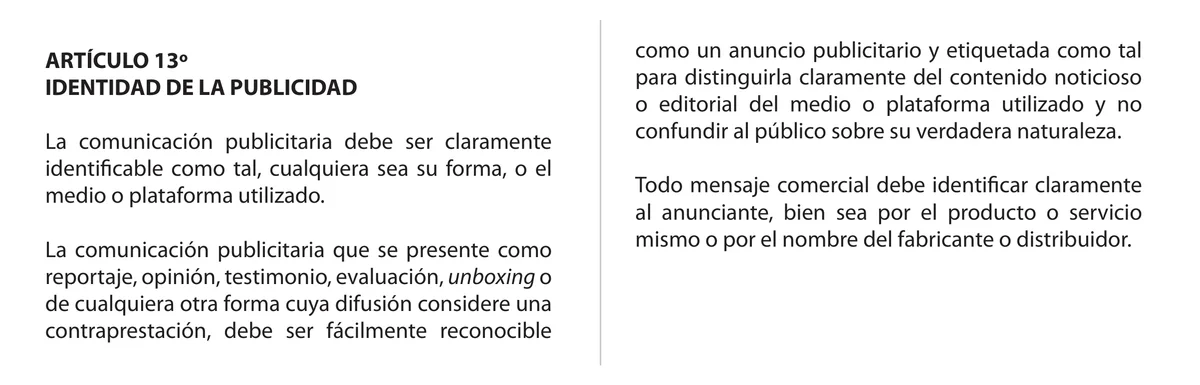
Article 35 adds a specific rule for native advertising, the kind that blends into an outlet's editorial content: the harder it is to notice its commercial nature, the clearer the label must be. This is not a formality. A University of Georgia study published in the Journal of Advertising found that only 17 of 242 readers (7%) recognized a sponsored article as advertising, and that labels reading "advertising" or "sponsored content" made readers about seven times as likely to recognize it as an ad compared with wording such as "presented by". The same research found that a label in the middle of the article worked better than one at the top or bottom.
In practice, a properly labeled advertorial on a news site carries three signals: a visible label ("Advertorial", "Sponsored content" or "Advertising") near the headline, the advertiser's name and, in the code, links marked as sponsored.
What Google says about paid links in media
For SEO, Google draws the line. Its spam policies list "advertorials or native advertising where payment is received for articles that include links that pass ranking credit" as an example of link spam. The same page clarifies that having such links is not a violation as long as they are qualified with rel="sponsored" or rel="nofollow". If you want to understand the difference between those attributes, see our guide to dofollow, nofollow, sponsored and UGC links.
In business terms: paying for an advertorial is fine; paying for it to manipulate rankings with a link that passes authority is not. So the SEO value of an advertorial should be measured by what it generates: readers who reach your site, branded searches after publication, mentions picked up by other outlets and the association between your brand and a topic.
Does AI cite paid content?
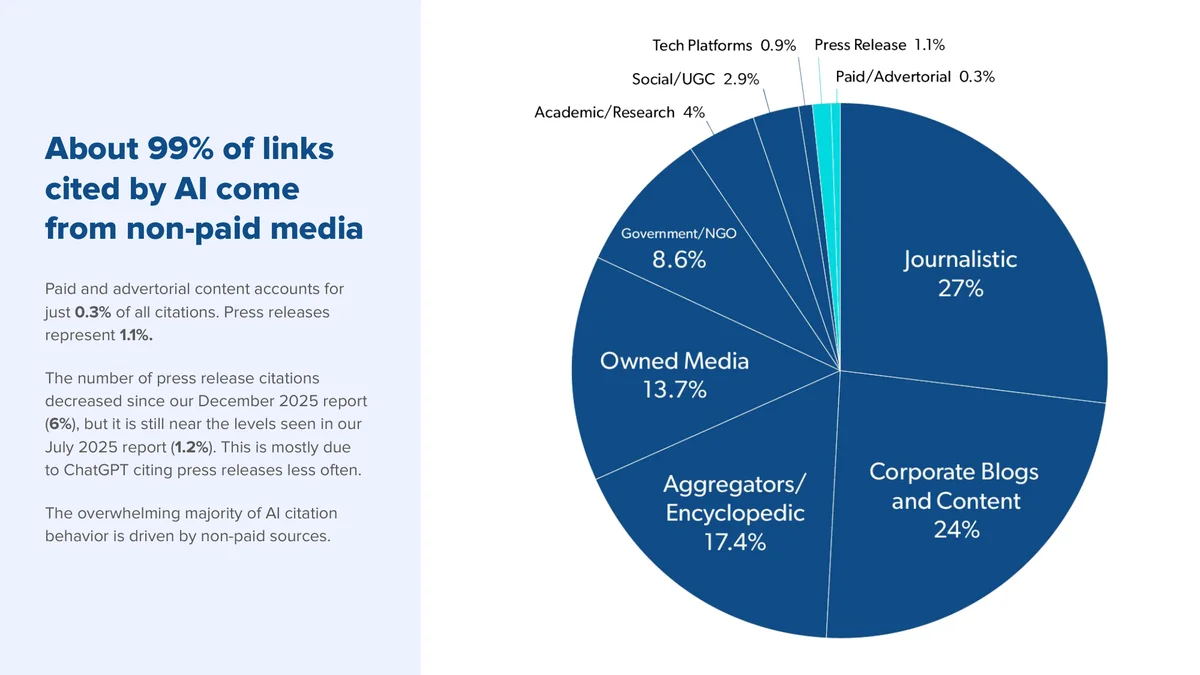
This is the question marketing managers ask today: if I pay for an advertorial, will ChatGPT start naming my brand? The available data says paid, labeled content carries little weight in AI answers. Muck Rack's What Is AI Reading report (May 2026) analyzed more than 25 million links cited by ChatGPT, Claude and Gemini and classified them by source type.
| Source type cited by AI | Share of citations |
|---|---|
| Journalism | 27% |
| Third-party corporate blogs and content | 24% |
| Aggregators and encyclopedias (Wikipedia, etc.) | 17.4% |
| Owned media of the brand in the query | 13.7% |
| Government and NGOs | 8.6% |
| Academic and research | 4% |
| Social media and user-generated content | 2.9% |
| Press releases | 1.1% |
| Tech platforms | 0.9% |
| Paid and advertorial content | 0.3% |
We saw a similar pattern in Chile in our study Which brands does AI cite in Chile?: of 3,730 citations across 96 purchase-intent questions, 48.6% went to third-party sites such as media, comparison sites and forums rather than brand websites. The conclusion is not that advertorials are useless, but that AI favors what looks like independent information. A good advertorial can start the conversation, but what AI ends up citing is usually editorial coverage, third-party rankings and data that others pick up. We cover this in our guide on how to get mentioned by AI.
When to pay for it, and when not to
| Brand objective | Format that usually performs best | Why |
|---|---|---|
| Launch a product or location with a controlled message | Advertorial | The brand decides the angle, figures and photos |
| Build credibility with customers and regulators | Earned press coverage | It is validated by a journalist who was not paid |
| Get AI to name the brand in its category | Earned media, proprietary data and mentions in trade media | It is what ChatGPT, Gemini and Claude cite most |
| Rank pages on Google | A mix of editorial coverage and properly labeled sponsored posts | It adds authority, traffic and brand signals without breaking the rules |
A good advertorial has four traits: an outlet with a real audience in your topic, an angle useful to the reader (a guide, a data point, a case) rather than a brochure, the clear labeling the code requires, and a correctly marked link. If the outlet fails the first condition, the format loses most of its value.
Examples by objective
- Opening feature: a company opens a plant or store and tells the story with investment, jobs and timeline figures.
- Sponsored how-to guide: a real estate developer explains how to estimate a mortgage payment, with its brand as advertiser.
- Executive interview: the CEO discusses the industry in a special supplement, labeled as advertising.
- Special report with proprietary data: the brand publishes survey or study results that other outlets can later cover as news.
The last format best connects the payment with what comes next. A new data point born in an advertorial can end up in editorial stories, and those do carry weight with Google and AI.
How to combine it with link building and digital PR
The brands that use advertorials best treat them as one piece of a plan, not a one-off purchase. The order we recommend: choose outlets by audience and topical authority, publish useful content with correct labeling, measure traffic and branded searches, and reinforce with earned coverage and mentions in trade media. At ESBUENISIMO LINKS we run that process with more than 1,400 outlets across Latin America; if your focus is Chile, see how publishing in Chilean media works as part of a measurable links and mentions strategy.
Frequently Asked Questions
What is an advertorial?+
An advertorial is paid advertising published in a media outlet in the format of a news story or feature article. It looks like editorial content, but a brand pays for it, which is why advertising codes such as Chile's CONAR code require it to be clearly labeled as advertising.
What is the difference between an advertorial and a press release?+
A press release is information a company sends to journalists, who decide for free whether to cover it and how. An advertorial is space the company pays for, with the content largely under its control. Earned coverage carries more credibility; an advertorial gives more control over the message.
What are some examples of advertorials?+
A newspaper feature about a company's new plant, paid for by that company and labeled as an advertorial; a real estate developer's guide to choosing an apartment in a property section, marked as sponsored content; or an interview with a clinic's CEO, funded by the clinic, in a health supplement.
Are advertorials good for SEO?+
They can be, if the outlet has a real audience in your topic, the content is useful and the link carries the rel="sponsored" attribute Google asks for. The value lies in visibility, referral traffic and branded searches, not in passing link authority: Google treats paid advertorials with links that pass ranking credit as link spam.
Does AI cite advertorials?+
Rarely, when they are identified as paid. In Muck Rack's What Is AI Reading report from May 2026, which analyzed more than 25 million links cited by ChatGPT, Claude and Gemini, paid and advertorial content accounted for just 0.3% of citations. AI cites journalism, third-party content and reference sources far more often.
Ready to rank #1 and get mentioned by AI?
Digital PR & Link Building in 1,400+ media outlets across 8 countries. Google and ChatGPT recognize you as an authority source.
See plans and pricing