By Felipe Morales, CEO of ESBUENISIMO LINKS
CTR (click-through rate): what it is, how to calculate it and how much AI Overviews cut it in 2026
CTR guide: what click-through rate is, how to calculate it, Google CTR by position in 2026 and why AI Overviews cut it by up to 58%. How to improve it.
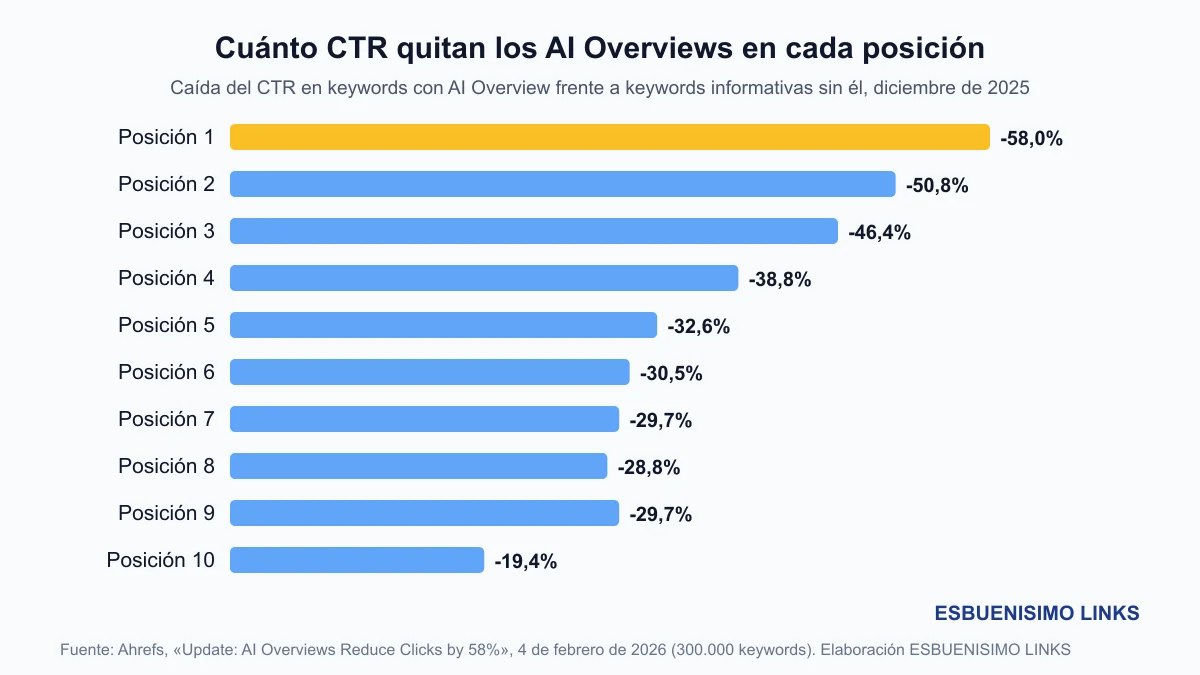
CTR is the metric that tells you how many of the people who saw your Google result, ad or email actually clicked. For years it was predictable: move up a position and clicks went up. In 2026 it is not that simple. According to Ahrefs, when Google shows an AI summary (AI Overview), the click-through rate of the top position falls by 58%. This guide explains what CTR is, how to calculate it, what CTR to expect by position and what to do to win clicks back.
What CTR is and why it matters
CTR stands for click-through rate. It measures the ratio between the times something was shown (impressions) and the times someone clicked it. It is used in three places that should not be mixed up:
- Organic CTR: for your pages in Google's regular results. You can see it in Google Search Console by query and by page.
- Google Ads CTR: for your paid ads. It feeds into Quality Score and therefore into how much you pay per click.
- Email, banner and social CTR: the same formula applied to an email, a display ad or a post.
For a marketing or ecommerce manager, organic CTR is the one to understand first, because it explains why a site can hold its rankings and still lose traffic. If you are new to these ideas, our guide on how to show up on Google covers the basics.
How to calculate CTR (click-through rate)
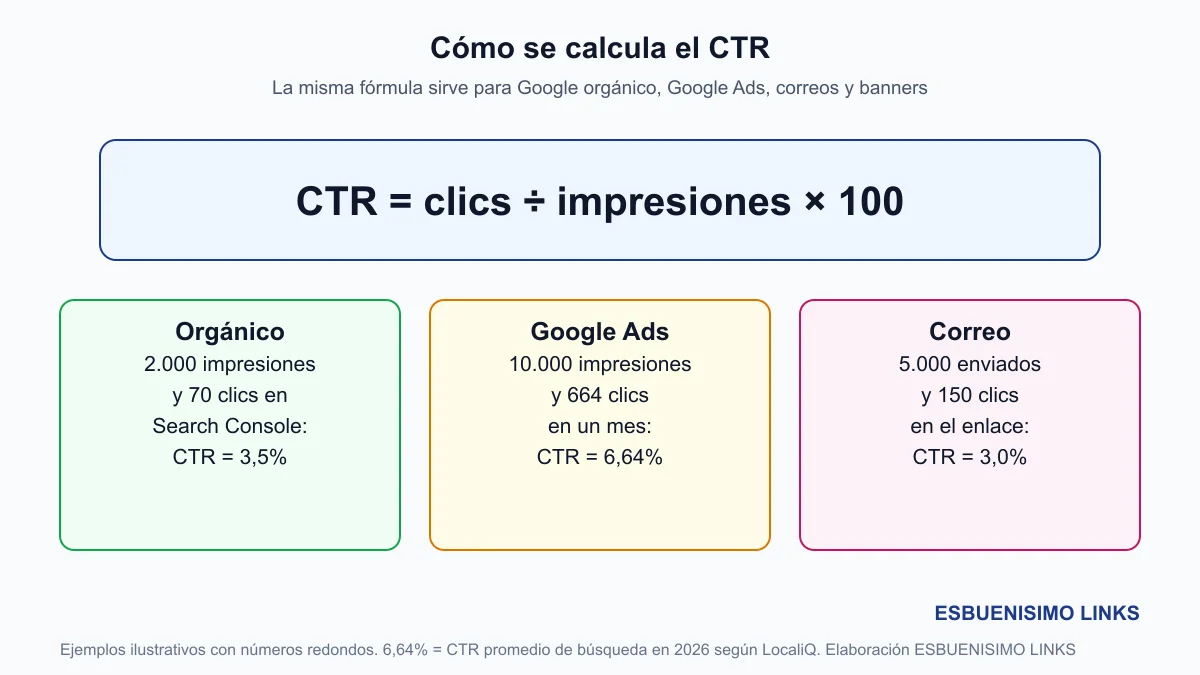
The formula is the same on every channel: CTR = clicks ÷ impressions × 100. If a page had 2,000 impressions on Google and 70 clicks, its CTR is 3.5%. If an ad was shown 10,000 times and got 664 clicks, its CTR is 6.64%, exactly the 2026 average for search ads according to LocaliQ.
Two practical warnings. First, a site's average CTR in Search Console blends branded queries (with very high CTR) and generic queries, so look at it query by query. Second, an impression counts even if the result sits far down the page and nobody scrolled to it, which is why pages moving from position 15 to 8 sometimes show a lower CTR while gaining clicks.
To see your organic CTR, open Search Console, go to the Performance report and turn on the CTR and average position columns. Sort by impressions: queries with many impressions, a good position and a low CTR are the first ones to fix, because the problem is not that Google does not show you, but that people do not pick your result.
🚀 Digital PR & Link Building
Rank #1 on Google and Get Mentioned by AI
1,400+ media outlets in 8 countries. Backlinks that Google and ChatGPT recognize as trusted authority sources.
See plans and pricing →CTR by Google position in 2026
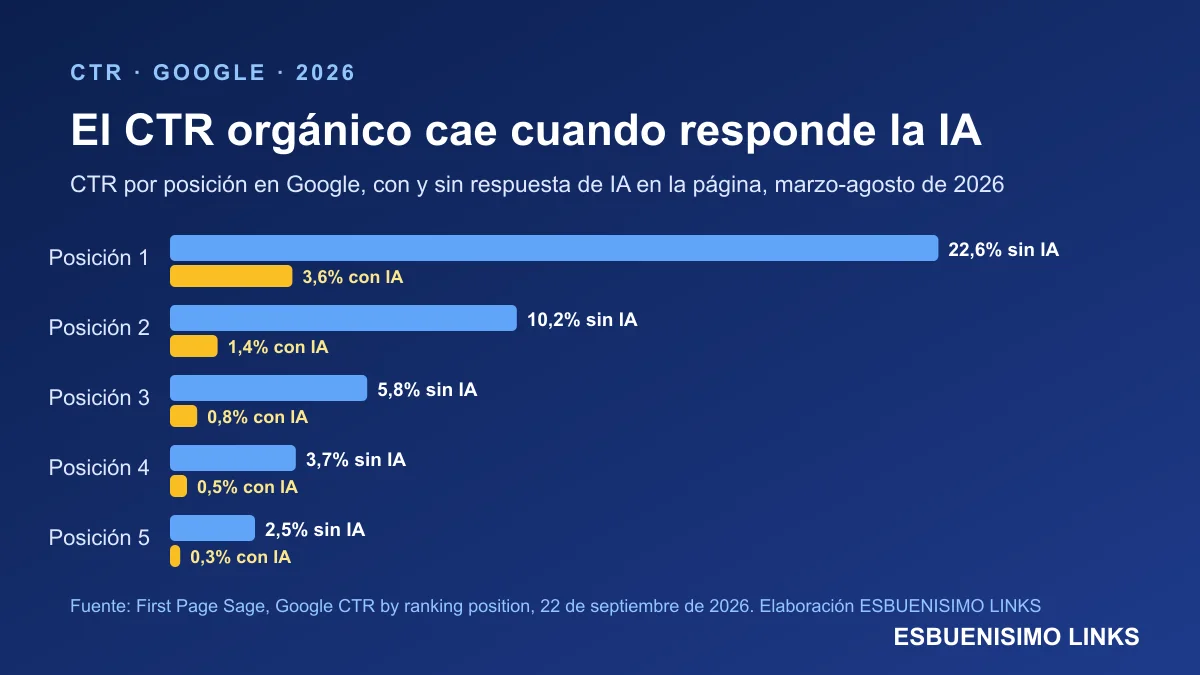
The most recent study comes from First Page Sage, published in September 2026 with data from 1,184 domains and 3.67 billion impressions between March and August. It splits two worlds: searches where Google shows an AI answer and those where it does not.
| Position | CTR with AI answer | CTR without AI answer | Blended CTR |
|---|---|---|---|
| 1 | 3.6% | 22.6% | 7.1% |
| 2 | 1.4% | 10.2% | 3.0% |
| 3 | 0.8% | 5.8% | 1.7% |
| 4 | 0.5% | 3.7% | 1.1% |
| 5 | 0.3% | 2.5% | 0.7% |
| 1 | 3.6% | 22.6% | 7.1% |
| 2 | 1.4% | 10.2% | 3.0% |
| 3 | 0.8% | 5.8% | 1.7% |
| 4 | 0.5% | 3.7% | 1.1% |
| 5 | 0.3% | 2.5% | 0.7% |
| 6 | 0.3% | 1.8% | 0.6% |
| 7 | 0.2% | 1.3% | 0.4% |
| 8 | 0.2% | 0.9% | 0.3% |
| 9 | 0.1% | 0.7% | 0.2% |
| 10 | 0.1% | 0.5% | 0.2% |
The gap is huge. With no AI answer, the top spot gets 22.6% of clicks; with an AI answer, only 3.6%. The blended average for position 1 is 7.1%. From position 6 down, CTR is under 1% in either scenario, which confirms the old rule: in SEO, being on page one is not enough; you need to be near the top.
Why AI Overviews keep the clicks
Google's AI summaries answer the question on the results page itself, so fewer people need to visit a site. Four independent studies reach the same conclusion with different methods:
| Study | Date | Sample | Finding |
|---|---|---|---|
| Ahrefs | Feb 2026 | 300,000 keywords | -58% CTR for position 1 when an AI Overview shows |
| Pew Research Center | Jul 2025 | 900 adults, 68,879 searches | Click on a result: 8% with an AI summary vs. 15% without |
| Seer Interactive | Nov 2025 | 3,119 queries from 42 companies | Organic CTR on AI Overview queries: from 1.76% to 0.61% (Jun 2024 to Sep 2025) |
| First Page Sage | Sep 2026 | 1,184 domains, 3.67 billion impressions | Position 1: 3.6% with an AI answer vs. 22.6% without |
Pew's figure is the easiest to explain to a board: with an AI summary, only 8% of visits ended with a click on a traditional result, versus 15% without one, and just 1% clicked a link inside the summary itself. Seer Interactive adds a nuance that matters for strategy: brands cited inside the AI Overview had an organic CTR about 35% higher than uncited brands, although the study itself warns it cannot prove causation. We looked at how often these summaries show up in the region in AI Overviews in Latin America 2026.
View the data as a table
| of visits clicked a result when there was no AI summary | 15% |
| clicked a result when there was an AI summary | 8% |
| clicked a link inside the AI summary | 1% |
| ended the session on a results page with an AI summary | 26% |
How to win back clicks on Google
Some levers raise CTR at the same position, and others raise it because they change the position. The second kind weighs more: according to the same First Page Sage study, moving from second to first place more than doubles CTR on searches without AI (from 10.2% to 22.6%).
| Lever | What to do | What it moves |
|---|---|---|
| Title tag | Keyword up front, a concrete benefit, under 60 characters | CTR at the same position |
| Meta description | Match the intent and preview the answer the user wants | CTR at the same position (Google often rewrites it) |
| Rich results | FAQ, product, review or event schema where it applies | Space and attention on the results page |
| Position | Content better than what ranks above and links from authoritative outlets | Moving up, which raises CTR the most |
| Brand | Make people know the name before they search (press, PR, AI) | Clicks to the result they recognize |
| AI citations | Be a source of the AI Overview with original data and media mentions | Clicks that survive the AI summary |
Title and description tweaks are quick and are covered in our on-page SEO guide. But when competitors do them well too, what separates one result from another is authority: links from recognized outlets and brand mentions. That is what helps you move up and, increasingly, what makes AI cite you as a source. That is why link building in Chilean media has a double effect: it improves your Google ranking and raises the odds of appearing inside the AI summary, where the few surviving clicks happen.
Paid click rates on Google Ads versus organic
For ads, the average search CTR was 6.64% in 2026 according to LocaliQ, ranging from 12.75% in arts and entertainment to 5.56% in automotive services. Ads do not escape AI either: Seer measured that paid CTR on AI Overview queries fell from 19.7% to 6.34% between June 2024 and September 2025. The takeaway for a manager is that paying more does not fix the underlying problem: people click less overall, and the clicks they do make go to brands they already know or that AI recommends.
That is why CTR should be read alongside other metrics: branded searches, conversions and presence in AI answers. If you need to organize that measurement, our SEO agency reviews CTR query by query in Search Console, separates branded from generic queries and prioritizes where a jump in position brings the most clicks.
Frequently Asked Questions
What is CTR?+
CTR stands for click-through rate. It is the percentage of people who click a link, ad or Google result out of the total number of times it was seen (impressions).
How is CTR calculated?+
Divide clicks by impressions and multiply by 100. If a result had 2,000 impressions and 70 clicks, its CTR is 3.5%.
What is a good CTR on Google?+
It depends on position and query type. According to First Page Sage (2026), the top organic result averages 7.1%, rising to 22.6% with no AI answer and dropping to 3.6% when there is one. For Google Ads, LocaliQ puts the average search CTR at 6.64% in 2026.
Why did my CTR drop if my ranking stayed the same?+
The most common cause in 2025 and 2026 is AI Overviews: Ahrefs measured a 58% lower CTR for position 1. Ads, featured snippets and Google rewriting your titles also play a part.
How do you improve organic CTR?+
Write titles and descriptions that match intent, add structured data for rich results, move up with better content and authoritative links, and get AI to cite your site as a source.
Ready to rank #1 and get mentioned by AI?
Digital PR & Link Building in 1,400+ media outlets across 8 countries. Google and ChatGPT recognize you as an authority source.
See plans and pricing