By Felipe Morales, CEO of ESBUENISIMO LINKS
On-page SEO: what it is, key factors and what 30 searches in Chile show
What on-page SEO is, which factors matter and what the 263 first-page Google results for 30 commercial searches in Chile have in common.
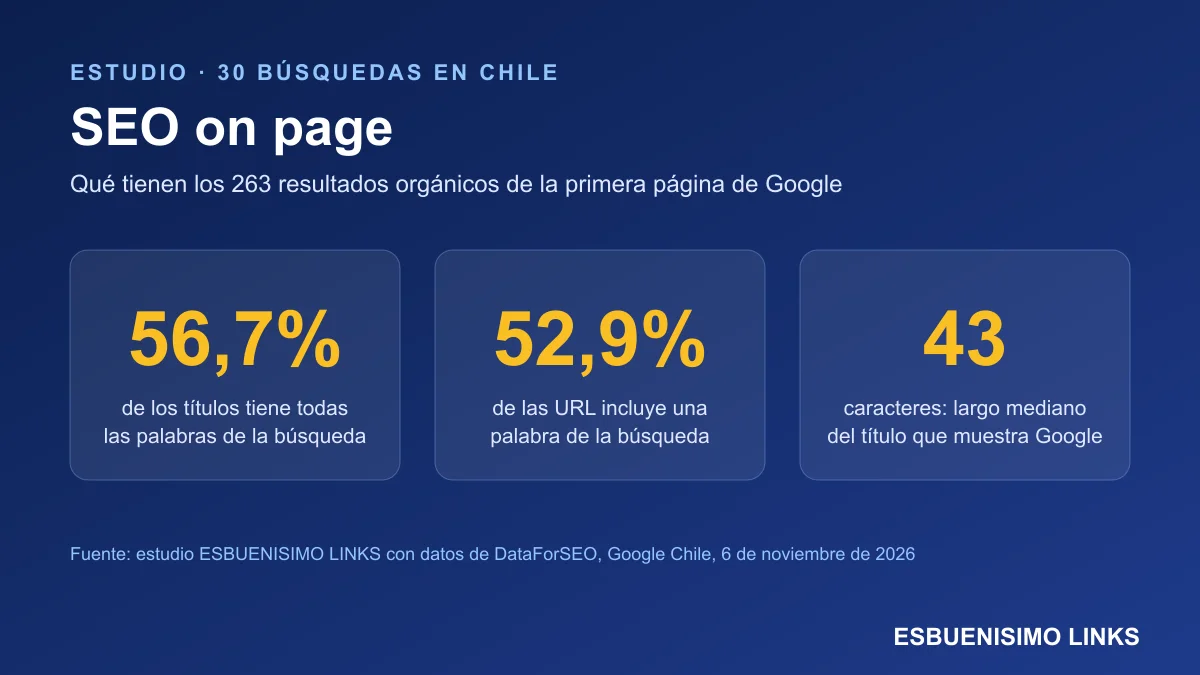
On-page SEO is everything you optimize within a page so Google understands what it is about and shows it for the right searches: the title, headings, copy, URL, images and internal links. It is the part of SEO that depends only on you. To see how it plays out in practice, we reviewed the 263 organic results of 30 commercial searches in Chile on November 6, 2026. This is what we found and what to do about it.
View the data as a table
| organic results reviewed | 263 |
| of titles contain every word of the search | 56.7% |
| of URLs include a word from the search | 52.9% |
| characters: median title length | 43 |
What on-page SEO is and how it differs from off-page
SEO splits into two big parts. On-page works on the page itself: what it says and how it is built. Off-page works outside the site: the links and mentions other sites give it, which act as votes of confidence. We explain it in detail in our guide to off-page SEO.
You need both. A well-optimized page with no authority stays on Google's second page; a page with lots of links that doesn't answer the search won't hold up either. On-page SEO is the starting point because it is cheap, fast and fully in your hands.
| On-page SEO | Off-page SEO | |
|---|---|---|
| Where the work happens | On your own site | On other sites (media, directories, blogs) |
| Examples | Title, H1, copy, URL, images, internal links, structured data | Backlinks, brand mentions, press coverage, reviews |
| Who controls it | You | Third parties |
| Time to see an effect | Once Google recrawls the page | Once Google discovers the links, usually slower |
What Google shows for 30 commercial searches in Chile
We picked 30 searches with buying or hiring intent across different industries: products ("colchón 2 plazas", a double mattress; "silla ergonómica", an ergonomic chair), B2B services ("software de remuneraciones", payroll software; "transporte de carga", freight), finance ("crédito hipotecario", mortgage; "seguro de vida", life insurance) and consumer services ("abogado laboral", employment lawyer; "psicólogo online"). For each, we reviewed the first-page organic results on desktop, with DataForSEO data, and measured the title Google displays and the URL path.
| On-page signal | All (263) | Positions 1 to 3 | Positions 4 to 10 |
|---|---|---|---|
| Title with every word of the search | 56.7% | 56.7% | 56.6% |
| Title with the exact phrase | 30.8% | 31.1% | 30.6% |
| URL with a word from the search | 52.9% | 48.9% | 54.9% |
| Title with the brand name | 23.6% | 28.9% | 20.8% |
| Title of 60 characters or fewer | 95.4% | 94.4% | 96.0% |
The main finding: putting the keyword in the title is the norm, but it is not what separates the top 3 from the rest. The top three include it at the same rate as positions 4 to 10. The same goes for the URL: Google says in its SEO starter guide that keywords in the domain name or URL path have hardly any ranking effect. On-page SEO gets you into the race; what decides the podium is usually somewhere else.
| colchón 2 plazas | 9 | 56% | 100% | 38 |
| notebook gamer precio | 10 | 0% | 60% | 32 |
| refrigerador no frost | 8 | 75% | 88% | 36 |
| bicicleta eléctrica | 8 | 88% | 50% | 55 |
| silla ergonómica | 8 | 88% | 75% | 46 |
| cafetera espresso | 8 | 63% | 63% | 41 |
| zapatillas running | 9 | 44% | 89% | 34 |
| smart tv 55 pulgadas | 9 | 11% | 78% | 27 |
| software de remuneraciones | 9 | 56% | 33% | 53 |
| facturación electrónica | 8 | 38% | 38% | 52 |
| contador para pymes | 9 | 33% | 0% | 51 |
| empresa de aseo industrial | 9 | 11% | 33% | 39 |
| transporte de carga | 7 | 86% | 14% | 51 |
| arriendo de oficinas | 10 | 80% | 30% | 35 |
| capacitación sence | 9 | 0% | 11% | 52 |
| agencia de marketing digital | 9 | 89% | 44% | 56 |
| crédito hipotecario | 9 | 89% | 67% | 48 |
| seguro automotriz | 9 | 33% | 67% | 36 |
| seguro de viaje | 9 | 89% | 44% | 47 |
| depósito a plazo | 8 | 100% | 63% | 32 |
| crédito de consumo | 9 | 89% | 67% | 43 |
| seguro de vida | 9 | 100% | 78% | 42 |
| psicólogo online | 9 | 22% | 11% | 51 |
| abogado laboral | 8 | 88% | 63% | 53 |
| clínica dental | 9 | 67% | 33% | 37 |
| veterinaria 24 horas | 9 | 0% | 0% | 50 |
| curso de inglés online | 9 | 44% | 56% | 41 |
| plan de celular | 9 | 22% | 56% | 42 |
| internet hogar | 9 | 89% | 100% | 49 |
| hotel en valparaíso | 9 | 78% | 78% | 46 |
🚀 Digital PR & Link Building
Rank #1 on Google and Get Mentioned by AI
1,400+ media outlets in 8 countries. Backlinks that Google and ChatGPT recognize as trusted authority sources.
See plans and pricing →The on-page SEO factors that do matter
Based on the data and Google's documentation, these are the elements to review on every page, in order of impact:
- The page answers the search. Someone searching for "double mattress" expects mattresses with prices, not an article about sleep. Intent beats any technical tweak.
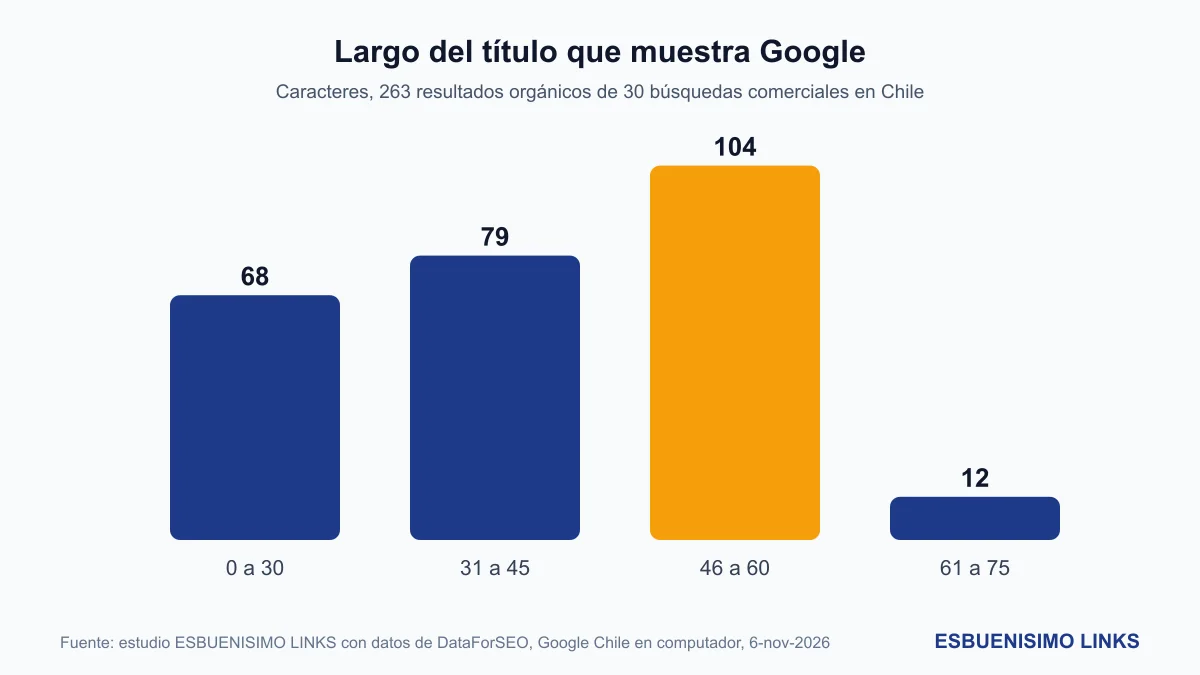
- The title tag. Unique, descriptive and with the main search. In our sample, the title Google displays has a median of 43 characters.
- The H1 and headings. The H1 should make the topic clear; H2s organize the content and can answer related questions.
- The copy. It should cover what the user needs to decide: prices, features, comparisons, FAQs.
- Internal links. They carry authority from the site's strong pages to the ones you want to rank. See our internal linking strategy guide.
- Images and speed. Lightweight images with descriptive alt text, and a page that loads fast on mobile.
- Structured data. Product, FAQ or organization markup helps Google and AI read the page. We explain it in structured data for AI.
How to write on-page SEO titles Google respects
The title is the most visible on-page element, because it is what users read in the results. But Google doesn't always use the one you wrote: according to its title link documentation, it builds it from several sources, including the title element, the H1, page text and even the anchor text of links pointing to the page.
Google sets no maximum length, but it truncates titles to fit the screen. In our sample, 95.4% of displayed titles had 60 characters or fewer, and none exceeded 66. Google's recommendations:
- A distinct title for each page, no "Home" or "Product".
- Concise, with no artificial keyword repetition.
- The brand at the start or end, separated by a hyphen, colon or pipe. In the results we reviewed, 42.6% of titles used one of those separators, and 8 of the 263 included an emoji.
- Consistent with the page's visible H1.
Checklist for your next page
| Element | What to check | Priority |
|---|---|---|
| Intent | Does the page deliver what the user wants (buy, compare, learn)? | High |
| Title | Main search, unique, around 60 characters, brand at the end | High |
| H1 | Only one, clear and consistent with the title | High |
| Content | Answers the question, with data, prices or comparisons where relevant | High |
| Internal links | At least 2 or 3 links from related pages, with descriptive anchors | Medium |
| URL | Short and readable (helps users more than rankings) | Medium |
| Images | WebP or similar, with alt text | Medium |
| Structured data | Product, FAQ or organization depending on the page type | Medium |
Optimizing the page also works for AI
The same good practices help ChatGPT, Gemini and Google's AI Overviews understand and cite a page. These systems read visible text, headings and structured data to decide what to answer. A page with a clear H1, direct answers to specific questions and figures with their source is easier to cite than one full of images or generic copy. So when reviewing the on-page SEO of a commercial page, it pays to add an FAQ section with short answers.
When optimizing the page is not enough
If your page already ticks every box above and is still in position 8 or on page two, the problem is rarely the title. For commercial searches, the top spots go to pages that also have authority: media links, brand mentions and years of history. That is the job of off-page SEO.
At ESBUENISIMO LINKS we handle it with link building in Chilean media: articles published in real outlets across the country, with links to the pages you want to rank. And if you need a full plan, on-page and off-page, see our web positioning service in Chile.
Method note: Google Chile desktop results from November 6, 2026, via DataForSEO. We measured the title Google displays, which may differ from the page's title tag. "Every word" accepts singular and plural and ignores words like "de" or "para".
Frequently Asked Questions
What is on-page SEO?+
It is optimizing everything within a page: the title, headings, copy, URL, images, internal links and structured data, so Google understands what it is about and shows it for the right searches.
What is the difference between on-page and off-page SEO?+
On-page is done on your own site and you control it. Off-page happens outside the site: links, brand mentions and media coverage that give the page authority.
What are the 4 pillars of SEO?+
They are usually described as technical SEO (Google can crawl and index the site), content, on-page SEO and off-page SEO or authority. All four are needed to compete for commercial searches.
How many characters should an SEO title have?+
Google sets no maximum, but it truncates titles to fit the screen. Across 263 Google Chile results, 95.4% of displayed titles had 60 characters or fewer and the median was 43.
Is SEO free?+
You don't pay Google for organic results, and much of on-page SEO can be done in-house. What usually costs money is time, tools and, for competitive searches, link work.
Ready to rank #1 and get mentioned by AI?
Digital PR & Link Building in 1,400+ media outlets across 8 countries. Google and ChatGPT recognize you as an authority source.
See plans and pricing