By Felipe Morales, CEO of ESBUENISIMO LINKS
Ecommerce SEO: which pages rank in Chile and how to position an online store
Ecommerce SEO with data from Chile: 77% of the top 10 for category searches are category pages. What to optimize, how to measure it and where links and AI fit in.
Ecommerce SEO is the work of getting an online store to show up on Google when someone searches for what it sells, without paying for each click. For an ecommerce manager the question is not whether to do it but where to focus: product pages, blog, categories or links? Data from Chile gives a fairly clear answer.
In this guide we look at the size of the market, which types of pages win on Google Chile today, what to optimize first and where media links and AI visibility come in. Every figure comes from a primary source or from our own dated measurement.
Why ecommerce SEO matters more in 2026
Chilean ecommerce passed US$10 billion in sales in 2025 for the first time and reached 12.6% of retail sales, according to George Lever, head of research at the Santiago Chamber of Commerce (CCS), in data published in April 2026. For 2026 the CCS projects about US$10.6 billion.
View the data as a table
| online sales in 2025: above that level for the first time | US$10,000 M |
| of retail sales were online in 2025 | 12.6% |
| projected online sales for 2026 | US$10,600 M |
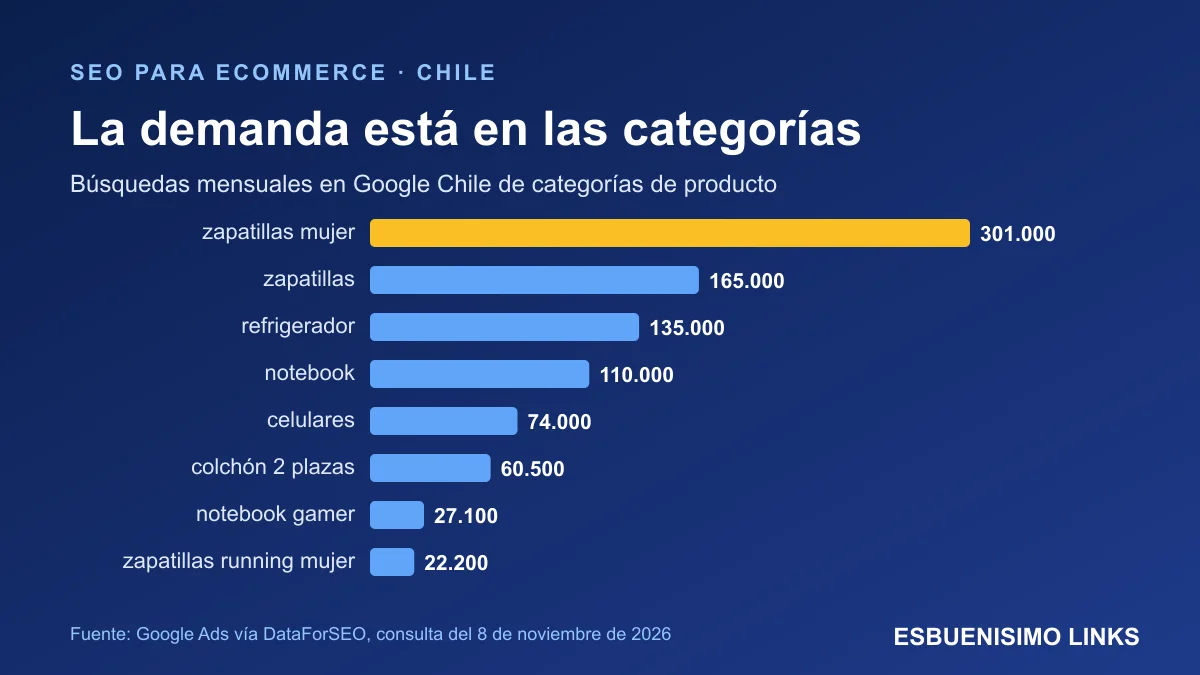
Every point of that market is fought over in search engines. And unlike Google Ads, where cost rises with competition, organic traffic to a well-ranked category accumulates month after month. In Chile the CPC for "zapatillas mujer" is just US$0.08 according to DataForSEO, but there are 301,000 searches a month: buying all that traffic stops being cheap very quickly. And paid traffic stops the day the budget runs out, while a category that ranks keeps selling during the months when the media plan is cut.
Which pages rank on Google Chile: the study
To find out where to focus, we reviewed the mobile organic top 10 on Google Chile for 10 high-volume category searches on November 8, 2026, using DataForSEO. We classified each of the 92 organic results by its title.
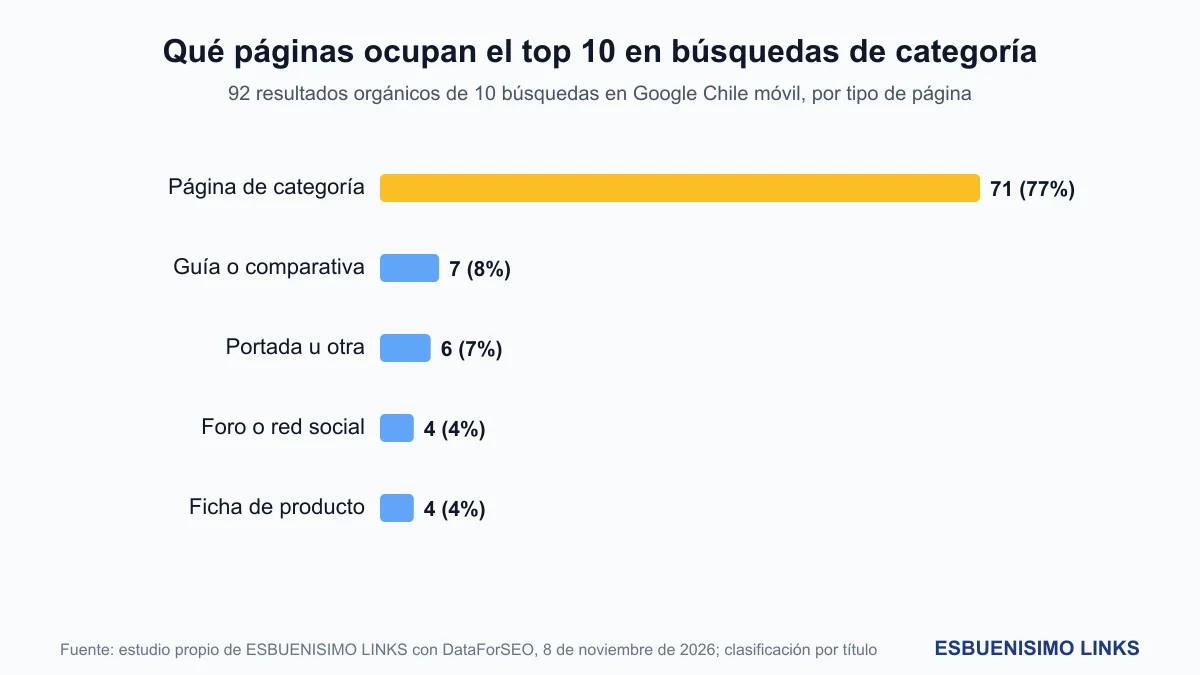
| Page type | Results | Share |
|---|---|---|
| Category or listing page | 71 | 77% |
| Guide or comparison ("best brands of…") | 7 | 8% |
| Home page or other | 6 | 7% |
| Forum or social network (Reddit, Instagram) | 4 | 4% |
| Product page | 4 | 4% |
The conclusion is direct: for generic searches, Google rewards the category, not the product. Product pages rank for very specific searches (model, size, SKU), but the big volume sits in categories. In addition, all 10 searches showed Google's popular products block and 5 of 10 showed an AI Overview, which push organic results further down.
| zapatillas mujer | 301,000 | 8 | 8 | Yes |
| zapatillas | 165,000 | 9 | 9 | Yes |
| refrigerador | 135,000 | 9 | 7 | Yes |
| notebook | 110,000 | 9 | 6 | Yes |
| celulares | 74,000 | 10 | 10 | No |
| colchón 2 plazas | 60,500 | 10 | 7 | No |
| notebook gamer | 27,100 | 10 | 4 | No |
| zapatillas running mujer | 22,200 | 8 | 6 | Yes |
| colchones | 18,100 | 10 | 7 | No |
| refrigerador no frost | 18,100 | 9 | 7 | No |
Another finding: three Reddit threads appear in the top 10 for "notebook gamer" (gaming laptop). When buyers want opinions, Google mixes forums and guides with stores. There, third-party authority, from media and communities, weighs as much as the store itself.
A pattern also repeats in the names: in the top 10 for "zapatillas" or "colchones" (mattresses), large department stores sit alongside brands (adidas, Rosen, CIC) and specialist stores (Belsport, PC Factory). In other words, a mid-size store can break into the top 10 of a large category if the page is well built and has authority. The pages that rank share one trait: a category name that matches the search exactly, such as "Zapatillas Mujer: Urbanas, Running y Outdoor" or "Refrigeradores No Frost".
🚀 Digital PR & Link Building
Rank #1 on Google and Get Mentioned by AI
1,400+ media outlets in 8 countries. Backlinks that Google and ChatGPT recognize as trusted authority sources.
See plans and pricing →Ecommerce SEO: what to optimize first
Based on that data, the priority order for an online store looks like this:
- Category architecture based on real demand. Build categories and subcategories that match what people search for ("women's running shoes", "no frost refrigerator"), not just how inventory is organized.
- Useful text on categories. A clear title, an H1 with the keyword and a short block that helps buyers choose (sizes, technologies, differences between models).
- Filters that do not duplicate. Every filter combination creates new URLs. Only those with their own demand should be indexable; the rest should canonicalize to the category.
- Complete product pages. Product structured data (price, availability, reviews), original photos and specifications in the HTML, as recommended in Google's ecommerce guide.
- A plan for out-of-stock products. If they return, keep the page; if not, 301-redirect to the category or an equivalent.
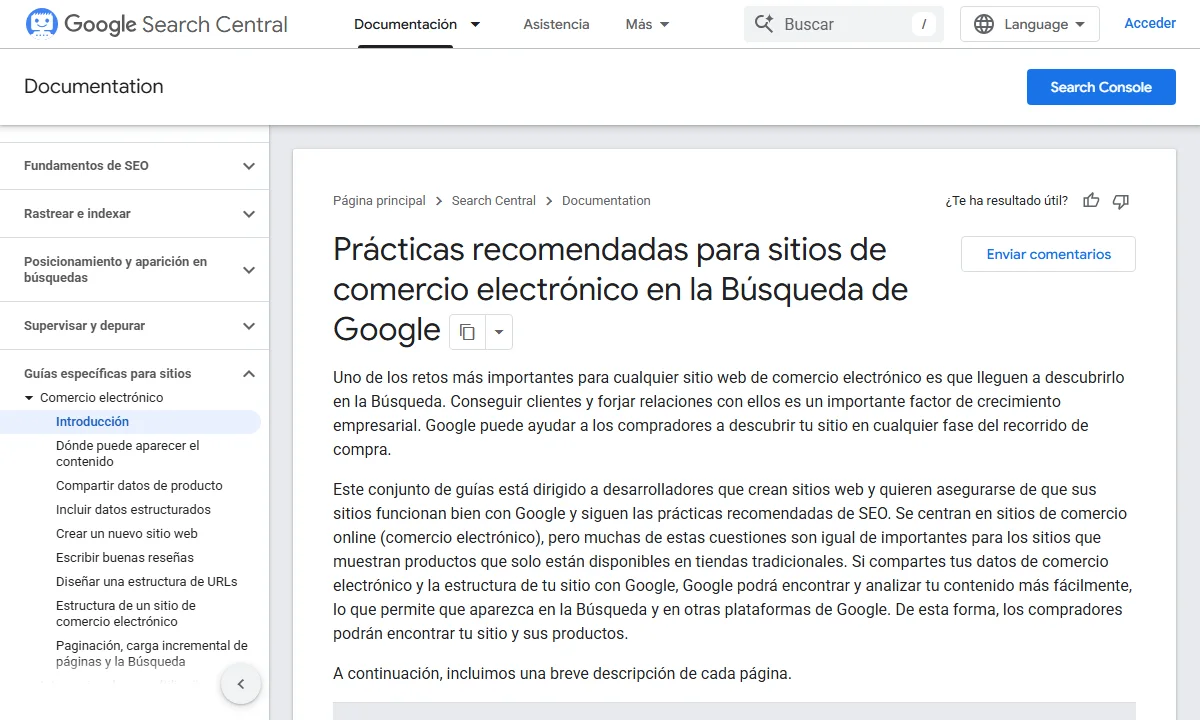
| Page | SEO goal | What to optimize | Metric |
|---|---|---|---|
| Category | High-volume generic searches | H1, supporting text, filters, internal links | Organic clicks and sales per category |
| Product page | Model or attribute searches | Product schema, stock, reviews, photos | Organic conversion |
| Guide or blog | Comparison searches ("best…") | Real comparisons and links to categories | Assisted traffic and earned links |
| Home page | Brand searches | Links to key categories | Brand searches |
How to measure ecommerce SEO
The most common mistake in online stores is measuring SEO only by rankings. A category can climb from position 8 to 4 and not sell more if the AI Overview and the products block take up the whole phone screen. It is better to measure on three levels.
Visibility: impressions and clicks per category in Search Console, grouping URLs by page type (categories, products, guides), to see whether growth comes from where demand is. Business: organic revenue in Google Analytics 4 by category, compared with the same month of the previous year to strip out seasonality from events such as CyberDay or Black Friday. Authority: new domains linking to the store each month and media mentions, which are what move the most competitive categories. If you are building the plan from scratch, our SEO strategy guide shows how to prioritize.
A good monthly dashboard for an ecommerce manager fits on a single page: organic clicks per category, organic revenue, out-of-stock products that still get traffic, pages out of the index and new linking domains. If any of those numbers moves in the wrong direction, you already know which front to review. It also makes the conversation with finance easier, because each line ties SEO work to sales rather than to rankings alone.
Links: why categories need authority
The searches in the study are contested by Falabella, Paris, Ripley, Lider, Sodimac and Mercado Libre, domains with thousands of linking sites. A mid-size store with solid technical content still sits behind them without authority. That is why stores that grow in SEO combine on-site work with link building for ecommerce: links from media in their sector pointing to their best-selling categories.
The links that work best come from articles in media with real traffic (fashion, technology, home, sports) that mention the store in a natural context. That is what we offer at esbuenisimolinks.com/link-building-chile, with Chilean media filtered by sector and authority.
AI already recommends products
Half of the searches in the study showed an AI Overview, and more and more shoppers ask ChatGPT directly which laptop or mattress to buy. Those assistants build their answers from guides, comparisons and media, not from the store's product page. Appearing in those sources is the 2026 version of ecommerce SEO; we explain it in our guide to GEO for ecommerce.
If the store also needs to sort out architecture, filters and migrations, an SEO agency can take on the technical side while links and mentions build the authority categories need to compete with the big players.
Frequently Asked Questions
What is ecommerce SEO?+
It is the work of getting an online store's pages, especially category and product pages, into Google's top results when someone searches for what it sells, without paying for each click.
Which ecommerce pages rank best on Google?+
For generic searches, category pages. In an ESBUENISIMO LINKS study of 10 searches in Chile, 71 of 92 organic results (77%) were category pages and only 4 were product pages.
What are the 4 pillars of SEO?+
They are usually summarized as technical, content, links and user experience. In ecommerce the technical pillar weighs more than on other sites because of filters, pagination and products that sell out.
How do I check a website's SEO?+
Search Console shows which searches bring traffic and which pages are indexed. Tools such as Ahrefs or Semrush estimate the keywords a site ranks for and the domains linking to it.
What should I do with an out-of-stock product to avoid losing SEO?+
If it will return, keep the page with a stock notice. If not, 301-redirect it to the category or an equivalent product. Deleting it without a redirect loses its links and rankings.
Ready to rank #1 and get mentioned by AI?
Digital PR & Link Building in 1,400+ media outlets across 8 countries. Google and ChatGPT recognize you as an authority source.
See plans and pricing