By Felipe Morales, CEO of ESBUENISIMO LINKS
Engagement: what it is, how to calculate it and what a good rate is in 2026
Engagement explained: the engagement rate formula, 2026 benchmarks by network (TikTok 2.01%, Instagram 0.30%) and why Google and AI look at other signals.
Engagement is the level of interaction a brand achieves with its audience: how many people react, comment, share or save what it publishes. It is one of the most requested metrics in marketing reports, and one of the most misread, because it measures what happens inside a social network and not always what happens in the business.
In this guide we explain what engagement is, how to calculate it, what a good rate looks like according to 2026 benchmarks, and why, to sell, it should be read alongside other signals: what Google, the media and AI assistants say about the brand.
What is engagement
In digital marketing, engagement describes the active relationship between a brand and its audience: it is not enough for someone to see a post, they have to do something with it. The interactions counted are likes, comments, shares, saves and, depending on the platform, clicks.
The term is also used in human resources (employee engagement) and in customer service. In this guide we cover brand engagement on social media and in the media.
How to calculate engagement rate
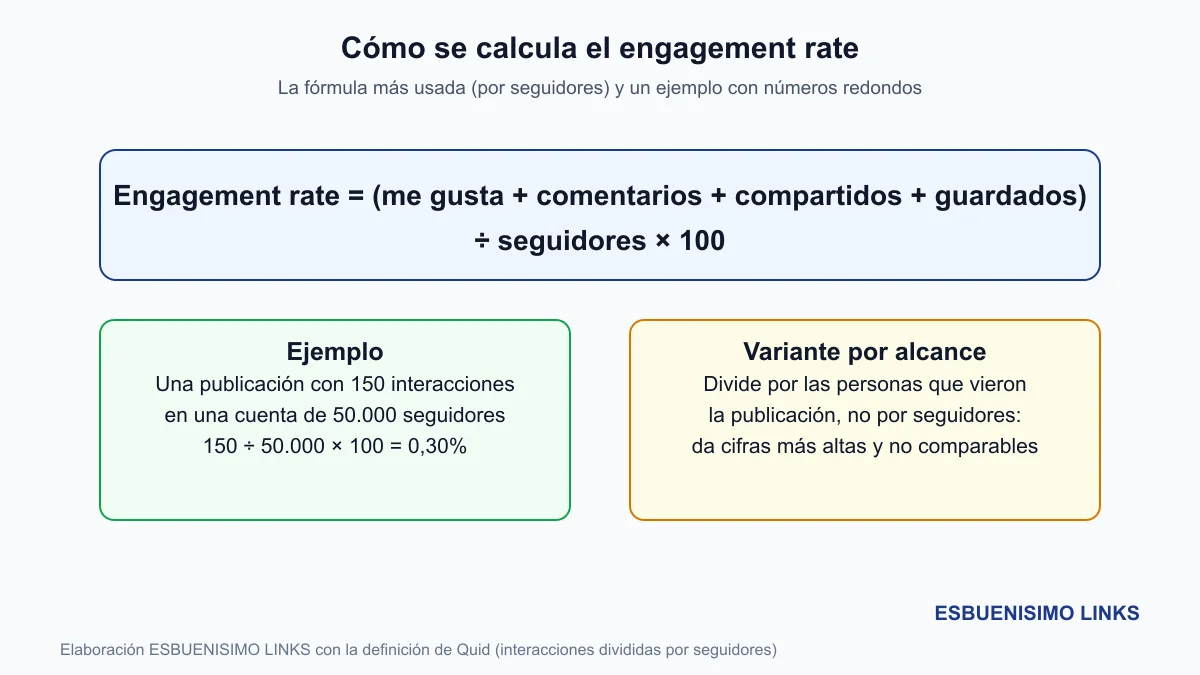
The most common formula divides a post's interactions by the account's follower count and multiplies by 100. It is the one used by Quid, the company formerly known as Rival IQ, in its annual benchmark report: “engagement rate is calculated by dividing total interactions by follower count”.
There are other variants, and mixing them is the most common reporting mistake: engagement by reach or by impressions always gives higher figures than engagement by followers, because the denominator is smaller.
| Metric | Formula | Example: 150 interactions | When to use it |
|---|---|---|---|
| Engagement by followers | Interactions ÷ followers × 100 | 50,000 followers: 0.30% | To compare with benchmarks like Quid's |
| Engagement by reach | Interactions ÷ people reached × 100 | 10,000 reached: 1.5% | To know if the content worked for those who saw it |
| Engagement by impressions | Interactions ÷ impressions × 100 | 15,000 impressions: 1.0% | For ads and paid posts |
🚀 Digital PR & Link Building
Rank #1 on Google and Get Mentioned by AI
1,400+ media outlets in 8 countries. Backlinks that Google and ChatGPT recognize as trusted authority sources.
See plans and pricing →What is a good engagement rate in 2026
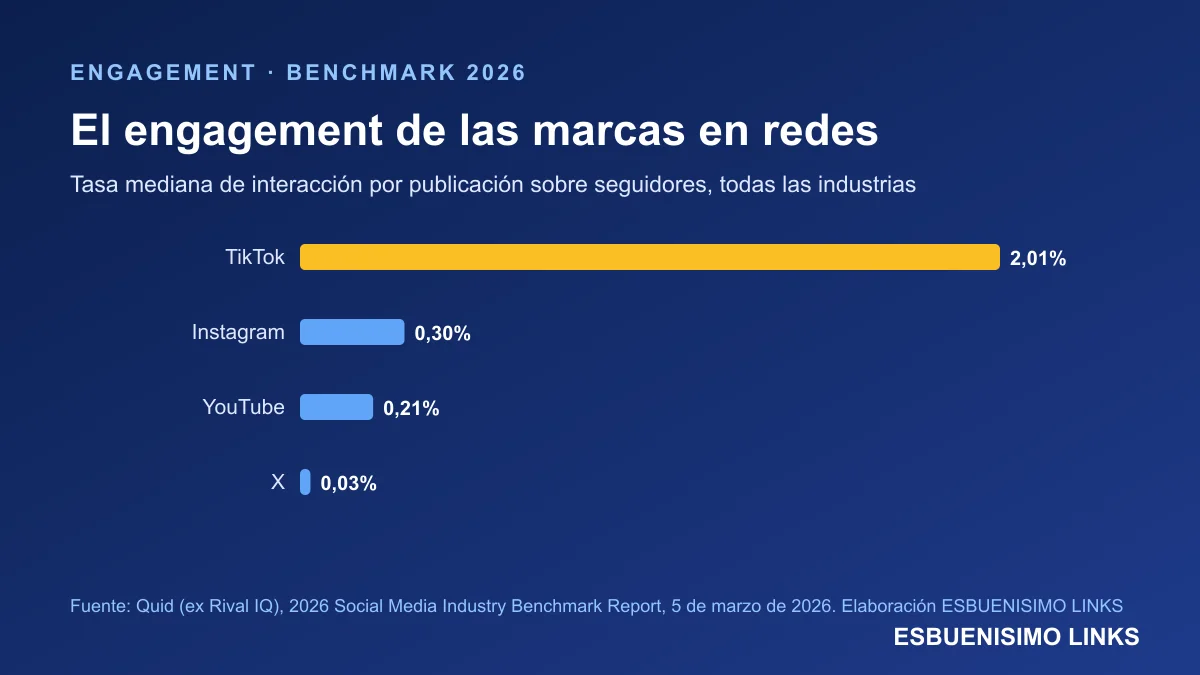
Quid's 2026 report analyzed 150 randomly selected companies in each of 18 industries, including organic and paid posts. The median engagement rate per post was 2.01% on TikTok, 0.30% on Instagram (down from 0.36% the year before), 0.21% on YouTube and 0.03% on X (2026 Social Media Industry Benchmark Report).
| Network | Median engagement 2026 | Previous year | Posts per week (median) |
|---|---|---|---|
| TikTok | 2.01% | No comparable figure | 1.98 |
| 0.30% | 0.36% (−17%) | 3.69 | |
| YouTube | 0.21% | First year in the report | No figure |
| X | 0.03% | 0.015% (+100%) | No figure |
Put another way: if your Instagram account is above 0.30% engagement by followers, you are above the median of the brands measured. The industries with the most Instagram interaction were higher education and sports; retail and beauty were at the bottom.
Which industries get the most interaction
The same report shows that the overall median hides large differences between industries. On Instagram, higher education and sports lead, while retail and beauty sit at the bottom; on Facebook, sports and higher education also lead, and retail and tech close the table. On TikTok, pharma, higher education, alcohol and energy stand out, while fashion and influencers fall below the median. On X, sports, automotive and aviation lead, and media outlets are among the lowest despite posting a lot.
The lesson for a marketing manager is to benchmark against their own industry, not the overall median. A retailer with 0.25% on Instagram may be doing better than its sector, and a university with the same number, worse.
Frequency matters too. On Instagram, brands posted a median of 3.7 times a week in 2026, the lowest figure in the six years the report shows, and on TikTok about 2 videos a week. Posting more does not guarantee more interaction: the industries that post the most, such as media, are not the ones with the best rates.
Well-known practices help raise engagement: replying to comments in the first hours, using each network's native formats (vertical video on TikTok, carousels on Instagram), asking people to save or share for a concrete reason and tracking which topics spark conversation so you can repeat them.
The limit of likes: what Google and AI do not see
Here is the problem for anyone who has to justify a budget. A 2% engagement rate on TikTok is a good number, but that like lives inside TikTok. When a manager or a customer searches the category on Google, or asks ChatGPT which brand it recommends, that like shows up nowhere.
Google ranks results with other signals: links from authoritative sites, useful content and brand searches. And AI assistants build their answers from the sources they read, mostly media, reference sites and reviews. Our study of the sources AI cites by industry in Chile shows clearly which kinds of sites sit behind each answer.
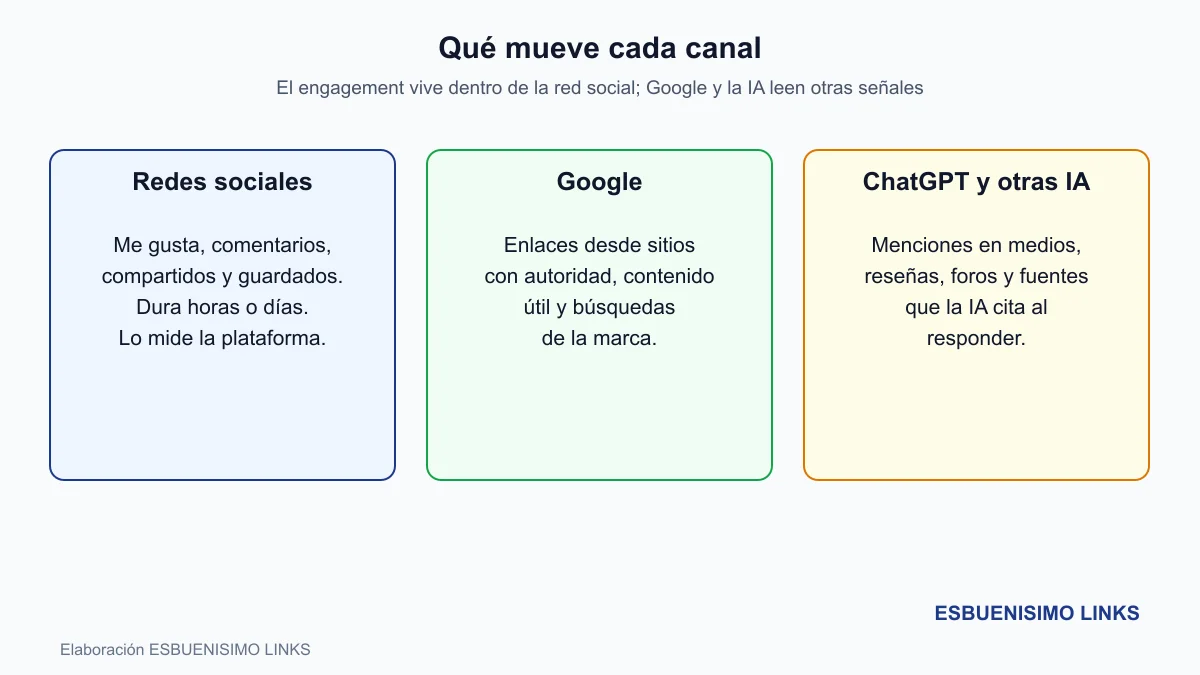
That is why engagement works best as a sign that content connects, not as a sign that the brand is known. For the latter there are other metrics, such as brand searches or presence in AI answers, which we explain in our guide to brand awareness and how to measure it.
How to move from interactions to visibility that sells
- Always measure with the same formula. Pick one (by followers, if you want to compare with benchmarks) and do not switch between reports.
- Separate organic from paid engagement. A campaign with budget inflates the month's interactions.
- Take the conversation off the network. Content that works on social media can become a data point for the press or an article in a news outlet, which gets indexed by Google and is available to AI.
- Add links and media mentions. That is the signal Google and assistants do read. At ESBUENISIMO LINKS we work on it with links from Chilean media and with strategies to appear in ChatGPT and Gemini answers through our GEO agency.
- Measure AI presence. Just as you measure engagement, you can measure how often AI names your brand versus competitors: see how to measure your share of voice in AI.
How much it is searched in Latin America
The concept draws interest across the region. Mexico searches it the most, and in Chile it gets 4,400 searches a month, although part of them refers to other meanings of the word, such as employee engagement. In the US, “customer engagement” gets 1,900 monthly searches and “engagement rate” 1,300.
View the data as a table
| Mexico | 14,800 |
| Argentina | 8,100 |
| Colombia | 6,600 |
| Peru | 6,600 |
| Chile | 4,400 |
| Country | “engagement” | “que es engagement” |
|---|---|---|
| Spain | 9,900 | Not measured |
| Mexico | 14,800 | 1,600 |
| Argentina | 8,100 | Not measured |
| Colombia | 6,600 | Not measured |
| Peru | 6,600 | Not measured |
| Chile | 4,400 | 390 |
Table source: Google Ads via DataForSEO, monthly average, queried November 18, 2026.
Engagement is still useful to know which content connects with the audience. What changed is where the purchase is decided: more and more people ask Google or an AI first, and there the media, links and reviews carry weight, not likes.
Frequently Asked Questions
What is a good engagement rate?+
It depends on the network. According to Quid's 2026 report, the median for brands was 2.01% on TikTok, 0.30% on Instagram, 0.21% on YouTube and 0.03% on X. Beating those numbers means beating the median.
How do you calculate engagement rate?+
The most common formula is a post's interactions divided by the account's followers, multiplied by 100. For example, 150 interactions on an account with 50,000 followers equals 0.30%.
What counts as engagement?+
Likes, comments, shares and saves, and on some platforms clicks. Views and impressions are not engagement: they measure exposure, not interaction.
Should engagement rate be calculated by followers or by reach?+
Both are valid, but they are not comparable. By followers is used by benchmarks such as Quid's; by reach shows whether the content worked for those who actually saw it and always gives higher numbers.
Does social media engagement help SEO or AI visibility?+
Not directly. Likes live inside each platform. Google and AI assistants rely more on links, media mentions and reviews, so engagement should be paired with earned media to build visibility that sells.
Ready to rank #1 and get mentioned by AI?
Digital PR & Link Building in 1,400+ media outlets across 8 countries. Google and ChatGPT recognize you as an authority source.
See plans and pricing