By Felipe Morales, CEO of ESBUENISIMO LINKS
Copywriting: what it is, techniques and what the data says about how people read
Copywriting explained: what it is, how it differs from SEO writing and news articles, techniques like AIDA and PAS, and why people read only 20% of a page.
Copywriting is writing to get someone to do something: buy, leave an email, request a quote or click. It does not aim to inform or to rank a text on Google, but to move a person to the next action. That is why good copy can be five words long and be worth more than a 2,000-word article.
In this guide we explain what copywriting is, how it differs from SEO writing and from a news article, what the data says about how people read, and how it combines with SEO and AI visibility in a business strategy.
What is copywriting
The term comes from copy (the text of an ad) and writing. A copywriter writes ads, landing pages, sales emails, video scripts, packaging, buttons and product descriptions. In the United States, the Bureau of Labor Statistics groups copywriters under writers and authors, describing them as people who “prepare advertisements to promote the sale of a good or service”; that category had a median wage of US$76,910 a year in May 2025, according to the BLS Occupational Outlook Handbook.
The difference from other marketing text is the goal. A blog post wants to be found; a press release wants to be published; copy wants a measurable action. If nobody clicks the button, the copy failed, even if it is well written.
Copywriting, SEO writing and media articles are not the same
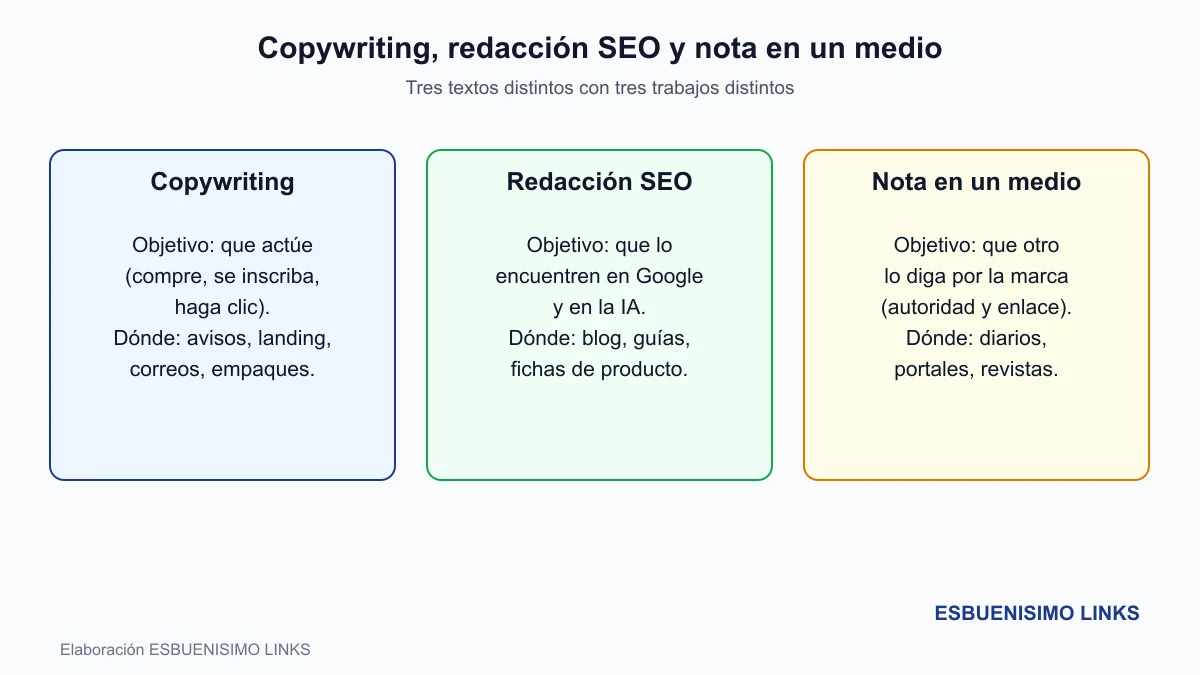
Many companies ask for “some copy” for everything, and that is where problems start: text built to sell rarely ranks, and text built for Google rarely persuades in an ad. The table sums up the differences.
| Copywriting | SEO writing | Article in a news outlet | |
|---|---|---|---|
| Goal | Get the reader to act: buy, sign up or click | Get the text found on Google and AI | Get a third party talking about the brand |
| Where it lives | Ads, landing pages, emails, packaging | Blog, guides, product pages | Newspapers, portals and magazines |
| How it is measured | Conversions and clicks | Rankings and organic traffic | Reach, link authority and AI mentions |
If the goal is to show up on Google, the discipline is different: we explain it in our guide to SEO copywriting and how to write to rank. SEO writing works with keywords, search intent and structure; copywriting works with the desires and objections of someone who already landed on the page.
And if the goal is for a third party to back the brand, the format is an article or an advertorial in a news outlet, with its own transparency rules: see what an advertorial is and how it is labeled.
🚀 Digital PR & Link Building
Rank #1 on Google and Get Mentioned by AI
1,400+ media outlets in 8 countries. Backlinks that Google and ChatGPT recognize as trusted authority sources.
See plans and pricing →What the data says about how people read
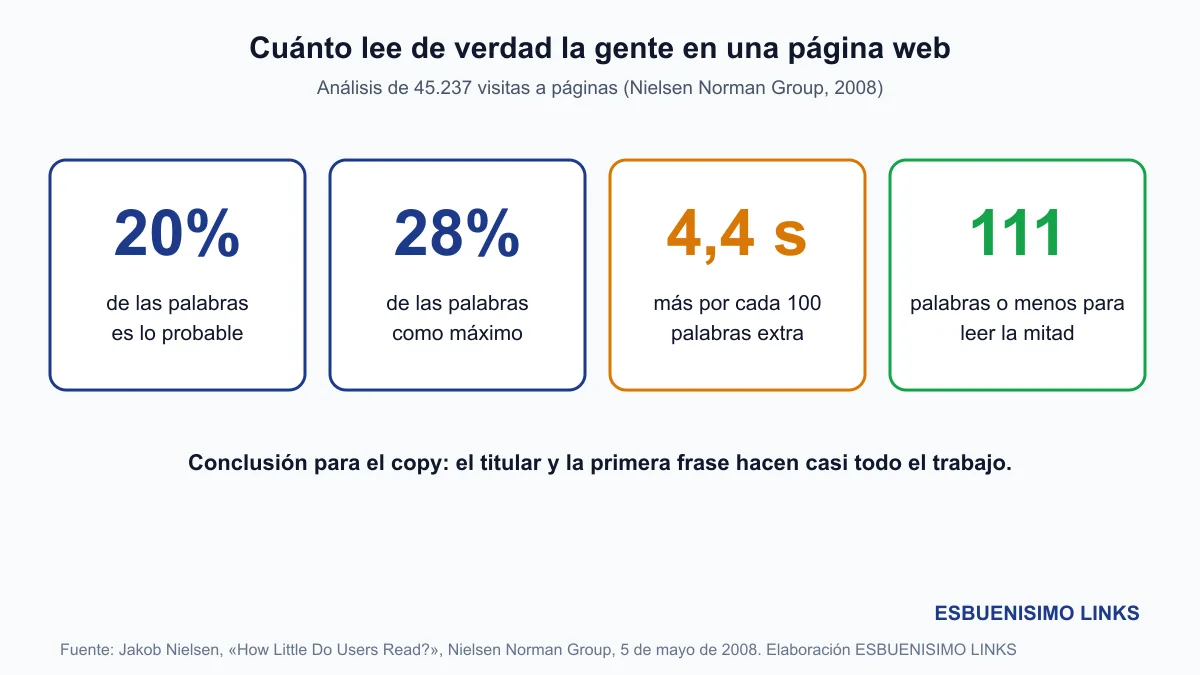
The strongest argument for good copywriting is not an opinion: it is reader behavior. Jakob Nielsen of Nielsen Norman Group analyzed 45,237 page views and estimated that people likely read about 20% of the words on an average page, and 28% at most. Every 100 extra words add only 4.4 seconds to a visit (How Little Do Users Read?, 2008).
View the data as a table
| of a page's words is what people likely read | 20% |
| of the words, at most | 28% |
| extra seconds of visit per 100 additional words | 4.4 |
| words or fewer: the limit for half to be read | 111 |
| Finding | Figure | What it means for copy |
|---|---|---|
| Words read on an average page | 20% (28% at most) | The headline, subheads and first sentence carry the message |
| Extra time per 100 words | 4.4 seconds | Longer text adds little reading: every word must earn its place |
| Length for half to be read | 111 words or fewer | Long sales pages only work if they can be scanned |
| Words on the study's average page | 593 | Most pages write more than people read |
The practical consequence is clear: the headline, the first sentence and the subheads do almost all the work. Copy that buries the value proposition in the third paragraph buries it for 80% of readers.
Techniques for writing text that sells
There are no magic formulas, but there are proven structures that organize the text:
- AIDA (attention, interest, desire, action): the classic scheme for ads and landing pages.
- PAS (problem, agitation, solution): name the customer's pain, show what not solving it costs and present the way out.
- Benefit before feature: “arrives in 24 hours” sells more than “integrated logistics”.
- Rule of three: three ideas or adjectives are remembered better than two or four.
- One call to action per piece: two buttons with different goals cancel each other out.
Add social proof to those structures: customer numbers, reviews and press mentions, which the brain reads as a trust signal before buying. We explain it with experiments in our guide to neuromarketing and why the brain trusts the media more.
How much it is searched in Latin America
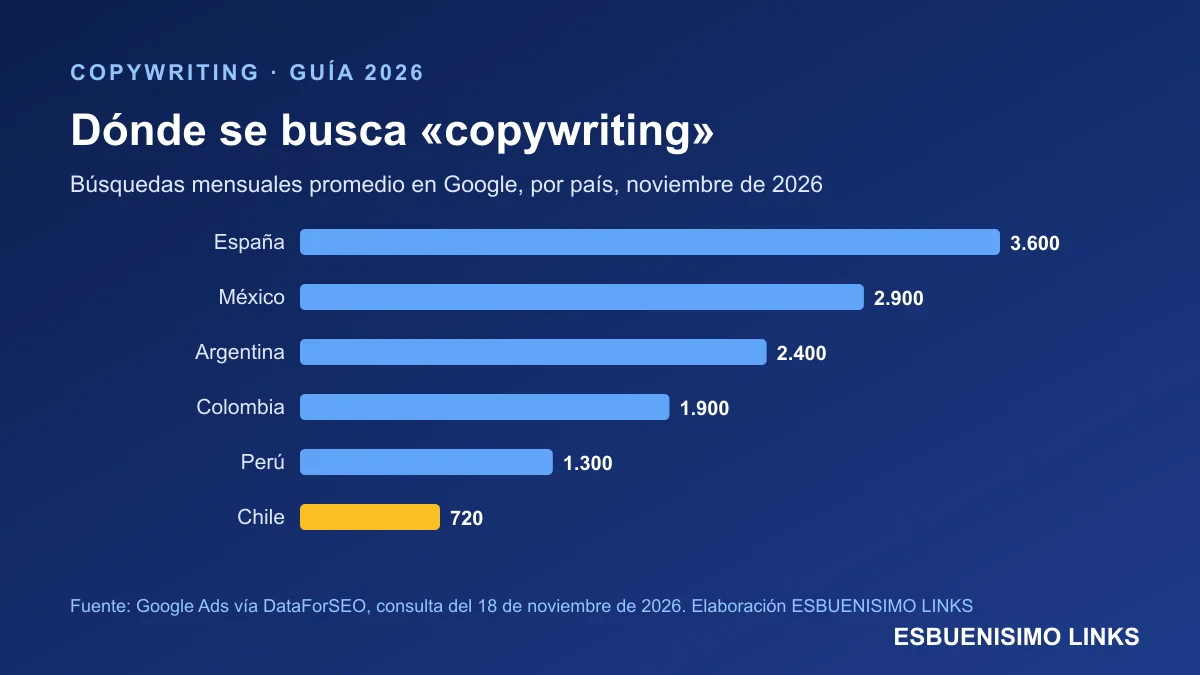
Interest in copywriting is higher in Mexico and Argentina than in Chile, where “copywriting” gets 720 searches a month (in the US it gets 22,200). The cost per click on Google Ads, however, shows advertisers are willing to pay for that audience, such as courses, agencies and writing platforms.
View the data as a table
| Mexico | 2,900 |
| Argentina | 2,400 |
| Colombia | 1,900 |
| Peru | 1,300 |
| Chile | 720 |
| Country | Monthly searches for “copywriting” | Google Ads CPC (US$) |
|---|---|---|
| Spain | 3,600 | 9.01 |
| Mexico | 2,900 | 2.35 |
| Argentina | 2,400 | 1.35 |
| Colombia | 1,900 | 3.72 |
| Peru | 1,300 | 6.37 |
| Chile | 720 | 2.60 |
Table source: Google Ads via DataForSEO, monthly average, queried November 18, 2026.
Copywriting, SEO and AI: how they work together to sell
The best copy in the world is useless if nobody gets to read it. That is why growing brands combine three pieces: copy that converts on their pages, content that ranks on Google and media mentions that build authority. The three feed each other: a landing page with good copy converts the traffic that SEO and press coverage bring better, and that coverage is also what ChatGPT, Gemini and Perplexity read when someone asks about a category.
Copywriting has a role there too. A sponsored article in a newspaper is not an ad: written as sales copy, the outlet rejects it or the reader ignores it. It works when it brings data, context and an expert voice, and leaves the call to action for the landing page. At ESBUENISIMO LINKS we work on that balance with sponsored articles with links in Chilean media, designed to add authority on Google and mentions that AI can cite.
If you also need to organize your page structure, keywords and the content behind them, our SEO agency connects conversion copy with what people actually search for.
Common mistakes when writing to sell
- Talking about the company instead of the customer. “We are leaders” answers none of the buyer's questions.
- Promising what you cannot prove. Unsourced numbers erode trust, and misleading advertising can draw consumer-protection complaints.
- Writing long by default. With 20% average reading, every paragraph must justify itself.
- Copying another brand's tone. Copy that works sounds like the brand that signs it.
- Not testing. Two headline versions in an A/B test teach more than a meeting full of opinions.
Copywriting does not replace strategy, but it makes it pay off. A good offer told badly sells less than an ordinary offer told well; and a good offer told well, in the right outlets and searches, sells far more.
Frequently Asked Questions
What does being a copywriter mean?+
It means writing text that aims for a reader action: ads, landing pages, sales emails, scripts, packaging and buttons. Copywriters work in-house or at agencies, and their output is measured in clicks, sign-ups or sales.
What is direct response copywriting?+
It is copy designed to trigger an immediate, measurable action, such as buying, calling or filling in a form, as opposed to brand copy that builds long-term recall. Every piece has one clear call to action and is tested against results.
How much do copywriters make?+
In the US, the BLS groups copywriters with writers and authors, whose median wage was US$76,910 a year in May 2025. Pay varies widely by experience, industry and whether the work is freelance or in-house.
Is AI replacing copywriters?+
AI tools speed up drafts and variations, but the core of the job, understanding the customer, choosing the offer and testing what converts, still needs human judgment. The BLS projects little or no change in writer and author employment from 2025 to 2035.
Is copywriting still worth it in 2026?+
Yes. People read only about 20% of a page's words, so the headline and first lines still decide whether a visit turns into a sale. Good copy makes the traffic you get from SEO, ads and press coverage pay off.
Ready to rank #1 and get mentioned by AI?
Digital PR & Link Building in 1,400+ media outlets across 8 countries. Google and ChatGPT recognize you as an authority source.
See plans and pricing