By Felipe Morales, CEO of ESBUENISIMO LINKS
Google Discover: what it is, how to appear and how much traffic it drives in 2026
What Google Discover is, where to find it, how to appear according to Google and why it now drives 68% of Google traffic to news sites. Chartbeat and NewzDash data and what it means for your brand.
Google Discover is the feed of news and articles Google shows without the user typing anything: it appears in the Google app, on Chrome's new tab page on mobile and, on many Android phones, when you swipe right on the home screen. Google builds that feed from each user's interests. For news publishers it has become the main entry point from Google, and that changes how a brand should think about its media presence.
What is Google Discover and where is it?
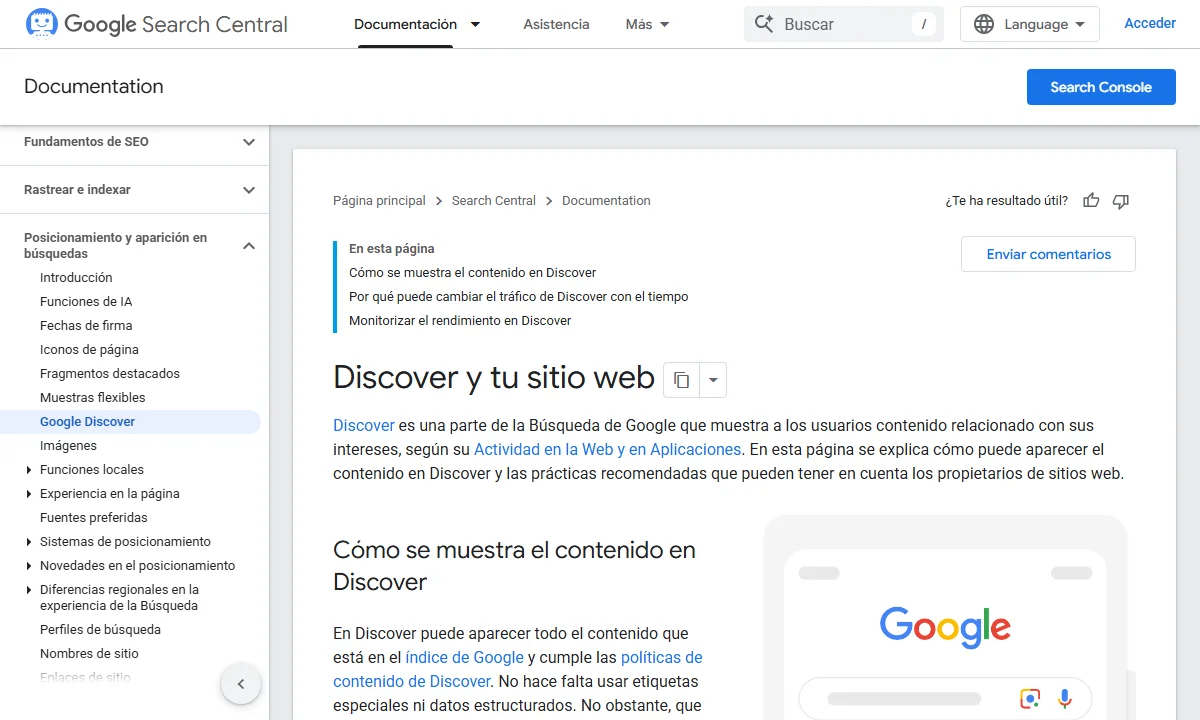
Google Search Central's official documentation describes it as a part of Google Search that shows people content related to their interests, based on their Web and App Activity. The difference from the search engine is fundamental: in search, people ask; in Discover, Google guesses what interests them and offers it.
| Google Search | Google Discover | |
|---|---|---|
| What triggers it | The user types a query | Google suggests content with no query |
| What decides what shows | Relevance to the query | The user's interests and activity |
| Type of content | Everything, including evergreen | Mostly news and recent content |
| Traffic stability | More predictable | Highly variable day to day |
| Where to measure it | Search Console, search report | Search Console, Discover report |
To turn it on in Android, long-press the home screen, open its settings and enable the Google feed; in the Google app it appears by default below the search bar.
How much traffic Google Discover sends to news sites
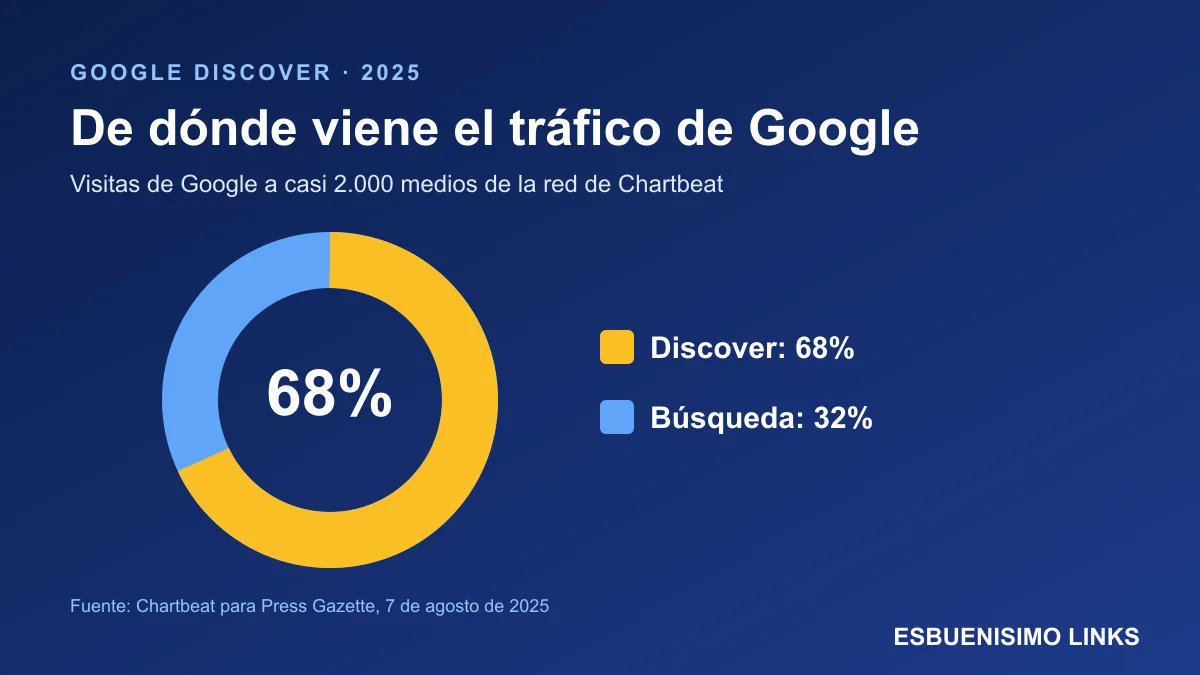
Two independent measurements reach the same conclusion. Chartbeat analyzed almost 2,000 news sites for Press Gazette in August 2025: 68% of the visits Google sends to publishers come from Discover and only 32% from search. Measured against those sites' total traffic, Google accounts for 25%: 17 points from Discover and 8 from search.
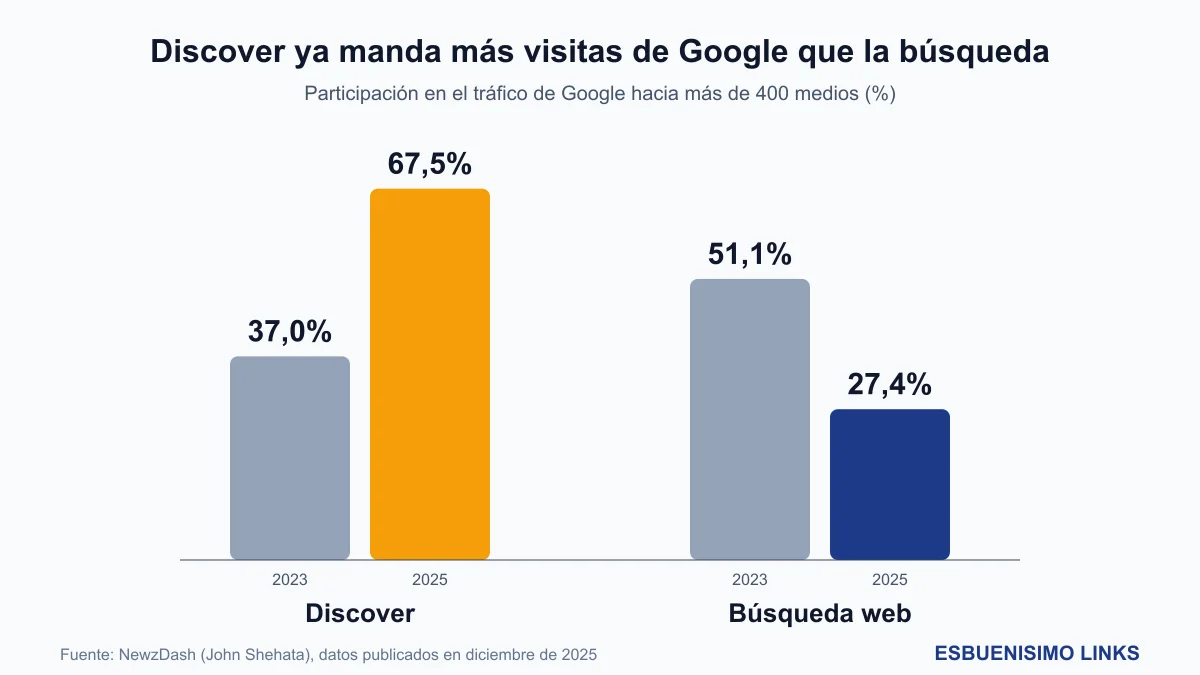
NewzDash, which tracks more than 400 publishers, showed how fast it changed: Discover went from 37.0% of Google traffic in 2023 to 67.5% in 2025, while web search fell from 51.1% to 27.4%, as reported by Search Engine Roundtable.
| Source | Sample | Discover | Web search |
|---|---|---|---|
| Chartbeat (August 2025) | Almost 2,000 news sites | 68% of Google traffic | 32% |
| NewzDash (2023) | 400+ publishers | 37.0% | 51.1% |
| NewzDash (2025) | 400+ publishers | 67.5% | 27.4% |
View the data as a table
| of Google traffic to news sites comes from Discover | 68% |
| of news sites' total traffic comes from Discover | 17% |
| of Google traffic was Discover in 2023 | 37% |
View the data as a table
| Discover | Web search | Other Google products | |
|---|---|---|---|
| 2023 | 37.0% | 51.1% | 11.9% |
| 2025 | 67.5% | 27.4% | 5.1% |
A word of caution: these are shares, not volumes. Part of Discover's larger weight comes from search sending fewer visits to publishers now that Google answers with AI summaries.
🚀 Digital PR & Link Building
Rank #1 on Google and Get Mentioned by AI
1,400+ media outlets in 8 countries. Backlinks that Google and ChatGPT recognize as trusted authority sources.
See plans and pricing →How to appear in Google Discover
Google says no special tags or structured data are needed: the page only has to be indexed and meet Discover's content policies. But being eligible doesn't guarantee appearing. What it does recommend:
- Large images: at least 1,200 pixels wide, more than 300,000 pixels in total and a 16:9 ratio, with the
max-image-preview:largesetting enabled. - A representative image set with og:image or schema.org, not the site logo or a text-heavy image.
- Honest headlines: no clickbait or sensationalism that plays on morbid curiosity or outrage.
- Timely content with real expertise on the topic, which is what the feed rewards.
Performance is measured in Search Console's Discover report, which keeps 16 months of impressions, clicks and CTR. Google warns on the same page that Discover traffic can change over time, so it's unwise to build a business that depends on it alone.
Why brands should appear in the outlets that live on the feed
A company rarely shows up in Discover with its own site: the feed favors outlets that publish daily and have a news track record. The practical way to get there is to appear in those outlets. A story about your brand in a digital newspaper with strong Discover traffic can reach thousands of people who would never have searched for your name.
That same article leaves two assets that outlast the traffic spike: a link from an authoritative domain, which helps your Google rankings, and a mention in a source AI tends to read. For reference, see the ranking of the most popular news sites in Latin America and the options for digital media advertising.
There's also a reputational effect that marketing and communications teams value: a brand that appears repeatedly in the outlets its customers read builds familiarity without buying ad space. When those same people later search for the category, or ask an AI assistant which company to choose, the name already sounds trustworthy. Discover multiplies the reach of each story, but the value stays in the outlet's archive, where search engines and AI tools keep finding it months later.
At ESBUENISIMO LINKS you can choose Chilean and Latin American outlets by authority and topic to publish stories linking to your site. And if you want to appear in classic results, the guide on how to show up on Google covers the rest of the way.
View the data as a table
| Mexico | 1,000 |
| Colombia | 590 |
| Argentina | 590 |
| Chile | 260 |
| Peru | 260 |
| Ecuador | 110 |
| Uruguay | 70 |
| Costa Rica | 70 |
| Dominican Republic | 70 |
What content works in the feed
Since the feed doesn't answer a query, the content that wins is what sparks interest at a glance on a card: an image, a headline and the outlet's name. That favors some formats over others.
| Works better | Works worse |
|---|---|
| News and topics of the day | Product pages and category pages |
| New data and studies with a clear figure | Generic text that exists on a thousand sites |
| Stories with a large original photo | Recycled stock images or images with text on top |
| Topics with sustained interest (finance, tech, sports, consumer) | Forms, applications and paperwork pages |
For a brand, the lesson is that Discover rewards the same thing a journalist looks for: something new, verifiable and with a good image. A study with proprietary data from your industry meets all three conditions and, published in a news outlet, has a better chance of circulating in the feed than a press release about a launch.
How to check the Discover report in Search Console
If your site already gets visits from Discover, Search Console shows the report in the performance menu, below the search report. It only appears once the site passes a minimum impression threshold. Three things are worth checking there:
- Which pages entered the feed and when, to understand which topics spark interest.
- Each card's CTR, which shows whether the image and headline are doing their job.
- The 16-month trend, to tell a lucky spike from a sustained presence.
If your site doesn't have the report, it most likely doesn't yet publish with the frequency or type of content the feed picks up. In that case, the most direct way to benefit from Discover is through the outlets that are already in it.
Common mistakes with Google's feed
- Measuring it like SEO. Discover is spiky: an article can bring thousands of visits one day and none the next.
- Using small images. Without a 1,200-pixel image and large preview, the card loses most of its appeal.
- Clickbait headlines. Discover's policies penalize them and readers notice.
- Relying on a single channel. The healthy mix combines search, Discover, social, newsletters and media presence. Google itself warns that Discover traffic can change over time, so treat every spike as a bonus, not as the baseline for your forecast.
Frequently Asked Questions
What is Google Discover?+
It's the feed of articles Google shows without the user searching, in the Google app, in Chrome on mobile and on many Android phones. Google builds it from each user's interests and activity.
How do I turn on Discover in Chrome?+
On mobile, Chrome shows Discover articles on the new tab page. If they're hidden, tap the settings icon next to the article list and choose to show them; also check that Discover is enabled in the Google app settings.
How do I get my site into Google Discover?+
The page must be indexed and meet Discover's policies. Google recommends images at least 1,200 pixels wide with large previews, headlines without clickbait and timely content. Eligibility doesn't guarantee appearing.
How much traffic does Google Discover drive?+
For news sites, a lot: according to Chartbeat (August 2025), 68% of the visits Google sends them come from Discover. NewzDash measured a rise from 37.0% in 2023 to 67.5% in 2025.
Where do I measure Discover traffic?+
In Google Search Console's Discover performance report, which shows impressions, clicks and CTR for the last 16 months once a minimum impression threshold is met.
Ready to rank #1 and get mentioned by AI?
Digital PR & Link Building in 1,400+ media outlets across 8 countries. Google and ChatGPT recognize you as an authority source.
See plans and pricing