By Felipe Morales, CEO of ESBUENISIMO LINKS
Technical SEO: what it is, what to check and how much it matters in 2026
What technical SEO is, the 6 layers to check (crawling, indexing, rendering, speed, structured data and AI) and the 2025 data from the Web Almanac and Vercel.
Technical SEO is the invisible part of search optimization: it makes sure Google, and now also the crawlers behind ChatGPT, Claude and Perplexity, can find, read, render and index every page on a site. If that foundation fails, it does not matter how good the content is or how many links the brand has: the page does not compete.
This guide explains what technical SEO covers, what to check first and what the latest data says. For readers coming from marketing or communications: "crawling" is when a search engine's robot visits a page, and "indexing" is when it stores that page so it can show it in results.
What technical SEO is and how it differs from the rest of SEO
SEO is usually split into three fronts. Technical work deals with infrastructure: server, code, URL architecture and speed. On-page work deals with each page: title, headings, content and internal links (we cover it in our on-page SEO guide based on 30 Chilean SERPs). Off-page work deals with authority coming from outside, mainly links and media mentions.
The practical difference is that technical SEO is a condition, not an advantage. A technically clean site does not climb just for being clean, but a site with technical problems drops even when everything else is right. That is why it should be checked before investing in content or links.
The six layers of technical SEO
In practice, the work is organized into six layers. Each one has a warning sign that can be spotted without being a developer.
| Layer | What it checks | Warning sign | Where to see it |
|---|---|---|---|
| Crawling | robots.txt, internal links, sitemap | Important pages Google never visits | Search Console, crawl stats report |
| Indexing | noindex, canonical, duplicate content | "Crawled, currently not indexed" | Search Console, pages report |
| Rendering | Content that depends on JavaScript | The initial HTML arrives almost empty | View source or the URL inspection tool |
| Speed | Core Web Vitals: LCP, INP and CLS | Red metrics with real-user data | PageSpeed Insights (CrUX data) |
| Structure | URLs, click depth, pagination | Key pages more than 3 clicks from the home page | A crawler such as Screaming Frog |
| Data and AI | Schema, robots.txt for AI bots, readable HTML | AI does not cite or misdescribes the brand | Rich results test and AI queries |
The order matters. If a page is not crawled, there is no point optimizing its speed. If it is not indexed, its structured data is useless. A full SEO audit walks through these layers and also reviews content and links; technical SEO is the ongoing work that keeps the foundation healthy between audits.
🚀 Digital PR & Link Building
Rank #1 on Google and Get Mentioned by AI
1,400+ media outlets in 8 countries. Backlinks that Google and ChatGPT recognize as trusted authority sources.
See plans and pricing →How healthy sites are: the 2025 Web Almanac data
HTTP Archive's 2025 Web Almanac analyzes millions of sites every year and is the best public snapshot of the web's technical state. Some results from its SEO chapter:
| Technical element | Desktop | Mobile |
|---|---|---|
| Valid robots.txt (returns 200) | 84.9% | 84.9% |
| Canonical tag present | 68% | 67% |
| Site on HTTPS | 91.7% | 91.5% |
| Meta viewport (mobile design) | 93.1% | 95.2% |
| Invalid elements in the <head> | 10.1% | 10.3% |
| Valid llms.txt file | 2.13% | 2.10% |
| robots.txt naming GPTBot | 4.5% | 4.2% |
Two takeaways. First, the basics are mostly solved: nearly everyone uses HTTPS and mobile design. Second, a third of sites do not declare a canonical URL and one in ten has invalid elements in the <head>, which can make Google ignore tags that come after them. These errors are cheap to fix and costly to leave.
Speed: fewer than half pass on mobile
Core Web Vitals are the three experience metrics Google uses as a signal: LCP (how long the main content takes to appear, good under 2.5 seconds), INP (how long the page takes to respond to a tap or click, good under 200 milliseconds; it replaced FID in March 2024) and CLS (how much elements shift while loading, good under 0.1).
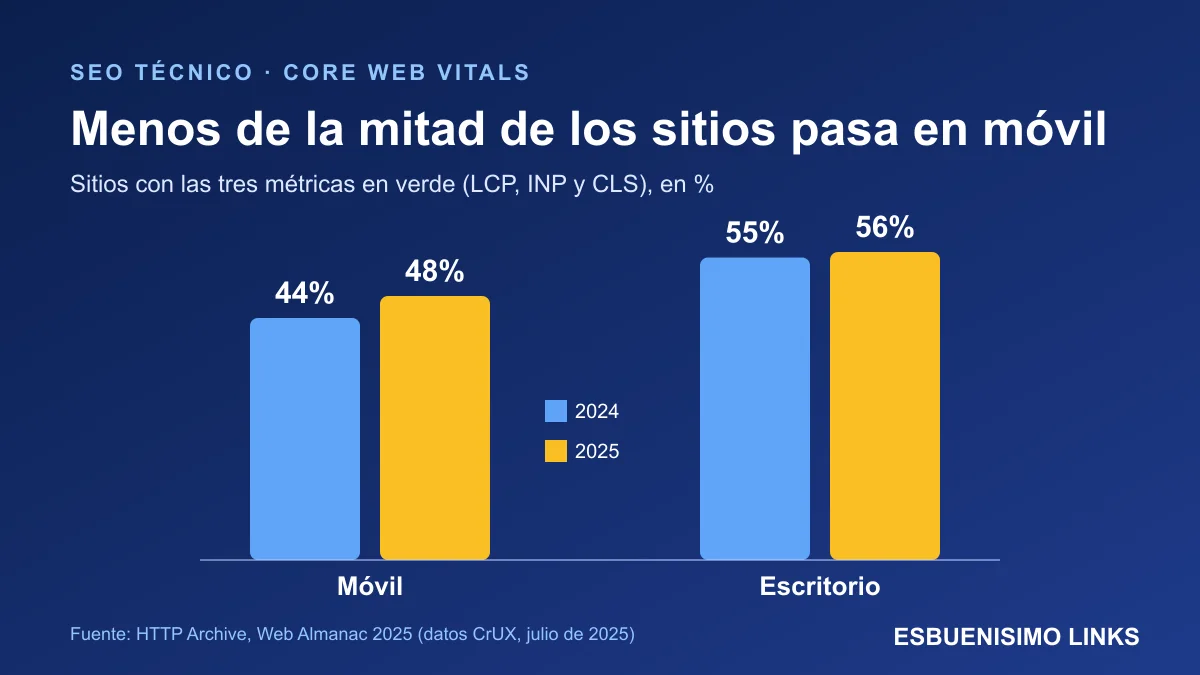
According to the 2025 Web Almanac performance chapter, with July 2025 data, only 48% of sites pass all three on mobile, versus 56% on desktop. In 2024 the figures were 44% and 55%. The bottleneck is LCP: just 62% of sites load their main content fast on mobile, usually because of heavy images or slow servers.
Technical SEO and JavaScript: what Google sees and AI does not
Many modern sites build their content with JavaScript in the browser. Google handles it better than people think: a Vercel and MERJ study of more than 100,000 Googlebot fetches on nextjs.org, in April 2024, found that Google rendered 100% of the indexable HTML pages.
View the data as a table
| HTML pages Google fully rendered | 100% |
| median delay between crawl and render | 10 s |
| delay at the 90th percentile | 3 hours |
| Googlebot fetches analyzed | +100,000 |
The problem is time and the other crawlers. The median delay between crawling and rendering was 10 seconds, but at the 90th percentile it rose to about three hours. And AI bots do not wait: in another report, Vercel concluded that none of the major AI crawlers execute JavaScript, except Gemini (which uses Googlebot's infrastructure) and AppleBot.
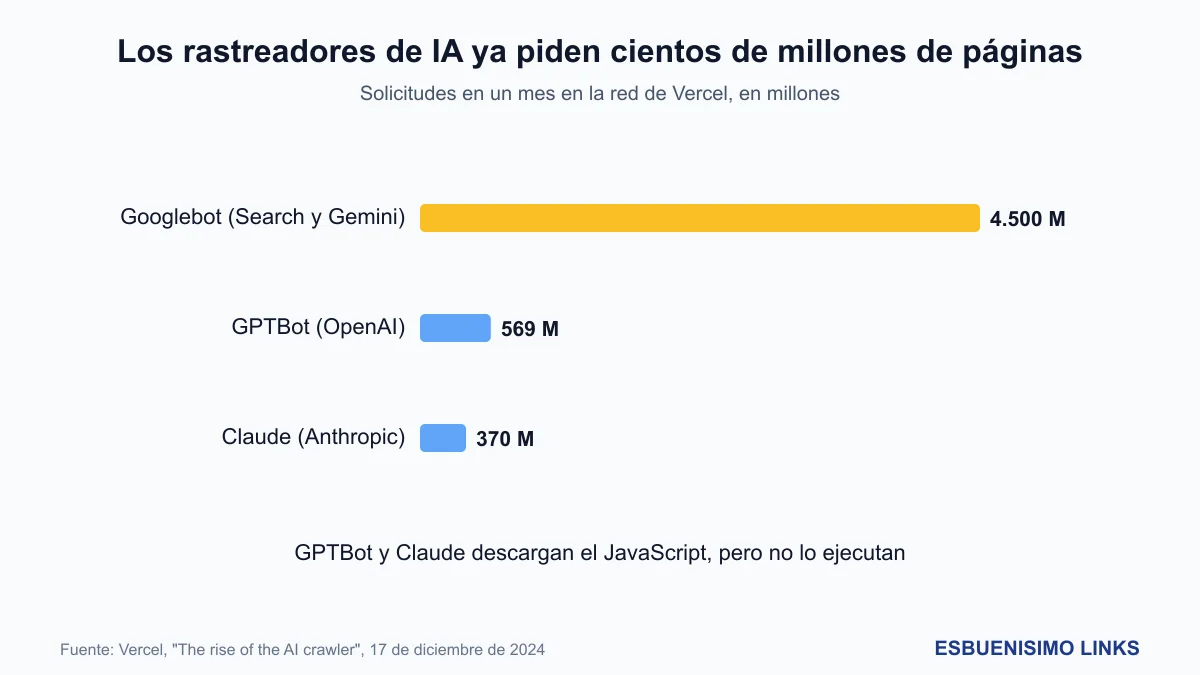
| Crawler | Requests in one month (Vercel) | Executes JavaScript? | Requests ending in 404 |
|---|---|---|---|
| Googlebot (Search and Gemini) | 4.5 billion | Yes | No data |
| GPTBot (OpenAI) | 569 million | No | 34.82% |
| Claude (Anthropic) | 370 million | No | 34.16% |
In practice: if a product's price, description or reviews only appear after JavaScript runs, ChatGPT does not read them. And more than a third of those bots' requests end on pages that no longer exist, which suggests they follow old URLs. Keeping redirects and serving text in the initial HTML is now technical SEO and GEO at the same time. We go deeper in technical GEO for AI crawlers.
A technical checklist to get started
A reasonable order for a corporate site or a mid-size ecommerce store:
- Search Console up to date: review the pages report and note how many important URLs are out of the index and why.
- robots.txt and sitemap: make sure they do not block valuable sections and that the sitemap only lists canonical URLs that return 200.
- Canonicals and duplicates: every page with a clear canonical URL, especially filters, parameters and trailing-slash variants.
- Content in the HTML: use "view source" to confirm titles, text and prices are there without running JavaScript.
- Core Web Vitals with real data: start with LCP on the highest-traffic templates (home, categories, product pages).
- 301 redirects: every removed or changed URL should point to its replacement, not to the home page.
- Structured data: Organization, Product, Article or FAQ depending on the page type, validated with the rich results test.
Google states in its crawl budget guide that the topic is only critical for very large sites (over a million pages) or medium sites whose content changes daily (over 10,000 pages). For most companies the real problem is not budget: it is blocked, duplicated or slow pages.
When to hire technical help and when to invest in authority
If Search Console shows key pages out of the index, if the site was recently rebuilt or if organic sales fell after a migration, the priority is technical. In those cases it pays to work with an SEO agency with a technical focus that reviews templates, server and migrations.
When the foundation is healthy and competitors still rank first, the limit is rarely technical: it is authority. That is where links from media with real traffic come in, along with the mentions AI tools also read, which is what we do at ESBUENISIMO LINKS with more than 1,400 media outlets across Latin America. Technical SEO opens the door; authority decides who ranks first.
Frequently Asked Questions
What is technical SEO?+
It is the part of SEO that makes sure Google and AI crawlers can find, read, render and index a site's pages. It covers crawling, indexing, JavaScript, speed, architecture, structured data and security.
How many types of SEO are there?+
Three are usually distinguished: technical SEO (the site can be crawled and indexed), on-page SEO (content and tags on each page) and off-page SEO (links and mentions from other sites). Some add local SEO as a fourth.
What are the 4 pillars of SEO?+
A common summary is technical, content, links and user experience. Without the technical pillar, the other three underperform, because Google cannot see the page properly.
What is the difference between technical SEO and an SEO audit?+
Technical SEO is ongoing work on the site's infrastructure. An audit is a one-off review that measures the site's state on a given date and prioritizes fixes, including content and links.
Does technical SEO help you appear in ChatGPT?+
Yes. According to Vercel, GPTBot and Claude's crawler do not execute JavaScript, so content that only appears after rendering is invisible to them. Serving text in the HTML is a technical requirement for AI.
Ready to rank #1 and get mentioned by AI?
Digital PR & Link Building in 1,400+ media outlets across 8 countries. Google and ChatGPT recognize you as an authority source.
See plans and pricing