By Felipe Morales, CEO of ESBUENISIMO LINKS
Native advertising: what it is, types, examples and how to label it in 2026
What native advertising is, the 3 types defined by the IAB, examples in news media, how it performs against banners and what the FTC and Chile's SERNAC require for labeling.
Native advertising is the ad that does not look like an ad: a sponsored article on a news site, a promoted post on LinkedIn or a "you may also like" module below a story. It takes the shape of the platform where it appears, which is why people read it instead of skipping it like a banner. For a marketing or communications manager it is one of the few paid formats that still gets attention; for an SEO, it is also a way into media mentions.
This guide explains what native advertising is, the three types recognized by the IAB, concrete examples, how it performs against banners according to the available research and what Chile's consumer agency (SERNAC) and the US Federal Trade Commission (FTC) ask for in terms of labeling.
What is native advertising
The IAB (Interactive Advertising Bureau, the US digital advertising trade group) defines native advertising as paid ads that blend into the design and behavior of the platform where they run, so users feel them as part of the experience. The two key words in that definition are paid and labeled. If nobody paid, it is earned media; if someone paid and it is not labeled, it is covert advertising.
Two related concepts are often confused with it. Branded content is content a brand produces to entertain or inform without selling directly; it can run as native advertising or on the brand's own channels. An advertorial or sponsored article is a specific native format: a full, journalistic-style article published on a news site and marked as paid content.
| Format | Who produces it | Where it appears | Labeled? |
|---|---|---|---|
| Display banner | The brand or its agency | Fixed ad slots on the site | Understood as an ad |
| Native advertising | The brand, the publisher or both | Inside the feed or the content | Yes, required |
| Branded content | The brand | Media, social or owned channels | Yes, when paid on a third-party site |
| Advertorial | The publisher or the brand | As an article on a news site | Yes, required |
| Earned media | The journalist | As news | No, because nobody paid |
Types of native advertising according to the IAB
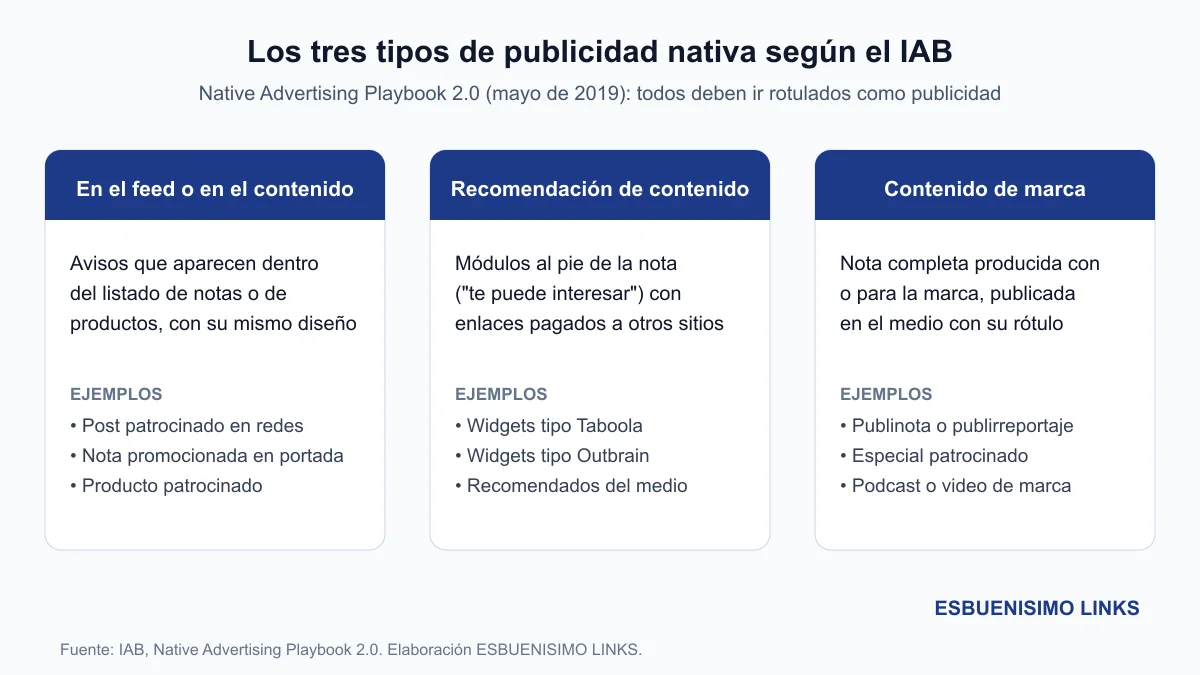
The IAB Native Advertising Playbook 2.0, published in May 2019, cut the core types of native advertising from six to three. The others (search ads and promoted listings) moved to their own category.
| Type | How it works | Examples |
|---|---|---|
| In-feed / in-content | The ad sits inside the list of articles, posts or products, with the same design | Sponsored post on Instagram or LinkedIn, promoted story on a news homepage, sponsored product on a marketplace |
| Content recommendation | Modules at the end of an article that send readers to other sites for a pay-per-click fee | Taboola or Outbrain widgets, "recommended content" blocks |
| Branded / native content | A full piece made with or for the brand and published by the outlet | Sponsored article, sponsored special section, branded podcast or video |
The playbook evaluates every ad with four criteria: design, placement, behavior and disclosure. The first three change with the format; disclosure does not: the IAB wants it clear and prominent in every case.
🚀 Digital PR & Link Building
Rank #1 on Google and Get Mentioned by AI
1,400+ media outlets in 8 countries. Backlinks that Google and ChatGPT recognize as trusted authority sources.
See plans and pricing →Native advertising examples in media and social networks
In practice, a Latin American brand runs into native advertising in four places:
- Social networks. Every promoted post on Instagram, Facebook, TikTok or LinkedIn is in-feed native advertising: it looks like the rest of the posts and carries an "Ad" or "Promoted" tag.
- Marketplaces. Sponsored products on Mercado Libre, Amazon or Falabella.com appear among normal results with a "Sponsored" tag.
- News sites. The sponsored article labeled "Sponsored content" or "In partnership with" is the format companies use when they want more room than an ad gives them.
- Recommendation widgets. The blocks at the bottom of many news articles that send readers to third-party sites.
Of the four, only one has a lasting effect on Google and on AI assistants: the article published on a news site. A promoted post disappears when the budget runs out; an article on an authoritative outlet stays indexed, can carry a link to the brand and is exactly the kind of source ChatGPT and Perplexity cite. That is why many companies use native advertising in news media as part of their digital media advertising strategy and their organic visibility at the same time.
Does native advertising work? What the data says
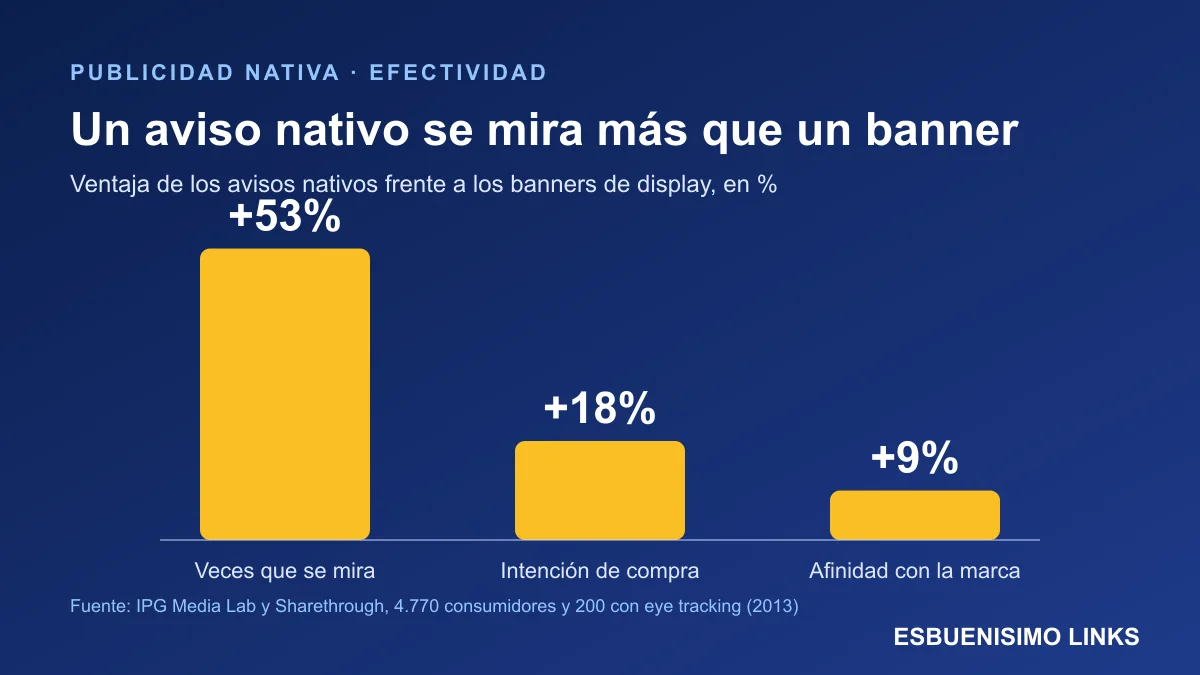
The most cited effectiveness study was run by IPG Media Lab and Sharethrough in 2013, with a survey of 4,770 consumers and eye-tracking tests with 200 people. Compared with a banner, the native ad:
- was looked at 53% more often;
- produced an 18% higher lift in purchase intent;
- and a 9% higher lift in brand affinity.
View the data as a table
| Looked at more often | +53% |
| Lift in purchase intent | +18% |
| Lift in brand affinity | +9% |
It is an old study, run by a company that sells native ads, so it should be read as a reference rather than a promise. What has held up over time is the logic: a format that looks like content competes for attention on better terms than a rectangle on the side of the page.
How to label native advertising: SERNAC and the FTC
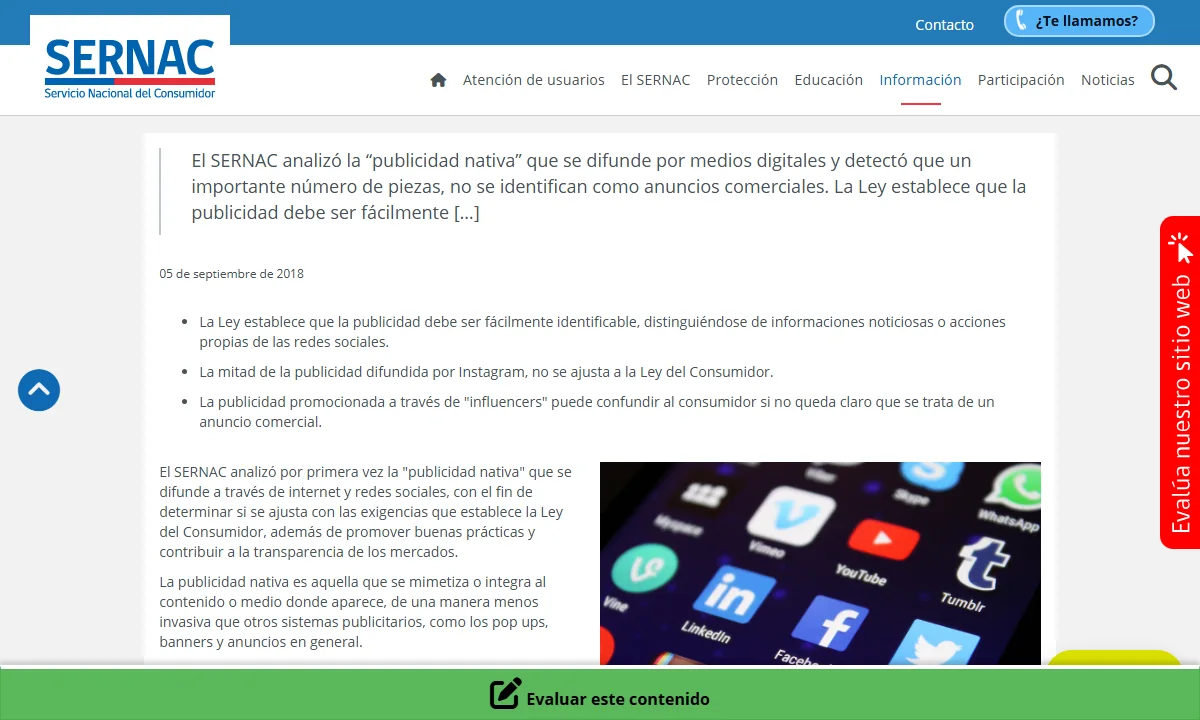
The risk with native advertising is misleading the reader, so regulators look at disclosure before anything else. In Chile, SERNAC reviewed in 2018 217 native ad pieces in media and social networks from at least 197 advertisers and concluded that the law requires advertising to be "easily identifiable". On Instagram, 22.7% of ads were not identified as advertising and 45.6% had some compliance problem; on Twitter, 11% carried no label. In July 2022 the agency also issued an interpretive circular on native advertising and influencers that repeats the same principle: paid content must be recognizable at a glance.
In the United States, the FTC published its native advertising guide for businesses in December 2015. It asks for plain-language labels such as "Ad" or "Paid content", placed before the content and not at the end, and discourages ambiguous terms.
- Dec 2013First IAB playbookDefines six types of native advertising and requires disclosure in all of them.
- Dec 2015FTC guideClear, plain-language labels placed before the content.
- Sep 2018SERNAC study217 pieces reviewed; on Instagram, 22.7% were not identified as ads.
- May 2019IAB Playbook 2.0Cuts the core types to three.
- Jul 2022SERNAC circularCriteria for native advertising and influencers.
For a brand, the practical rule is simple: any paid content on a news site or social network must say it is paid. A clear label does not hurt a sponsored article's performance; what hurts it is copy that reads like a brochure.
How much Latin America searches for native advertising
Interest in the term is still niche, but it shows in which markets the format is becoming more professional.
| Country | "publicidad nativa" | "native ads" | Total |
|---|---|---|---|
| Mexico | 170 | 90 | 260 |
| Colombia | 50 | 70 | 120 |
| Argentina | 30 | 70 | 100 |
| Peru | 50 | 30 | 80 |
| Chile | 20 | 20 | 40 |
Average monthly Google searches. For reference, "native advertising" gets 4,400 monthly searches in the United States. Source: Google Ads via DataForSEO, queried on November 9, 2026.
View the data as a table
| Mexico | 260 |
| Colombia | 120 |
| Argentina | 100 |
| Peru | 80 |
| Chile | 40 |
How to use native advertising for SEO and AI visibility
If the only goal is reach, in-feed formats are enough. If the brand also wants to show up on Google and in ChatGPT's answers, part of the budget should go to branded content published on news sites. Three criteria to choose where:
- Outlet authority. A newspaper with history and real traffic weighs more than a blog built to sell posts.
- Topic fit. A fintech gains more on a business outlet than on an entertainment one.
- Indexable, permanent article. The piece must stay online, on its own URL, without blocks for Google.
That is the job of a media marketplace: choosing where and how to publish sponsored content in Chilean media with proper labeling, verified authority and an article that keeps adding value months after it was paid for.
Frequently Asked Questions
What is native advertising?+
It is paid advertising that takes on the form and style of the platform where it appears: an article on a news site, a post in a feed or a recommendation below an article. Unlike a banner, it does not interrupt reading, but it must still be labeled as advertising.
What are the types of native advertising?+
The IAB's Native Advertising Playbook 2.0 (2019) recognizes three: in-feed or in-content ads, content recommendation ads and branded or native content, such as sponsored articles.
How do you spot native advertising?+
By its label: 'sponsored content', 'paid post', 'in partnership with' or 'presented by'. The FTC asks for plain-language labels placed before the content, not at the end.
How much does native advertising cost?+
There is no single price. In-feed ads on social networks are bought by auction (CPM or CPC), recommendation widgets are usually paid per click and sponsored articles in news media have a fixed rate per piece set by each outlet.
Does native advertising help SEO?+
Only branded content published as an article on an authoritative news site helps SEO, because it leaves a mention and sometimes a link. In-feed ads and recommendation widgets do not leave links that Google counts.
Ready to rank #1 and get mentioned by AI?
Digital PR & Link Building in 1,400+ media outlets across 8 countries. Google and ChatGPT recognize you as an authority source.
See plans and pricing