By Felipe Morales, CEO of ESBUENISIMO LINKS
What is branded content: examples and how to measure it in 2026
What is branded content, how it differs from native advertising and advertorials, examples that work and how to measure it, with 2026 data on trust in news across Latin America.
A marketing manager buying media today faces a double problem: people avoid ads, and when they look for information they ask Google less and ChatGPT more. Branded content is the answer many brands are testing: instead of interrupting with an ad, the brand funds content the audience actually wants to watch, read or hear. This guide explains what branded content is, how it differs from advertising and advertorials, which examples worked and how to measure it, with data on trust in news across Latin America.
What is branded content
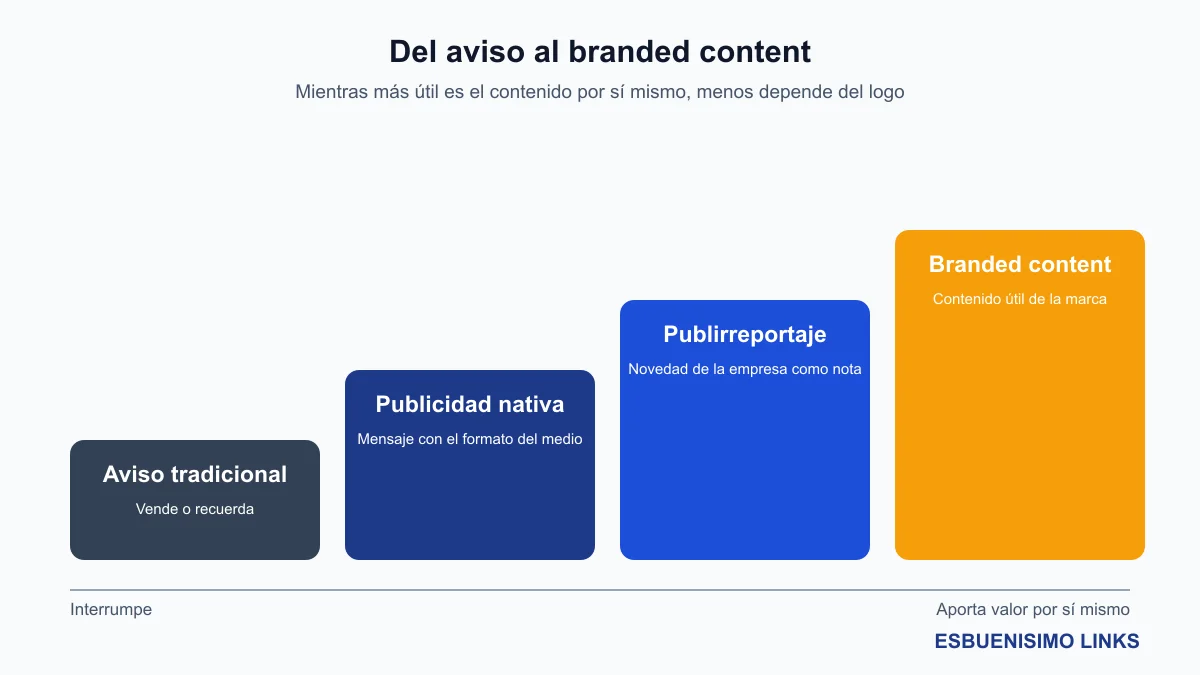
Branded content is content funded by a brand whose main value is to inform, entertain or be useful, not to sell a product directly. The brand appears as author, sponsor or presenter, but the core of the piece is a story, a piece of data or a service for the reader.
The difference from an ad lies in the question it answers. The ad says "buy this". Branded content answers something the audience already wonders about: how to choose travel insurance, what to do with a first paycheck, what it really costs to charge an electric car. The brand earns an association with that topic and the trust that comes from having helped.
The format is old. The Michelin brothers published their first guide in 1900 so drivers would travel more and, along the way, wear out more tires. A more recent case is Red Bull Stratos: Felix Baumgartner's jump from the stratosphere on October 14, 2012 was a broadcast millions followed live, with no can in the foreground.
Branded content vs. native advertising vs. advertorials
Communications teams mix these terms up, and that complicates buying. This table separates them by who controls the message and how it is labeled.
| Format | Main goal | Who controls the text | Where it lives | Label |
|---|---|---|---|---|
| Branded content | Associate the brand with a topic and build trust | Shared between brand and outlet or studio | Media, own site, video, podcast | "Presented by", "in partnership with" |
| Native advertising | Distribute a message in the outlet's format | The brand, adapted to the outlet's design | Feeds and sections of the outlet | "Sponsored", "advertising" |
| Advertorial | Tell company news in an article format | The brand, edited by the outlet | Digital or print outlet | "Advertorial" |
| Traditional ad | Sell or remind | The brand | Banner, TV, radio, outdoor | Obvious ad format |
We cover advertorials in more detail, including how they must be labeled in Chile, in our guide on what an advertorial is and when it pays off. In practice: every advertorial is paid content, but not all branded content is an advertorial. A brand podcast or a documentary series on YouTube also count.
🚀 Digital PR & Link Building
Rank #1 on Google and Get Mentioned by AI
1,400+ media outlets in 8 countries. Backlinks that Google and ChatGPT recognize as trusted authority sources.
See plans and pricing →Why branded content in news media matters in 2026
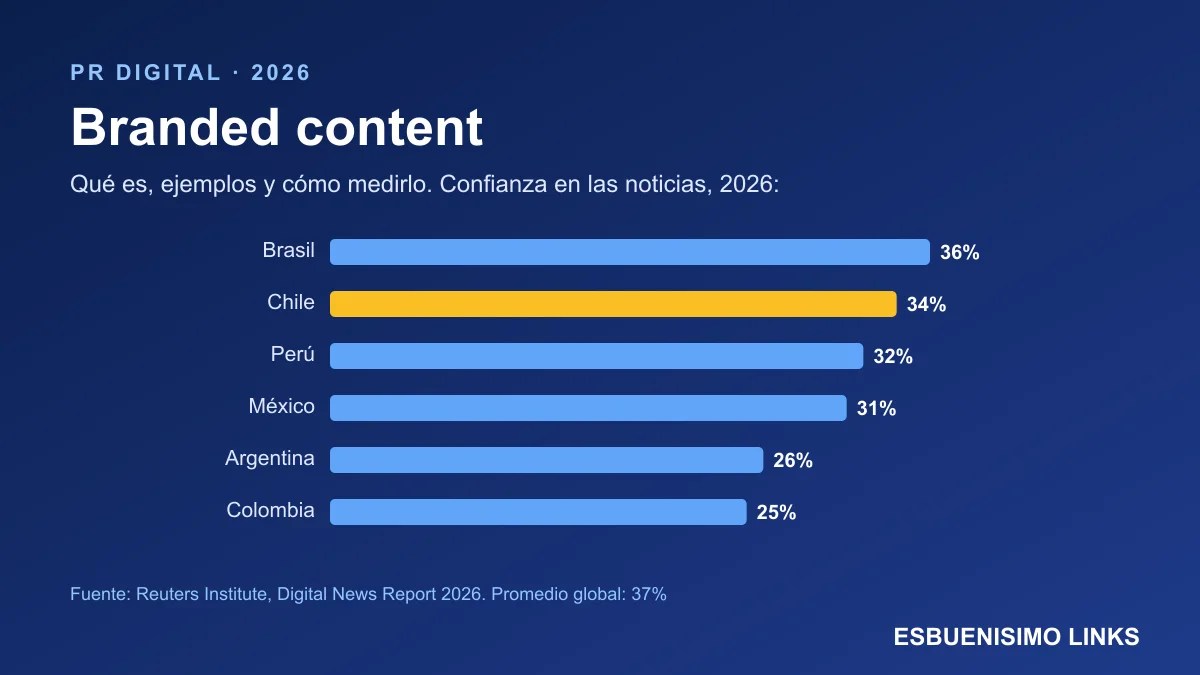
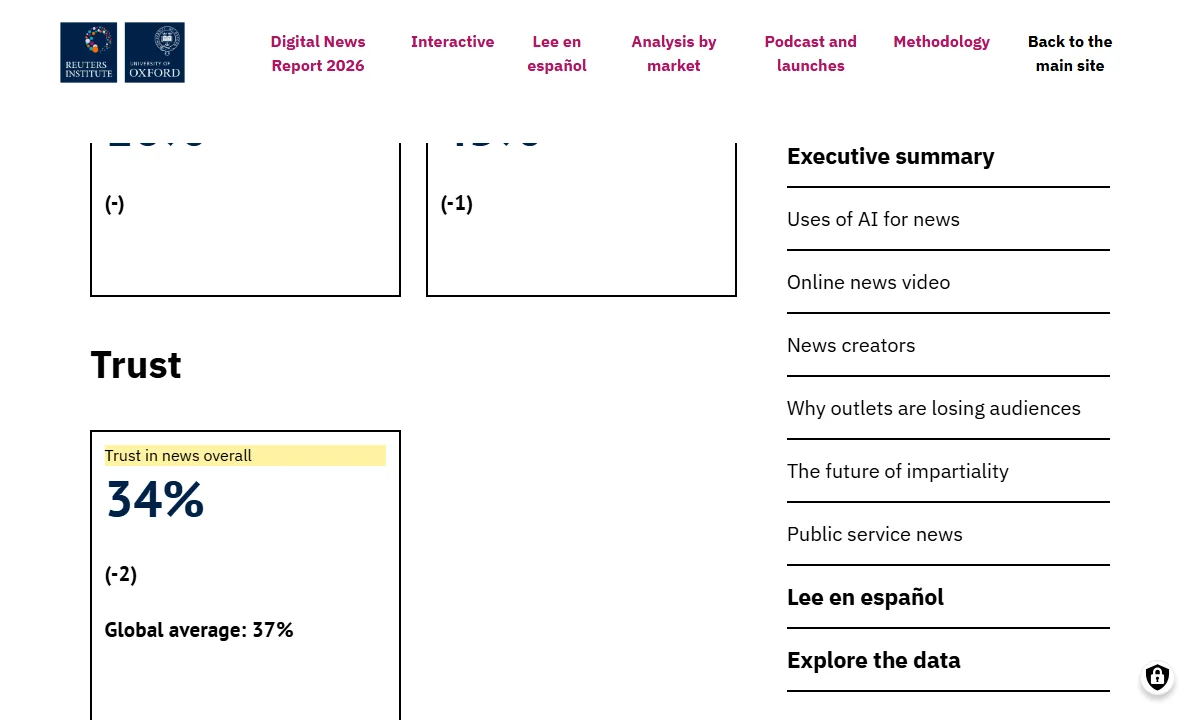
The case for branded content in news outlets is borrowed trust: the brand shows up in an environment readers already consider credible. The problem is that this trust is scarce and falling. According to the Reuters Institute Digital News Report 2026, only 34% of Chileans trust most news most of the time, two points less than in 2025 and below the global average of 37%.
View the data as a table
| Brazil | 36% · 2025: 42% |
| Chile | 34% · 2025: 36% |
| Peru | 32% · 2025: 40% |
| Mexico | 31% · 2025: 36% |
| Argentina | 26% · 2025: 32% |
| Colombia | 25% · 2025: 32% |
The rest of the region is the same or worse. Colombia fell 7 points to 25%, and Peru dropped 8 to 32%. In the six Latin American countries the report covers, trust fell between 2 and 8 points in a year.
| Country | Trust in news 2025 | Trust in news 2026 | Change | Pay for online news (2026) |
|---|---|---|---|---|
| Brazil | 42% | 36% | -6 | 15% |
| Chile | 36% | 34% | -2 | 10% |
| Peru | 40% | 32% | -8 | 14% |
| Mexico | 36% | 31% | -5 | 15% |
| Argentina | 32% | 26% | -6 | 10% |
| Colombia | 32% | 25% | -7 | 15% |
Source: Reuters Institute, Digital News Report 2025 and 2026, country pages.
There are two takeaways for a brand. First, not every outlet lends the same trust, so choosing where to publish matters more than publishing a lot. Second, since almost nobody pays for news (10% to 15% in these countries), outlets depend on advertising and are open to well-made branded content. That is the opportunity.
Branded content examples you can apply
You don't need Red Bull's budget. These formats are within reach of a mid-sized company and work for both communications and SEO:
- Buying guides with data published in a trade outlet: an insurer explaining how to compare travel insurance, with a coverage table.
- Original studies: a survey or industry data analysis the outlet publishes and other journalists cite.
- Interview series with customers, experts or suppliers, presented by the brand.
- Podcast or video on a topic of general interest, with the brand as host, not star.
- Tools: calculators, simulators or comparison tools that solve a real reader problem.
What they share is that they could exist without the logo. If removing the brand makes the piece pointless, it is probably an ad in disguise, and readers will notice.
Branded content, SEO and AI mentions
For the SEO team, branded content in media has a concrete value: it leaves a link and a brand mention on an authoritative site. Site authority is usually measured with DR (Ahrefs' Domain Rating), a 0 to 100 score based on the quantity and quality of links a site receives. In our database of 1,090 media outlets, average DR varies widely by country.
The full country breakdown is in our report on average DR of media outlets by country. The lesson for buyers: high DR is not enough; the outlet must cover the brand's topic and have real readers in the target country.
One rule is non-negotiable. Google's spam policies treat paid content with links that pass authority as link spam. A sponsored piece's link must be marked rel="sponsored"; the differences between that attribute, nofollow and ugc are in our guide to dofollow, nofollow, sponsored and ugc links. The value lies in the traffic, the brand searches it generates and the association with the topic.
ChatGPT, Gemini and Perplexity read that association too. When an authoritative outlet publishes a useful guide featuring the brand, the content joins the set of pages those tools consult when answering. That is why at ESBUENISIMO LINKS we plan branded content in Chilean media for both audiences: readers and search engines, AI included.
View the data as a table
| of Chileans trust the news | 34% |
| global average trust | 37% |
| of Chileans pay for online news | 10% |
| Chilean outlets with DR 60+ | 20 |
How to measure branded content
Measurement is where most campaigns fail: they report "impressions" and nobody knows whether it worked. These are metrics a marketing manager can ask for and an SEO team can deliver.
| Goal | Metric | How to measure |
|---|---|---|
| Real reach | Reads and reading time | Outlet report and referral traffic in Google Analytics |
| Brand interest | Brand searches after publication | Search Console and Google Trends, before and after |
| SEO authority | New domains linking to or mentioning the brand | Ahrefs or Semrush, month by month |
| AI visibility | Times ChatGPT or Gemini name the brand for industry questions | A fixed set of questions, measured monthly |
| Business | Leads or sales originating from the piece | UTM links and CRM conversions |
A final recommendation: decide the metric before producing. A piece meant to get the brand cited by AI needs verifiable data and an outlet AI consults; a piece meant for leads needs a clear call to action and a form. Mixing both goals in the same text usually delivers neither.
Frequently Asked Questions
What is branded content?+
Content funded by a brand whose main value is to inform, entertain or be useful, not to sell a product directly. The brand appears as author or sponsor, but the core is a story, data or a service for the audience.
What is the difference between branded content and advertising?+
Advertising asks for something (buy, remember the brand). Branded content answers a question the audience already has, and the brand earns an association with that topic. A simple test: if the piece is still useful without the logo, it is branded content.
What are examples of branded content?+
The Michelin Guide, created in 1900 by a tire brand, and Red Bull Stratos, the 2012 jump from the stratosphere, are the classic cases. For a mid-sized company, buying guides with data, original studies, interview series, podcasts and tools such as calculators work well.
Does branded content help SEO?+
Yes, when published on an outlet with authority and a real audience on the topic. It leaves a brand mention and a link, which must be marked rel="sponsored" under Google's rules. Its value lies in traffic, the brand searches it generates and associating the brand with the topic.
How do you measure branded content?+
With metrics set before production: reads and referral traffic, brand searches before and after, new linking domains, how often ChatGPT or Gemini name the brand for industry questions, and leads tracked with UTM links.
Ready to rank #1 and get mentioned by AI?
Digital PR & Link Building in 1,400+ media outlets across 8 countries. Google and ChatGPT recognize you as an authority source.
See plans and pricing