By Felipe Morales, CEO of ESBUENISIMO LINKS
Neuromarketing: what it is, real examples and why the brain trusts the media more
Neuromarketing explained: what it is, the most cited experiments (Coke vs. Pepsi, wine, purchases), the biases it explains and why a news story outweighs an ad.
Neuromarketing studies how the brain reacts to brands, prices and messages to understand why we buy what we buy. It is not magic or a hidden buy button: it is a mix of neuroscience, psychology and behavioral data that helps explain why the same product sells differently depending on who recommends it and where it shows up.
In this guide we cover what neuromarketing is, the most cited experiments, the biases it explains and one practical takeaway for brands in Chile and Latin America: the brain trusts what others say (media, reviews, AI) more than what the brand says about itself.
What neuromarketing is
Neuromarketing applies neuroscience tools to consumer research. The best known are functional magnetic resonance imaging (fMRI), which shows which brain areas activate; electroencephalography (EEG), which measures electrical activity with a headset; eye tracking; and measures such as skin conductance or heart rate.
The core idea is simple: what people say in a survey does not always match what they do. Many decisions are made quickly, with mental shortcuts, and neuromarketing tries to measure those reactions before people rationalize them. In practice, most companies do not use scanners: they use what those studies taught about attention, memory and trust.
Three neuromarketing experiments still cited today
Three peer-reviewed studies support much of what is taught today. The first, by McClure and colleagues in Neuron (2004), had people taste Coke and Pepsi inside a scanner. Blind, the brain response followed actual taste. When they knew which drink they had, brand knowledge dramatically influenced both stated preference and brain activity.
| Study | What they did | What they found |
|---|---|---|
| McClure et al., Neuron, 2004 | Coke and Pepsi tasting with and without brand cues, inside an fMRI scanner | Blind, the ventromedial prefrontal cortex tracked real taste. With the brand visible, knowing it was Coke changed the preference and the brain response |
| Plassmann et al., PNAS, 2008 | The same wine presented at different prices | A higher price raised reported pleasantness and activity in the medial orbitofrontal cortex |
| Knutson et al., Neuron, 2007 | Simulated purchases of priced products | Liking the product activated the nucleus accumbens; an excessive price activated the insula. Those signals predicted purchases beyond self-reports |
The second, by Plassmann et al. in PNAS (2008), showed that the same wine is enjoyed more when it is believed to be more expensive: price changes not only opinion but the experience measured in the brain. The third, by Knutson et al. in Neuron (2007), predicted purchases from brain activity before the decision.
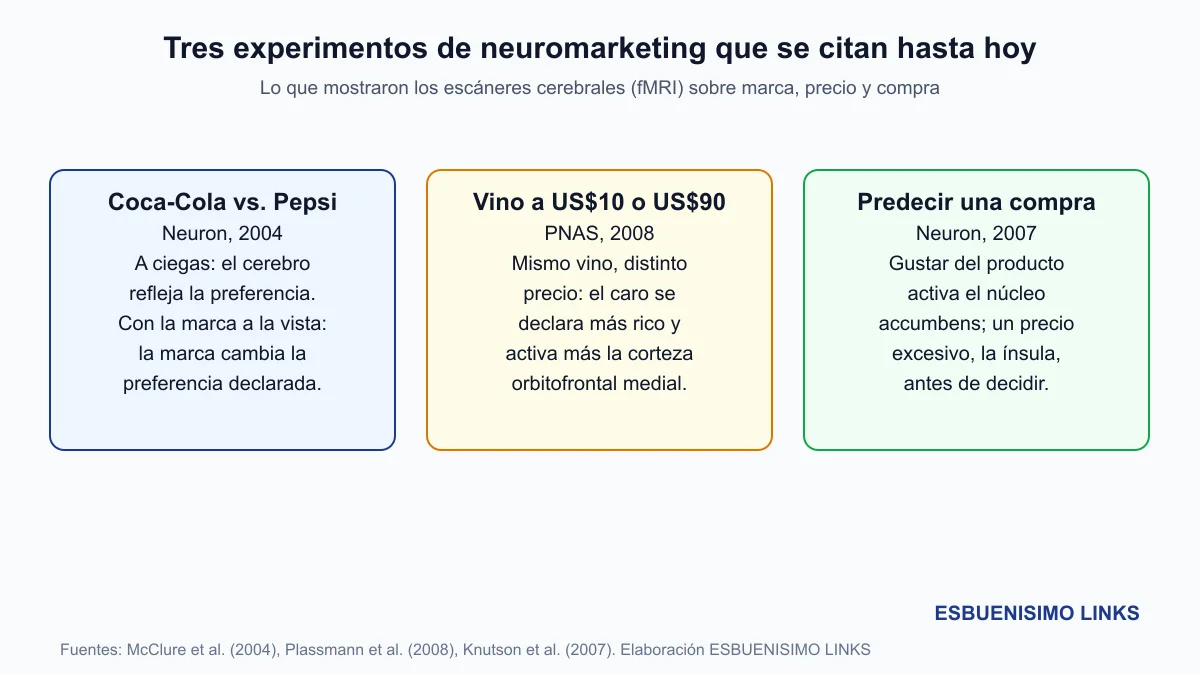
The shared lesson: how a brand is perceived does not depend only on the product. It depends on the brand, the price and the context in which people meet it.
🚀 Digital PR & Link Building
Rank #1 on Google and Get Mentioned by AI
1,400+ media outlets in 8 countries. Backlinks that Google and ChatGPT recognize as trusted authority sources.
See plans and pricing →The biases that drive a purchase
Much of applied neuromarketing relies on cognitive biases documented by psychology. Robert Cialdini popularized them in Influence (1984), and Robert Zajonc described the mere exposure effect in 1968: what we see repeatedly seems more pleasant. These are the ones brands use most:
| Bias | What it says | Where it shows up in marketing |
|---|---|---|
| Social proof | We copy what others seem to choose | Reviews, “best seller” labels, brands AI recommends |
| Authority | We believe a credentialed source more | Press coverage, quoted experts, seals and awards |
| Mere exposure | What we see repeatedly we like more (Zajonc, 1968) | Showing up across several outlets and searches |
| Price anchoring | The first price we see sets the reference | Crossed-out prices, premium plan next to basic |
| Loss aversion | Losing weighs more than gaining the same | “Last units”, expiring free trials |
For communications teams, three are decisive: social proof, authority and mere exposure. All three kick in when a brand is mentioned by third parties, repeatedly, in places the audience already considers trustworthy.
Neuromarketing and trust: why a news story outweighs an ad
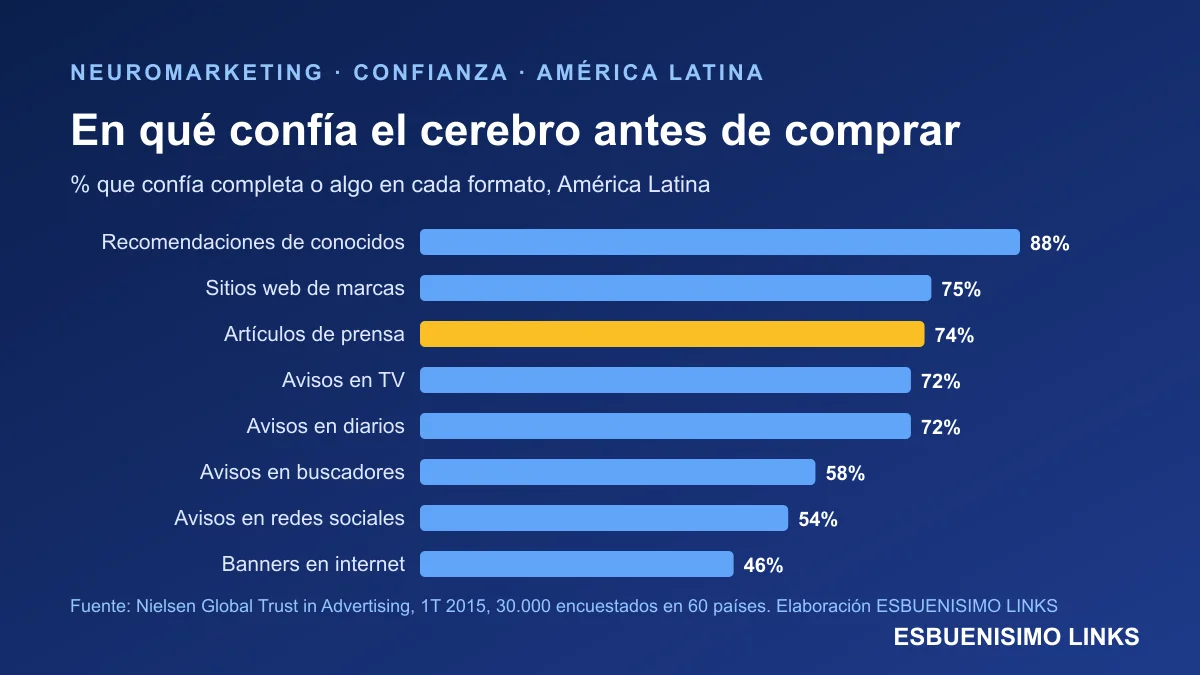
Nielsen's advertising trust study, with 30,000 respondents in 60 countries, provides the data point that best connects neuromarketing to media strategy. In Latin America, 74% trust editorial content such as a news article, versus 54% for social network ads and 46% for banners. Recommendations from people they know reach 88%.
| Format | Latin America | Global average |
|---|---|---|
| Recommendations from people I know | 88% | 83% |
| Branded websites | 75% | 70% |
| Editorial content (news articles) | 74% | 66% |
| TV ads | 72% | 63% |
| Newspaper ads | 72% | 60% |
| Search engine ads | 58% | 47% |
| Social network ads | 54% | 46% |
| Online banner ads | 46% | 42% |
It is a 2015 study and trust shifts over time, but the order holds in most measurements: what a credible third party says outweighs what the brand pays for. That is the authority bias at work. A story in a newspaper readers recognize does for a brand what a banner cannot.
That is the logic behind link building with Chilean media: publishing on sites with a real audience adds the mention that triggers reader trust and, at the same time, the link Google uses as an authority signal (a backlink is a link from another site to yours). We explain the difference between both effects in backlinks vs. unlinked mentions.
The new social proof: what AI recommends
In 2026, a large share of social proof happens inside ChatGPT, Gemini or Perplexity. When someone asks “which sneaker brand should I buy?” and the answer names three brands, those three get the same mental shortcut as a “best seller” label. AI builds that answer from what it read in media, reviews and forums.
That is why neuromarketing is no longer played only at the point of sale: it is also played in what AI says about your brand. We cover it in how to get mentioned by AI and in the role of reviews and social proof in AI citations. If you want to measure and improve it, a GEO agency works on exactly that visibility.
How to apply it to your brand without a scanner
An fMRI study is expensive and few brands need one. What any team can do:
- Borrowed authority: earn mentions in outlets your customers already read, not just paid ads.
- Consistent repetition: the same message in press, search, social and AI reinforces mere exposure.
- Visible social proof: real reviews, case studies and customer figures shared with permission.
- Price with a reference: show the full plan next to the basic one to set the anchor.
- A/B tests: measure which headline, image or price converts better instead of guessing.
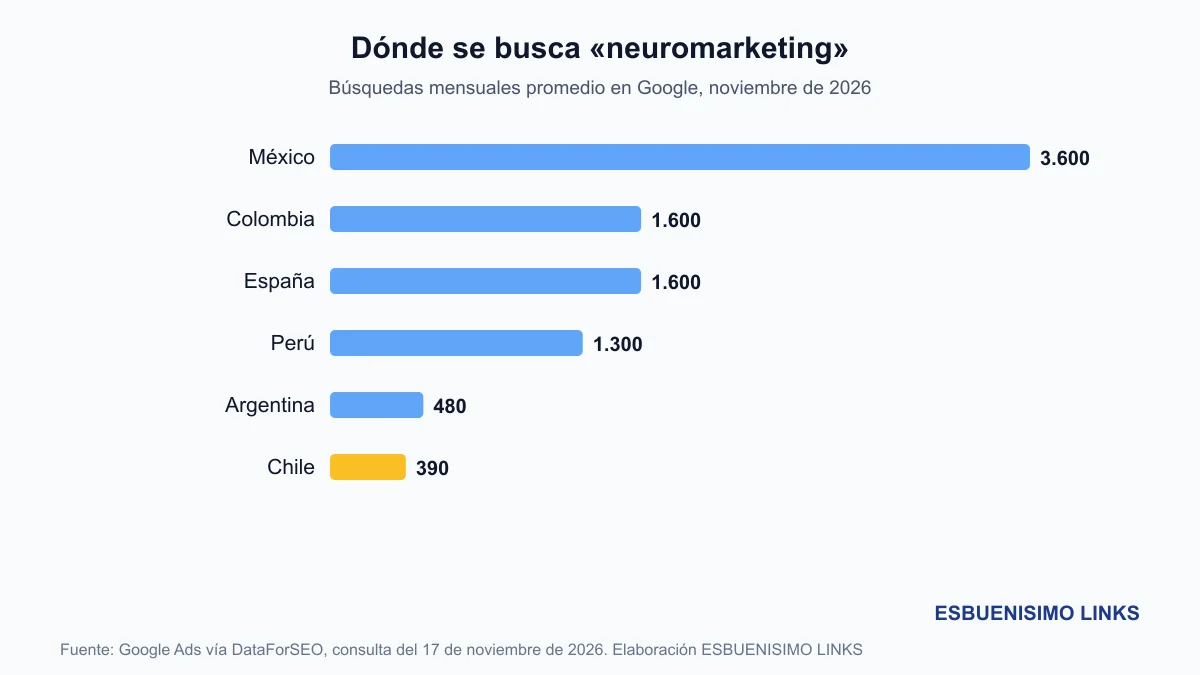
Interest in the topic is high across the region: Mexico logs 3,600 monthly searches for “neuromarketing” and Chile 390.
View the data as a table
| Mexico | 3,600 |
| Colombia | 1,600 |
| Peru | 1,300 |
| Argentina | 480 |
| Chile | 390 |
Limits and ethics: what science does not support
Neuromarketing has critics with serious arguments. Scanner studies tend to use small samples, an area of the brain lighting up does not equal purchase intent, and some companies sell “mind reading” that science does not support. There is no “buy button” in the brain either.
Responsible use stays at understanding customers better: clearer messages, more honest prices and presence where they already place their trust. Manipulating with fake scarcity or invented reviews destroys exactly what neuromarketing teaches you to protect: trust.
Frequently Asked Questions
What is neuromarketing?+
It is the use of neuroscience tools such as fMRI, EEG or eye tracking to measure how the brain reacts to brands, prices and messages, in order to understand purchase decisions people do not always explain in a survey.
What are examples of neuromarketing?+
The most cited are the Coke and Pepsi experiment (Neuron, 2004), where knowing the brand changed preference; the wine-price study (PNAS, 2008); and everyday use of reviews, crossed-out prices, “best seller” labels and press mentions to trigger social proof and authority.
What are the 3 brains of neuromarketing?+
It refers to Paul MacLean's triune brain theory (reptilian, limbic and neocortex), widely used in neuromarketing courses. Current neuroscience considers it an oversimplification, though it helps convey that many decisions combine emotion and reason.
Is neuromarketing ethical?+
It depends on how it is used. It is ethical when it helps communicate better and understand customers; it is not when used to manipulate, for example with fake scarcity or invented reviews. Several commercial neuromarketing claims also lack scientific backing.
How does neuromarketing relate to SEO and AI?+
Authority bias and social proof explain why a mention in a recognized outlet or in a ChatGPT answer outweighs an ad. That is why media link building and AI visibility work rely on the same principles.
Ready to rank #1 and get mentioned by AI?
Digital PR & Link Building in 1,400+ media outlets across 8 countries. Google and ChatGPT recognize you as an authority source.
See plans and pricing