By Felipe Morales, CEO of ESBUENISIMO LINKS
SEO audit: what it covers, a 2026 checklist and what to do with the results
SEO audit: what it checks across the technical, content, links and AI layers, a 2026 checklist backed by Web Almanac data and how to prioritize fixes in a company.
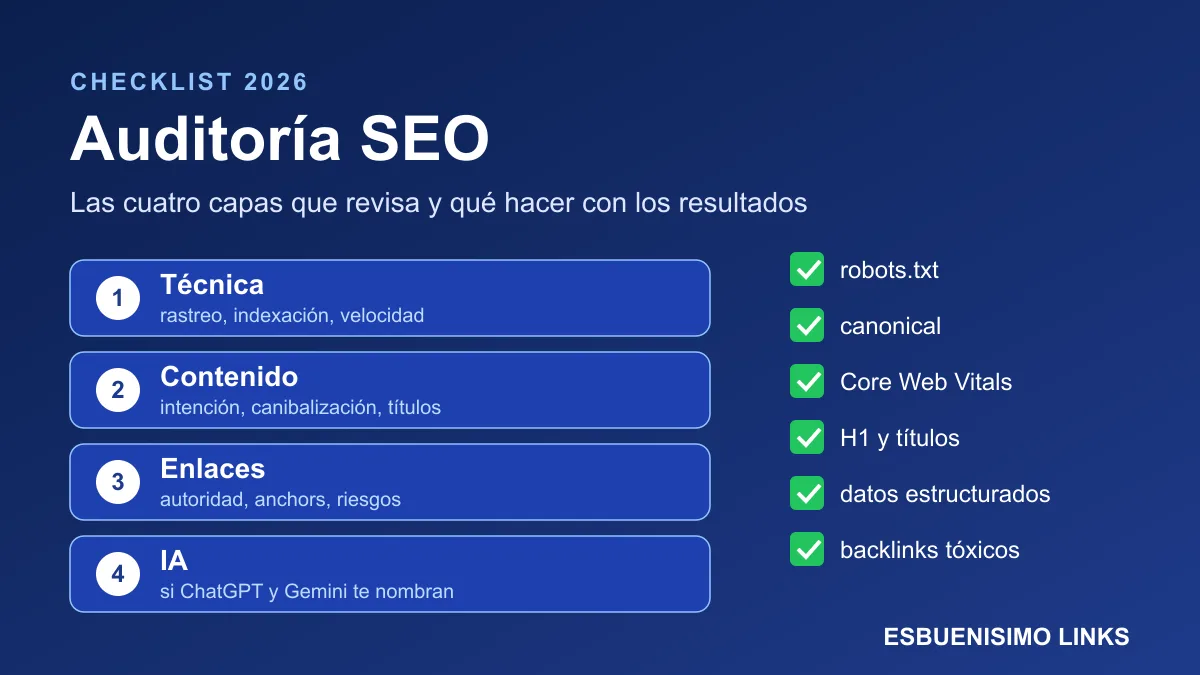
An SEO audit is a website's medical checkup: it tells you what is keeping the company from showing up on Google when customers search for what it sells. The problem is that many audits end up as an 80-page PDF with hundreds of "errors" that nobody prioritizes. This guide explains what an audit should cover in 2026, how common each problem is according to data from the real web and, above all, how to turn the diagnosis into a plan.
It is written for two readers. For the SEO manager, it organizes the checklist with reference data. For the marketing, ecommerce or communications manager, it explains what to ask for, what to question and how to tell whether the audit you received is any good.
What an SEO audit is and what it should deliver
An SEO audit is a systematic review of a site to find what holds back its rankings. It is not an automatic report from a tool: tools find symptoms, and the audit decides which ones matter for the business.
A good deliverable has three parts: a diagnosis (what is wrong and where), a prioritization (what to fix first based on impact and effort) and a baseline of metrics (clicks, rankings, indexed pages, referring domains) to check later whether the changes worked. If you only get the first part, you have a to-do list, not an audit.
What an SEO audit covers: the four layers
Until recently, an audit had three layers. In 2026 a fourth one belongs on the list: what artificial intelligence says about the brand, because more and more customers ask ChatGPT first or read Google's AI answer before they click.
| Layer | What it checks | Common tools |
|---|---|---|
| Technical | Crawling, indexing, robots.txt, canonicals, redirects, speed (Core Web Vitals), mobile version, HTTPS | Google Search Console, PageSpeed Insights, Screaming Frog |
| Content | Whether each page answers a real search, titles and H1s, duplicate content, pages competing for the same keyword, internal linking | Search Console, keyword tools, crawler |
| Links | Domains linking to the site, their authority, anchor distribution (the clickable text of the link), toxic links or links bought from low-quality networks | Ahrefs, Semrush, Moz |
| AI | Whether ChatGPT, Gemini, Perplexity and Claude mention the brand for category questions, which sources they cite and whether the facts they give are right | Manual prompts or AI monitoring platforms |
The links layer deserves its own analysis when the site is several years old or has gone through several agencies. We cover it in detail in our guide to auditing your backlink profile.
🚀 Digital PR & Link Building
Rank #1 on Google and Get Mentioned by AI
1,400+ media outlets in 8 countries. Backlinks that Google and ChatGPT recognize as trusted authority sources.
See plans and pricing →The most common problems according to the 2025 Web Almanac
How frequent is each issue? The best public benchmark is the SEO chapter of HTTP Archive's 2025 Web Almanac, which analyzes millions of sites with data crawled in mid-2025. Use it to see whether your site is above or below the average.
| Indicator (Web Almanac 2025) | Desktop | Mobile |
|---|---|---|
| Pages with a canonical tag | 68% | 67% |
| Pages with a non-empty H1 | 66% | 66% |
| Home pages with structured data | 50% | 50% |
| Images with alt text (median per site) | 60% | 60% |
| Sites passing Core Web Vitals (June 2025) | 56% | 48% |
| robots.txt requests returning a valid 200 code | 85% | |
Read the other way around, the data is more useful: one in three sites does not declare its canonical page, one in three lacks an H1 with content and half of home pages skip structured data, which are precisely the tags that help Google and AI understand who the company is. The same report shows that llms.txt, the file meant to guide AI models, is still used by around 2% of sites.
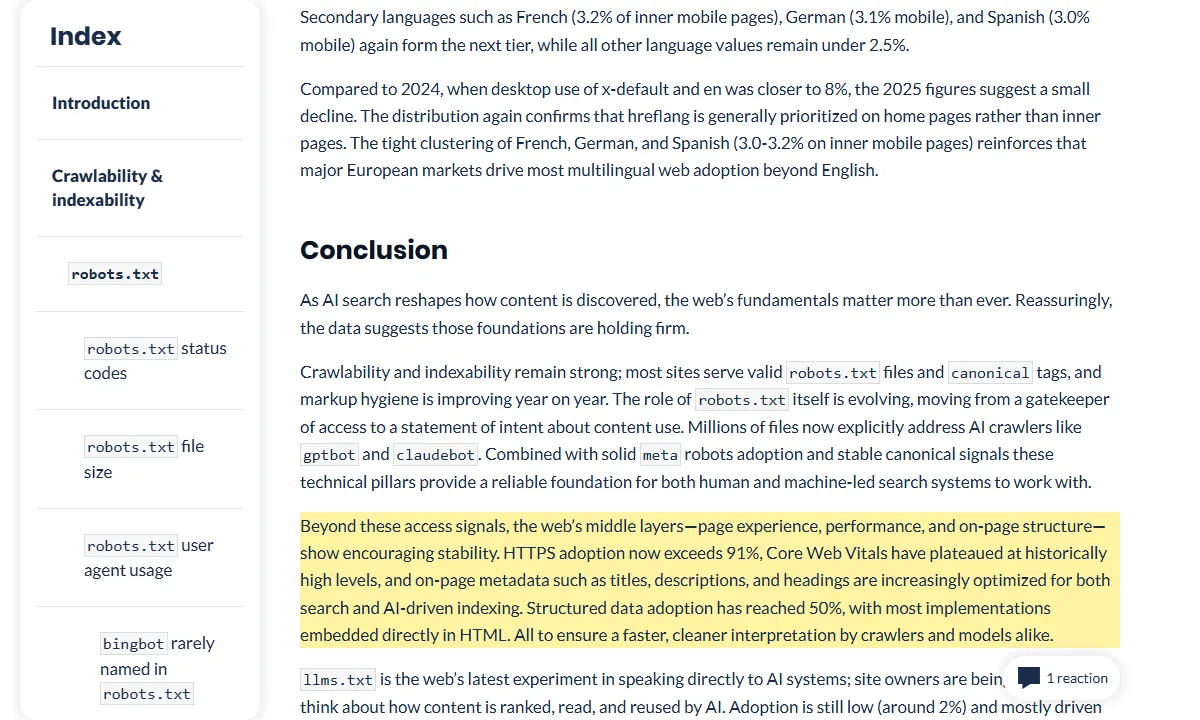
Core Web Vitals: the thresholds an audit checks
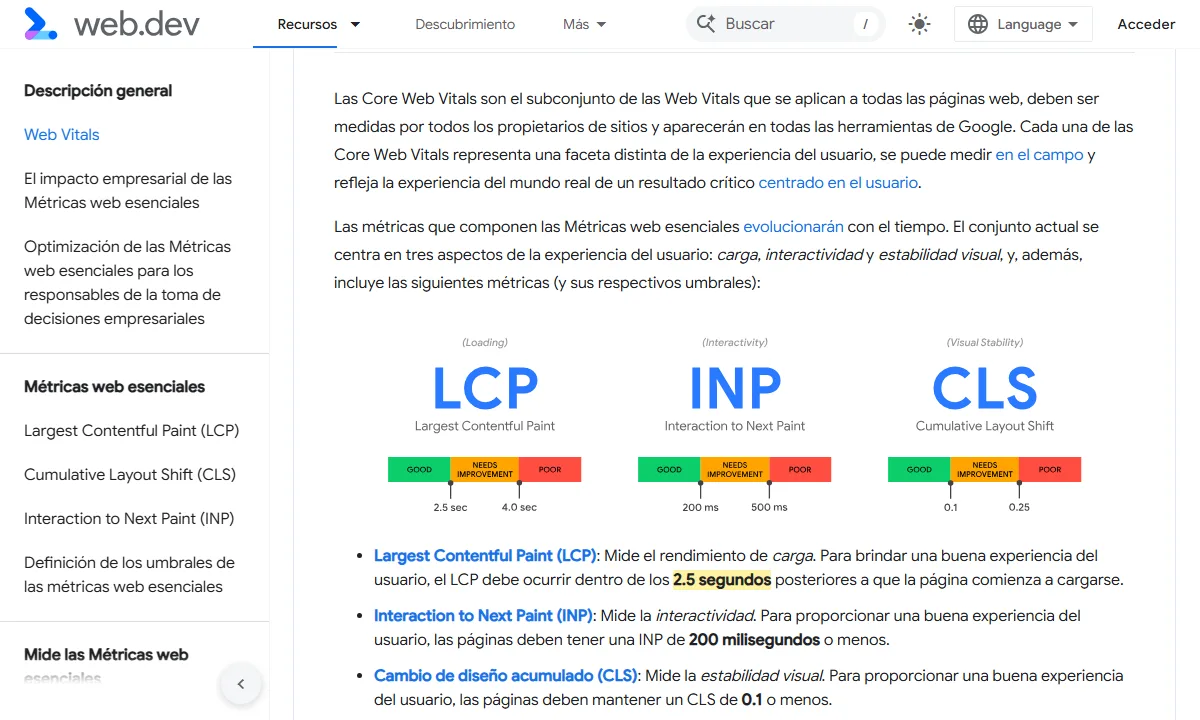
Speed is measured with Core Web Vitals, three metrics defined by Google and calculated from real Chrome user data. The thresholds are published on web.dev, and an audit should compare them with the site's field data, not just with a lab test.
| Metric | What it measures | Good | Mobile sites passing (2025) |
|---|---|---|---|
| LCP (Largest Contentful Paint) | How long the main element takes to load | 2.5 seconds or less | 62% |
| INP (Interaction to Next Paint) | How long the page takes to respond to a click or tap | 200 milliseconds or less | 77% |
| CLS (Cumulative Layout Shift) | How much the page "jumps" while loading | 0.1 or less | 81% |
Main content loading (LCP) is the metric that fails most often on mobile, which is why it is the first one to check on an ecommerce site with heavy product photos or a corporate site with video on the home page.
SEO audit checklist, step by step
- Define the searches that matter. Before opening any tool, list the 20 to 50 keywords that bring in customers. Without them, the audit cannot prioritize.
- Check indexing in Search Console. How many pages are indexed, which were excluded and why. A catalog with thousands of filter URLs indexed is a common ecommerce problem.
- Crawl the whole site. 404 errors, redirect chains, misplaced canonicals, pages with no H1 or with duplicate titles.
- Review robots.txt and AI crawlers. Make sure you are not accidentally blocking Google or the assistant bots you do want reading your site. See our guide to robots.txt for GPTBot, ClaudeBot and PerplexityBot.
- Measure Core Web Vitals with field data on the key templates: home, category, product or service, and article.
- Audit content against search intent. Find pages that compete with each other for the same keyword and service pages that do not answer what the customer is asking.
- Benchmark the link profile against competitors. How many domains link to your site and how many link to the three competitors that outrank you.
- Ask the AI. Run your category's questions in ChatGPT, Gemini, Perplexity and Claude, and record which brands they name and which media they cite.
What to do with your SEO audit results
The most common mistake is trying to fix everything. A useful SEO audit sorts each finding into a simple impact-and-effort matrix: first whatever blocks (important pages not indexed, a robots.txt that cuts off crawling, broken redirects after a migration), then what moves rankings for the searches that sell, and last the low-impact technical hygiene.
The technical side usually depends on a single team, development, and can be scheduled in sprints. What takes longest to close is the authority gap: competitors have more relevant media and sites linking to them and mentioning them. That gap is worked on outside the site, with press coverage and links, as we explain in our guide to off-page SEO. At ESBUENISIMO LINKS we close it with link campaigns in Chilean media, and that same media presence is what AI assistants end up citing.
How often to audit and who should do it
A reasonable pace is a full audit once a year and a light technical review every quarter, plus an audit before and after any migration, redesign or platform change. Doing it in-house makes sense if the company has an SEO manager with access to developers; otherwise an outside view avoids the bias of whoever built the site.
If you want to start with the newest layer, the free AI audit shows in minutes what assistants say about your brand. And if you need the full diagnosis with an execution plan, see how we handle technical audits and SEO strategy for companies in Chile and Latin America.
Frequently Asked Questions
What is an SEO audit?+
It is a structured review of a website to find what keeps it from ranking better on Google and, today, from showing up in AI answers. It covers four layers: technical (whether Google can crawl and index the site), content (whether it answers what people search for), links (the authority the site earns elsewhere) and visibility in assistants such as ChatGPT or Gemini. The useful deliverable is not a list of errors but a plan prioritized by impact.
How do you measure SEO?+
With business and visibility metrics: clicks and impressions in Google Search Console, rankings for the keywords that sell, organic traffic and conversions in Google Analytics, indexed pages, referring domains and, increasingly, how often AI mentions the brand compared with competitors. An SEO audit records the starting point for those numbers so progress can be measured.
How often should you run an SEO audit?+
A full audit once a year and a light technical review every quarter is a reasonable pace for most companies. It is also worth auditing before and after any major change: a domain migration, a redesign, a new ecommerce platform or a merger of two sites.
Who is in charge of SEO in a company?+
It depends on size. Large companies usually have an SEO manager in marketing or ecommerce who coordinates with tech and content. Mid-sized companies often have marketing lead it with an outside agency. Either way, an audit only pays off if someone with authority over the site owns the fixes.
Which tools are used in an SEO audit?+
Google Search Console and PageSpeed Insights (free, from Google), a crawler such as Screaming Frog to check the site page by page, and a link tool such as Ahrefs or Semrush for the backlink profile. For the AI layer, the key business questions are run in ChatGPT, Gemini, Perplexity and Claude and the brands that appear are recorded.
Ready to rank #1 and get mentioned by AI?
Digital PR & Link Building in 1,400+ media outlets across 8 countries. Google and ChatGPT recognize you as an authority source.
See plans and pricing