By Felipe Morales, CEO of ESBUENISIMO LINKS
Website traffic: where it comes from, how to measure it and how to grow it (2026 data)
What website traffic is, which channels it comes from in Google Analytics 4 and how to grow it. Chile data as of October 2026: Google falls to 89.8% of searches, Bing rises and Gemini leads AI referrals.
Website traffic is the number of visits a site receives. For a company, it's the first sign of whether its brand can be found online, but the total says little: what matters is where those visits come from and how many end in a sale or a lead. This guide explains the channels, how to measure them with Google Analytics 4 and what works to grow them, with data for Chile and Latin America as of October 2026.
What is website traffic and where does it come from?
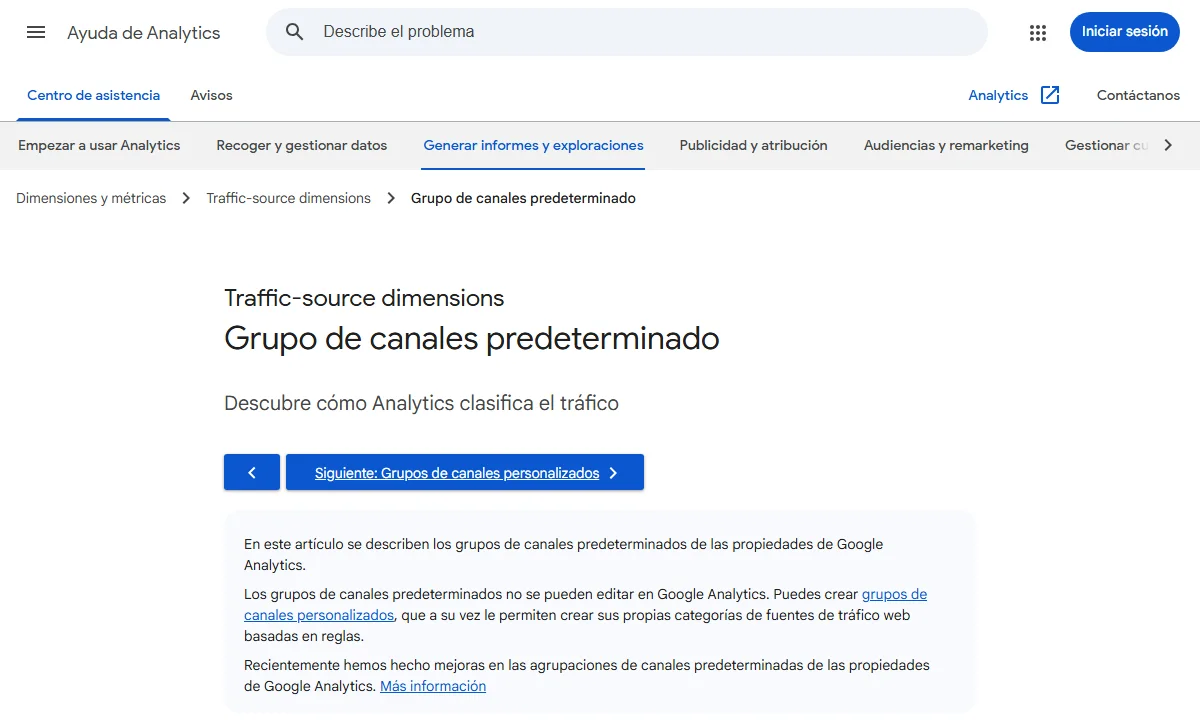
Google Analytics 4 (GA4) classifies every visit into a "default channel group." Google Analytics' official help page lists 19 channels; these are the ones that matter most for a company website:
| GA4 channel | Where the visit comes from | Paid per click |
|---|---|---|
| Organic Search | Unpaid results from Google, Bing and other search engines | No |
| Direct | Someone types your URL or uses a bookmark | No |
| Referral | Links on other sites, such as blogs or news sites | No |
| Organic Social | Unpaid links on social networks | No |
| AI Assistant | Assistants like ChatGPT or Gemini (excludes AI Overviews and AI Mode) | No |
| Paid Search | Search engine ads | Yes |
| Links in emails and newsletters | No |
The "AI Assistant" channel is new and worth watching: it separates visits coming from AI chatbots. Note one detail in the documentation itself: visits from Google's AI summaries are still counted as organic search.
Search engines in Chile: Google rules, but less than before
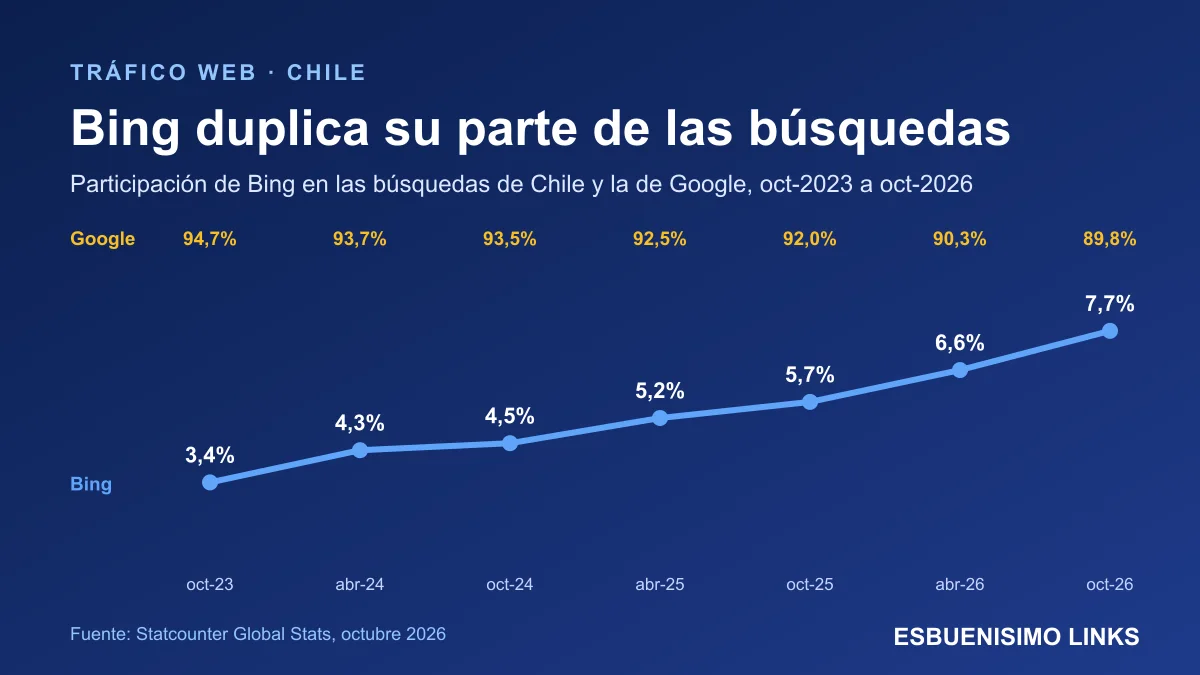
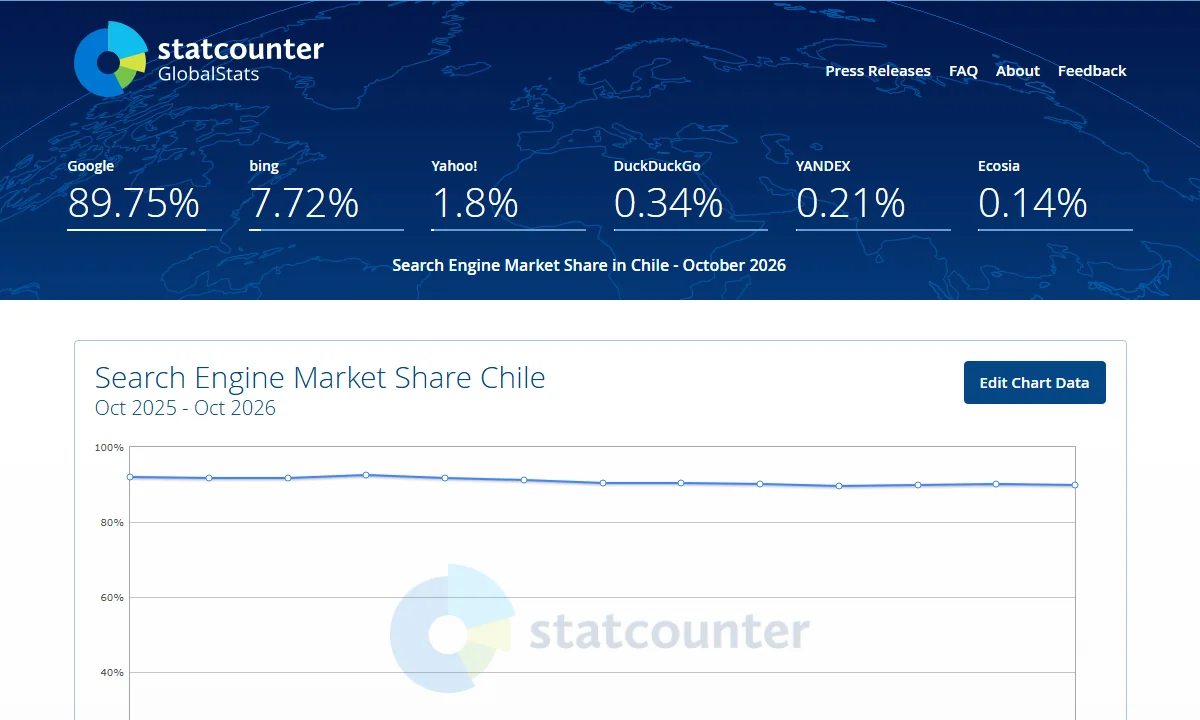
Search is still the biggest source of website traffic for almost any company, and in Chile searching is almost synonymous with Google. According to Statcounter Global Stats, which measures visits to sites using its tracking code, Google had 89.8% of searches in Chile in October 2026. Three years earlier it had 94.7%. Over the same period, Bing rose from 3.4% to 7.7%.
| Search engine | October 2023 | October 2026 |
|---|---|---|
| 94.7% | 89.8% | |
| Bing | 3.4% | 7.7% |
| Yahoo! | 1.6% | 1.8% |
| DuckDuckGo | n/a | 0.4% |
View the data as a table
| Bing | Yahoo! | |
|---|---|---|
| Oct-23 | 3.36% | 1.59% |
| Jan-24 | 3.35% | 1.36% |
| Apr-24 | 4.28% | 1.58% |
| Jul-24 | 5.41% | 2.04% |
| Oct-24 | 4.48% | 1.63% |
| Jan-25 | 4.87% | 1.65% |
| Apr-25 | 5.20% | 1.62% |
| Jul-25 | 5.85% | 1.90% |
| Oct-25 | 5.66% | 1.68% |
| Jan-26 | 5.49% | 1.39% |
| Apr-26 | 6.57% | 2.42% |
| Jul-26 | 7.52% | 2.20% |
| Oct-26 | 7.69% | 1.80% |
Why does Bing matter? Because Copilot, Microsoft's AI assistant, searches the web with Bing. Being well indexed in Bing is no longer a technical footnote: it also affects whether a site shows up in those tools' answers. The rest of the region looks similar, with Google between 86% and 94% depending on the country.
View the data as a table
| Guatemala | 94.0% |
| Argentina | 93.9% |
| Uruguay | 93.3% |
| Venezuela | 93.1% |
| Colombia | 92.5% |
| El Salvador | 92.5% |
| Paraguay | 92.4% |
| Bolivia | 92.3% |
| Brazil | 92.0% |
| Peru | 91.4% |
| Ecuador | 91.3% |
| Chile | 89.8% |
| Costa Rica | 89.1% |
| Panama | 88.4% |
| Mexico | 86.6% |
| Honduras | 86.4% |
| Dominican Republic | 85.8% |
🚀 Digital PR & Link Building
Rank #1 on Google and Get Mentioned by AI
1,400+ media outlets in 8 countries. Backlinks that Google and ChatGPT recognize as trusted authority sources.
See plans and pricing →Visits by device: mobile versus desktop
People often say "all traffic is mobile," but Chile's data doesn't back that up. In October 2026, Statcounter measured that 50.3% of page views in Chile came from desktop computers, 48.8% from phones and 0.8% from tablets. The region is split: mobile dominates in Colombia and Mexico, while in Peru and Brazil about two thirds of the measured visits came from computers.
| Country | Mobile | Desktop | Tablet |
|---|---|---|---|
| Chile | 48.8% | 50.3% | 0.8% |
| Colombia | 58.2% | 41.4% | 0.4% |
| Mexico | 52.9% | 46.0% | 1.1% |
| Argentina | 51.8% | 47.7% | 0.5% |
| Peru | 34.3% | 64.9% | 0.8% |
View the data as a table
| Mobile | Desktop | Tablet | |
|---|---|---|---|
| Venezuela | 65.4% | 34.3% | 0.3% |
| Guatemala | 65.2% | 33.8% | 1.0% |
| Colombia | 58.2% | 41.4% | 0.4% |
| Mexico | 52.9% | 46.0% | 1.1% |
| Argentina | 51.8% | 47.7% | 0.5% |
| Chile | 48.8% | 50.3% | 0.8% |
| Peru | 34.3% | 64.9% | 0.8% |
| Brazil | 34.7% | 64.7% | 0.6% |
For a B2B company the takeaway is practical: the site has to work perfectly on mobile, because Google evaluates that version first, but the visits that convert (a manager requesting a quote, a buyer comparing options) often come from a computer during office hours. Check conversion by device in GA4 before deciding where to invest.
Organic or paid visits: which is better?
Paid traffic arrives the day you launch the campaign and stops the day you stop paying. Organic traffic takes months to build, but every well-ranked page keeps bringing visits with no cost per click. That's why companies that grow steadily use ads to test messages and cover urgent needs, and SEO and media presence to lower acquisition costs over time. A sensible mix checks every quarter how much of the converting traffic comes from channels that don't depend on a monthly budget. If that share isn't growing, the company is renting its visibility instead of building it, and every price increase in the ad auctions goes straight to its acquisition cost.
Social media and AI as sources of visits
On social, Statcounter shows Facebook still sends 69.7% of the visits that reach websites from social networks in Chile, far ahead of Instagram (12.5%) and YouTube (8.0%). LinkedIn, key for B2B, contributes only 1.0% of the total, although those visits are usually worth more per person.
The newest data point is chatbots. In October 2026, Statcounter recorded that Google Gemini generated 54.4% of the visits arriving from AI chatbots in Chile, ahead of ChatGPT (33.7%) and Perplexity (6.2%). To understand who uses each tool, see our analysis of the most popular AI tools in Latin America.
How to increase your company's website traffic
There's no shortcut, but there is a logical order. What moves the needle most on a corporate site, from longest to shortest term:
- Organic rankings. Pages that answer your customers' real searches, with clear titles and better content than competitors. We cover it in our guide to SEO ranking.
- Authority through links. Google and AI trust sites that others link to. A story in a news outlet brings referral visits that day and lifts your search position for months. There are several ways to get backlinks; the fastest for a company is link building in Chile with real media.
- Bing and AI. Verify your site in Bing Webmaster Tools and check what ChatGPT and Gemini answer about your category.
- Your own newsletter. It's the only channel that doesn't depend on an algorithm.
- Paid ads for urgent needs, knowing the traffic stops when the budget runs out and that each click costs as much on the last day as on the first.
If you'd rather delegate the organic side, our team handles web positioning in Chile end to end.
How to measure your visits without fooling yourself
- Look at channels, not totals. A month with more direct and fewer organic visits can hide an SEO problem.
- Cross-check with Search Console to see which searches bring organic visits.
- Define conversions in GA4: forms, calls, purchases. Traffic without conversions is a cost.
- Compare against the same month last year so you don't mistake seasonality for growth.
- Review referrals one by one. The Referral channel shows which outlets and sites send you visits; a news story that still brings traffic months later is a sign it's worth repeating.
- Separate branded traffic from the rest. Searches for your company name grow when you appear in the media or in AI answers, even if the click arrives later through Google.
One last point: much of today's influence leaves no trace in Analytics. When ChatGPT or a Google summary recommends your brand without a link, the person may arrive days later by typing your URL, and that shows up as direct traffic. That's why it pays to complement visit metrics with regular checks of what AI says about your category. Treat the numbers in this guide as a benchmark, not a target: Statcounter measures the sites that use its code, so your own mix may differ, and the only figures that matter for decisions are the ones in your own GA4 property, read month after month with the same definitions.
Frequently Asked Questions
What is website traffic?+
It's the visits a site receives. It's analyzed by channel (organic search, direct, referral, social, AI, ads, email) to know where people come from and which visits end in a sale or a lead.
What are the sources of website traffic?+
Google Analytics 4 has 19 default channels. The main ones for a company are organic search, direct, referrals from other sites, organic social, AI assistants, paid search and email.
How can I increase my company's website traffic?+
With content that answers real searches, links from authoritative sites such as news outlets, good indexing in Google and Bing, your own newsletter and paid ads for urgent needs.
Which search engine is most used in Chile?+
Google, with 89.8% of searches in October 2026 according to Statcounter. Bing has 7.7%, more than double three years earlier, and Yahoo! has 1.8%.
Does Google Analytics track traffic from ChatGPT?+
Yes. GA4 has a channel called AI Assistant that groups visits from assistants like ChatGPT or Gemini. Visits from Google's AI summaries are still counted as organic search.
Ready to rank #1 and get mentioned by AI?
Digital PR & Link Building in 1,400+ media outlets across 8 countries. Google and ChatGPT recognize you as an authority source.
See plans and pricing