By Felipe Morales, CEO of ESBUENISIMO LINKS
Brand guidelines: what they are, what to include and real examples (plus the AI layer)
Brand guidelines: what they are, what to include, the Marca Chile example (44 pages, 11 incorrect uses) and how to describe your brand so AI gets it right.
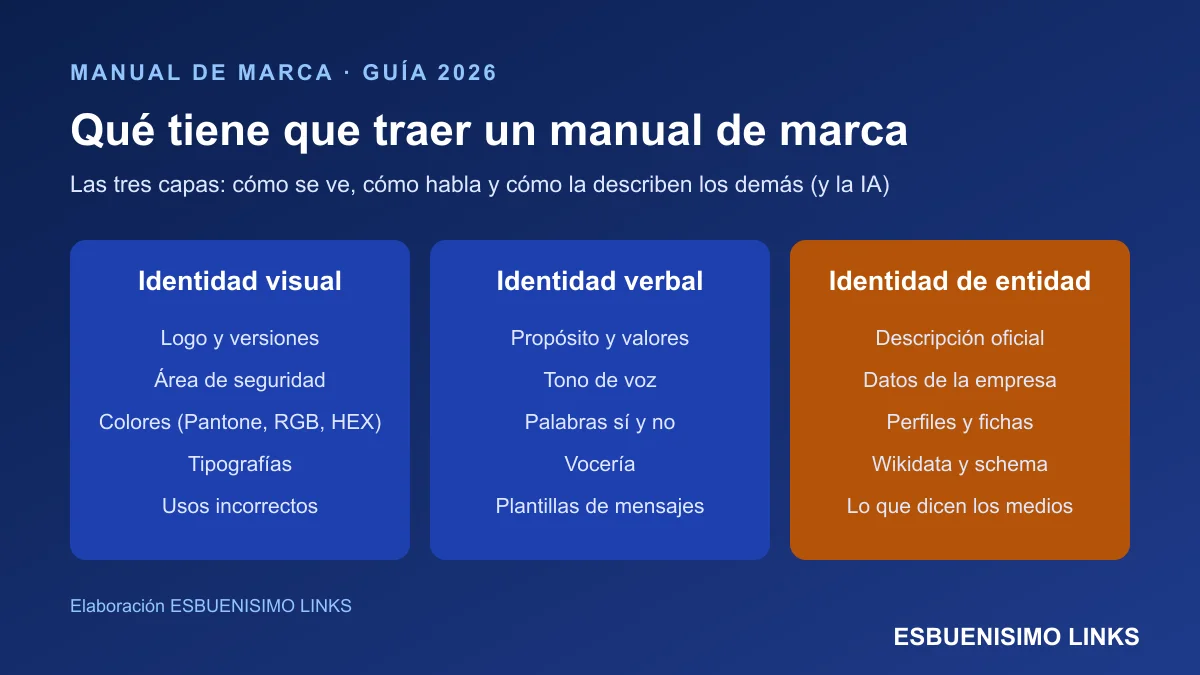
Brand guidelines are the document that stops every team, agency or supplier from using the brand their own way. They define how the brand looks, how it speaks and what is never done with it. Until recently that was enough. In 2026 there is a new reader that also builds an image of the brand: artificial intelligence, which describes it using what it finds on the website, on Wikipedia and in the media. This guide explains what brand guidelines are, what they should include, reviews real public examples and proposes the layer almost no manual has yet.
What brand guidelines are and what they are for
They are a usage guide for inside and outside the company. Inside, because they align marketing, sales and communications; outside, because they go to agencies, printers, media and partners who publish the brand. The goal is consistency: a logo, colors and tone that are recognizable on a billboard, an Instagram post or an email.
Do not confuse them with a visual style guide, which covers design only. Complete brand guidelines also include verbal identity: purpose, values, tone of voice and spokesperson rules. If you have not yet defined how your brand speaks, start with our guide on how to define a brand's tone of voice.
What brand guidelines include: the Marca Chile example
The best public example in Chile is the Marca Chile brand manual, published by Fundación Imagen de Chile in April 2024. It runs 44 pages, starting with the brand story («We Care») and going down to exact measurements in pixels and millimeters.
View the data as a table
| pages in the Marca Chile manual (April 2024 version) | 44 |
| type variants across Montserrat (15) and Chilena (24) | 39 |
| colors in the palette, each with Pantone, CMYK, RGB and HEX | 4 |
| incorrect logo uses, numbered and illustrated | 11 |
| Section | What it defines | Example in the Marca Chile manual |
|---|---|---|
| Story and purpose | What the brand is and which values it stands for | «We Care» and three pillars: democracy, diversity and sustainability |
| Logo and versions | Primary, secondary, negative and single-color versions | Vertical and horizontal logo, outline, on black and on red |
| Clear space and sizes | Free space around it and minimum size | Protection equal to the height of the «C»; 32 and 16 px favicon |
| Colors | Palette with Pantone, CMYK, RGB and HEX codes | Red Pantone 185 C (#e40e36), black, gray and blue |
| Typefaces | Families and weights for headlines and text | Montserrat (15 variants) and Chilena (24 variants) |
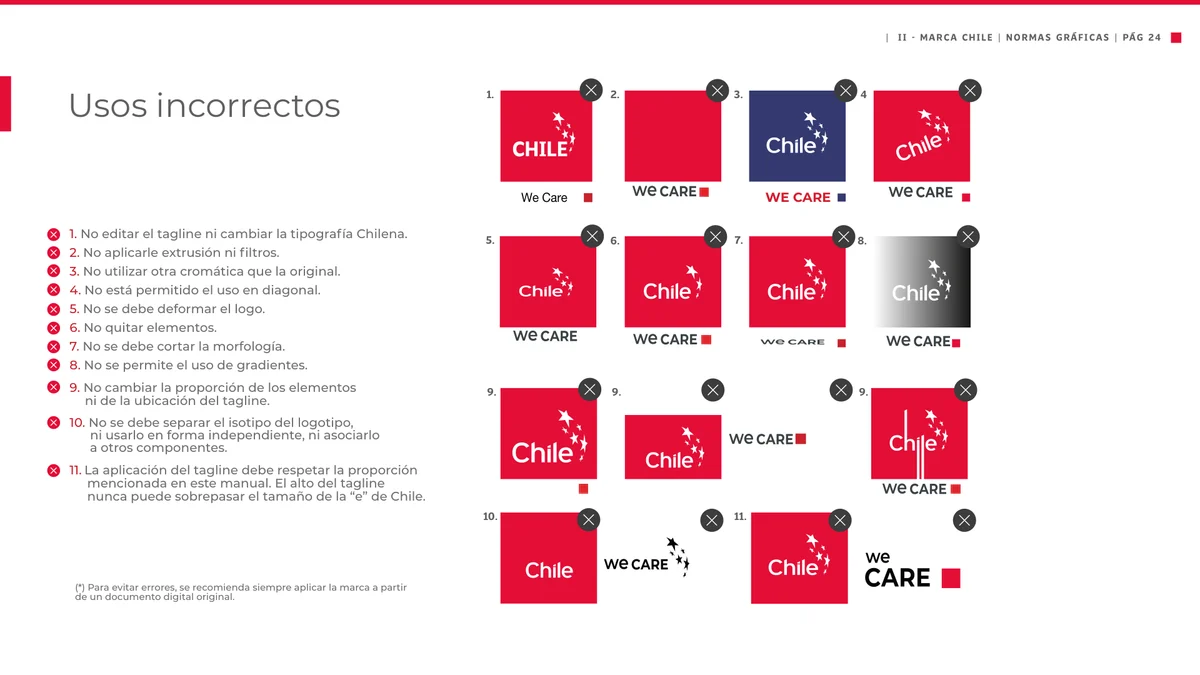
| Incorrect uses | What you never do with the brand | 11 rules: do not distort, no gradients, do not split the symbol… |
| Applications | How it looks on each medium | Web, Instagram, video pieces and email |
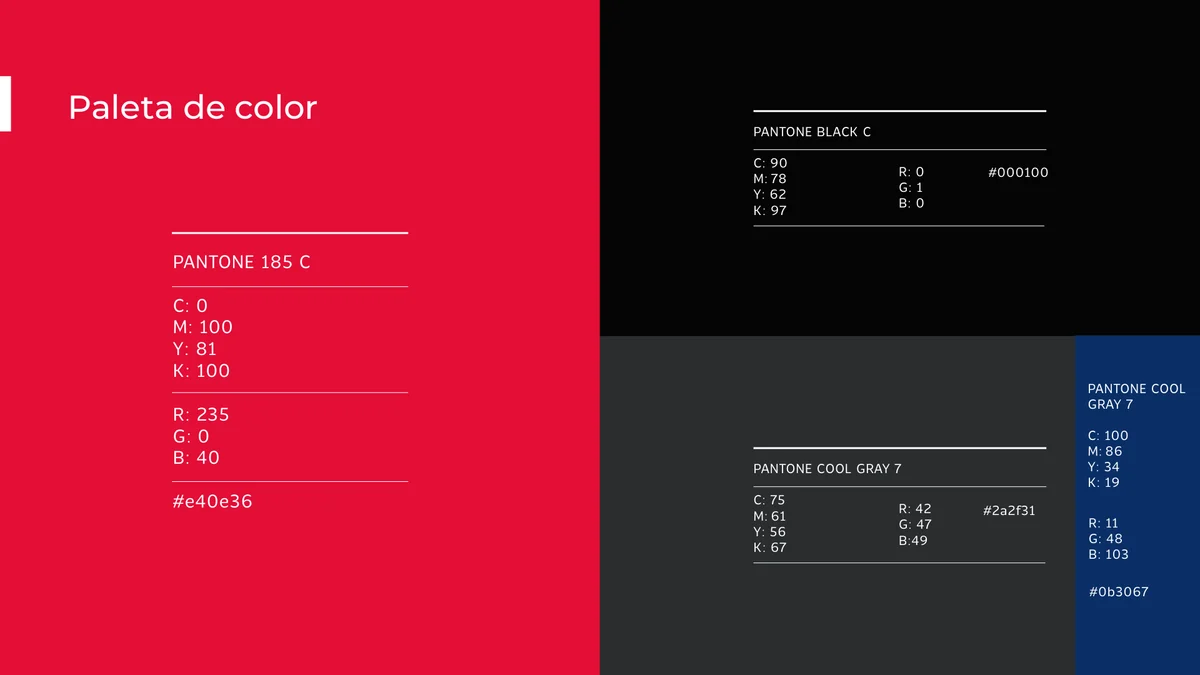
Two details show why this manual is useful. The first is precision: the main red is not just «red», it is Pantone 185 C, RGB 235-0-40 and HEX #e40e36, so the printer and the web developer reach the same color. The second is the incorrect uses page, with 11 numbered, illustrated rules: do not distort the logo, no gradients, do not change the tagline typeface, do not split the symbol from the name. It is the page that prevents the most mistakes, because it shows what not to do instead of describing it.
🚀 Digital PR & Link Building
Rank #1 on Google and Get Mentioned by AI
1,400+ media outlets in 8 countries. Backlinks that Google and ChatGPT recognize as trusted authority sources.
See plans and pricing →Four public examples worth reviewing
Many organizations publish their guidelines online, and reviewing them saves weeks when building your own. Each one gets a different part right:
| Marca Chile brand manual | Fundación Imagen de Chile | Logo, typefaces, palette, minimum sizes, incorrect uses, web, social and video | Numbered rules and exact measurements |
| Content Style Guide | Mailchimp | Voice and tone, grammar, social, accessibility, translation, word list | Verbal identity written as rules |
| Kit Digital | Government of Chile | Graphic standards and logos, typeface, social media manual, web templates | One place to download everything |
| Design Guidelines | Spotify (for developers) | Logo and misuse, colors, attribution, linking and app naming | Rules so others use the brand correctly |
Mailchimp's Content Style Guide is the benchmark for verbal identity: it describes its voice in four lines («We are plainspoken», «We are genuine», «We are translators», «Our humor is dry») and sums up the key distinction in one sentence: you have the same voice all the time, but your tone changes. The Chilean Government's Kit Digital, by contrast, shows how to distribute guidelines: graphic standards, typeface, a social media manual and web templates on a single download site.
The missing layer: describing the brand so AI gets it right
Traditional guidelines control what the brand publishes. They do not control what others say about it, and that is exactly what ChatGPT, Gemini or Perplexity read when someone asks «which company do you recommend for…» or «what is this brand». If the website says one thing, LinkedIn another and an old press story a third, AI blends all three. That is why we recommend adding an entity identity section: an official one-line description, the company's hard facts and the list of places where that description must be repeated unchanged.
| Where | What to include | Why it matters for AI |
|---|---|---|
| Website (About us) | The official one-line description, identical everywhere | It is the primary source AI search engines read first |
| Structured data | Organization schema with name, logo, founders and profiles (sameAs) | Tells Google which profiles belong to the same entity |
| Wikidata and Wikipedia | An entry with verifiable data and sources, if the brand meets the criteria | They feed the Knowledge Graph and model training |
| Profiles and listings | LinkedIn, Google Business Profile, industry directories | They repeat the same facts and avoid contradictions |
| Media | Stories and interviews that describe the brand with its key terms | They are among the outside sources ChatGPT, Gemini and Perplexity cite most |
Wikidata is the least known piece on that list: an open database, edited by volunteers, that feeds Wikipedia and many systems that need structured data about organizations. We explain when a brand can be there and why it weighs on AI answers in Wikipedia, ChatGPT and your brand entity.
The last row of the table moves the needle most and depends least on the company itself: real outlets describing the brand in their own words. That is where stories and sponsored articles with links in Chilean media come in, adding authority on Google while giving AI outside sources to describe the brand the way the guidelines intend. Measuring and correcting how assistants name you is the job of a brand visibility in AI plan.
How to create brand guidelines in 6 steps
- Write the story first. Purpose, values and an official one-line description. Everything else follows from it; we cover it in our branding guide.
- Set the logo and its versions, with clear space and minimum sizes for print and digital.
- Define the palette with Pantone, CMYK, RGB and HEX codes, and the typefaces with their weights.
- Write the verbal identity: tone, words to use and avoid, and who may speak for the brand.
- Show incorrect uses with visual examples, as Marca Chile does.
- Add the entity identity and review it every six months: when an executive, an address or a service changes, AI takes a while to notice if nobody updates the sources.
One decision many guidelines skip is ownership. Someone in marketing or communications must approve changes, answer questions from agencies and suppliers and keep a single current version, with a date and version number on the cover, as Marca Chile does with its «V.01, April 2024». Without an owner, in two years three different manuals coexist and nobody knows which one rules.
Brand guidelines are not a PDF to file away: they only work if they are applied the same way on every channel, including the ones the company does not control directly.
Frequently Asked Questions
What are brand guidelines?+
Brand guidelines are the document with the rules for using a brand consistently: logo and its versions, colors, typefaces, tone of voice, incorrect uses and examples on web, social, print and video.
What should brand guidelines include?+
At minimum: purpose and values, the logo with its versions and clear space, the color palette with codes, typefaces, incorrect uses and application examples. The most complete ones add tone of voice, spokesperson rules and an official company description.
What is the difference between brand guidelines and a style guide?+
A visual style guide covers only design: logo, colors and typefaces. Brand guidelines are broader and also define how the brand speaks, its values and its story. Many companies also keep a separate content style guide, like Mailchimp's.
How long should brand guidelines be?+
It depends on the organization. Chile's 2024 country brand manual runs 44 pages; a small business can start with 10 to 15 well-made pages and expand when new formats appear.
Do brand guidelines help you show up in ChatGPT?+
Indirectly. AI does not read the PDF, but it does read the website, structured data, Wikidata and press coverage. If the guidelines set an official description and that same description appears in all those places, AI has less room to get it wrong.
Ready to rank #1 and get mentioned by AI?
Digital PR & Link Building in 1,400+ media outlets across 8 countries. Google and ChatGPT recognize you as an authority source.
See plans and pricing