By Felipe Morales, CEO of ESBUENISIMO LINKS
Media plan: what it is, how to build one step by step and how Chile invests in 2026
Media plan guide: what it is, how to develop a media plan in 6 steps, the PESO model and how ad spend splits in Chile (54% digital in 2025, AAM).
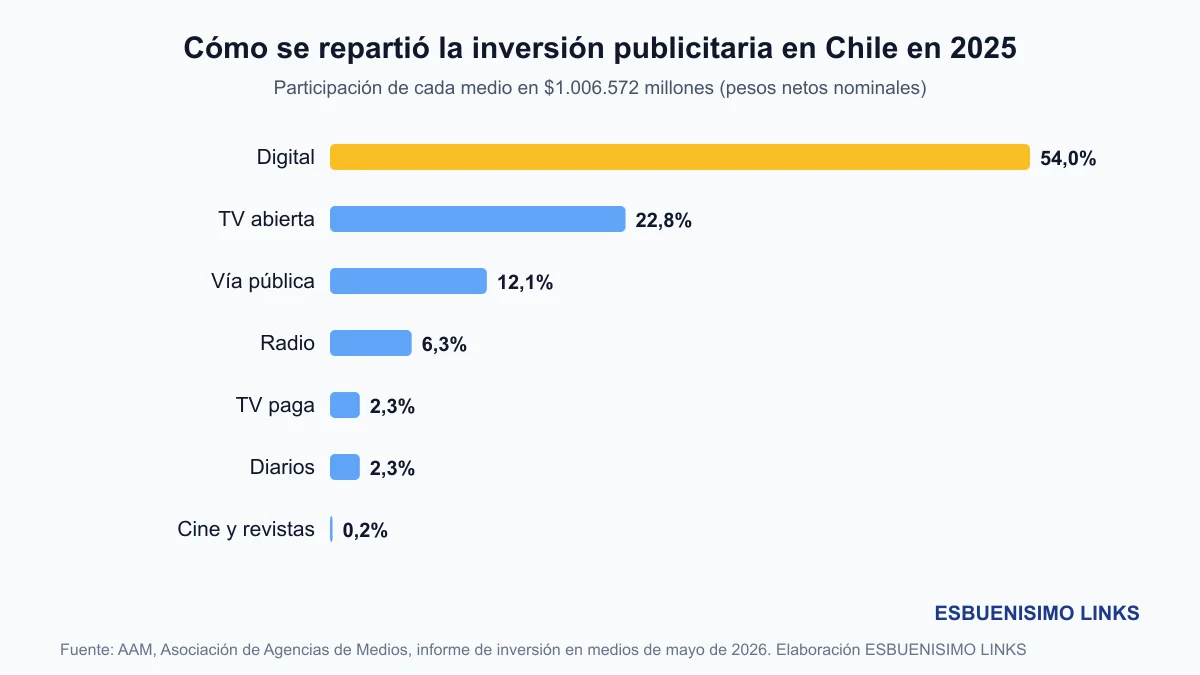
A media plan answers a simple question that is expensive to get wrong: where the brand will appear, when and with how much money. In Chile that question moves more than a trillion pesos a year: CLP 1,006,572 million in media advertising in 2025, according to the Chilean Association of Media Agencies (AAM). This guide explains what a media plan is, how to build one step by step, how ad spend is being split in 2026 and why a good plan no longer stops at buying ads.
View the data as a table
| million pesos spent on media advertising in 2025 | 1,006,572 |
| of that spend went to digital | 54% |
| of Chileans get news on social media (2026) | 59% |
| already use an AI chatbot for news each week | 7% |
What a media plan is
A media plan turns a marketing or communication goal into concrete channels. It defines five things: who you want to reach, in which media, with what message and format, on which dates and with what budget, plus how each part will be measured. Media agencies use it to buy ad space, but communication teams also use it to plan press, and SEO teams use it to decide where to earn links.
It should not be confused with a communication plan. A communication plan defines what the company wants to say and why; the media plan defines where it will say it. Message first, channel second, never the other way around.
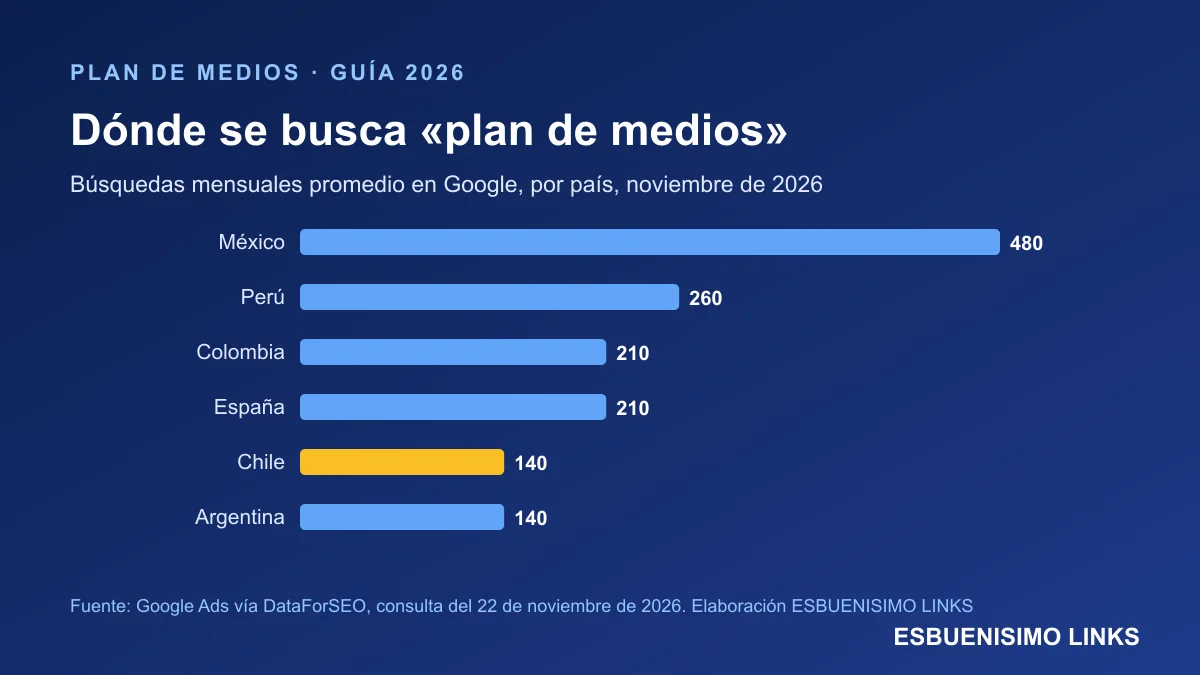
In Spanish-speaking markets the topic draws steady interest. According to Google Ads, "plan de medios" is searched about 480 times a month in Mexico, 260 in Peru, 210 in Colombia and 140 in Chile and Argentina, while "media plan" gets about 1,600 monthly searches in the United States, with a cost per click above US$36, a sign of how much advertisers value the people who search for it. Behind those searches are mostly marketing managers, communication leads and small business owners who need to justify a budget, rather than students looking for a definition.
View the data as a table
| Mexico | 480 |
| Peru | 260 |
| Colombia | 210 |
| Chile | 140 |
| Argentina | 140 |
How media spend is split in Chile
Before building a media plan, it helps to look at how the market invests. The AAM series, which starts in 2014, shows an almost complete shift to digital: in 2014 digital had 12.4% of the pie; in 2025 it had 54%. Newspapers fell from 20.3% to 2.3%, and out of home, driven by digital screens and programmatic buying, is the fastest-growing traditional medium (+15.6% in 2025).
| Medium | 2025 spend (CLP million) | 2025 share | 2014 share | Change vs. 2024 |
|---|---|---|---|---|
| Digital | 543,669 | 54.0% | 12.4% | +6.4% |
| Broadcast TV | 229,782 | 22.8% | 36.9% | +0.7% |
| Out of home | 121,393 | 12.1% | 10.3% | +15.6% |
| Radio | 63,784 | 6.3% | 7.7% | -0.8% |
| Pay TV | 23,043 | 2.3% | 9.7% | -24.9% |
| Newspapers | 22,892 | 2.3% | 20.3% | -11.7% |
| Cinema | 1,478 | 0.1% | 0.3% | -13.5% |
| Magazines | 532 | 0.1% | 2.4% | -27.2% |
The trend continues in 2026: from January to September digital took 55.8% of spend, and the AAM projects CLP 1,066,486 million for the full year. We analyze the full series in our piece on advertising spend in Chile in 2026. For a media plan, the practical takeaway is that competition for digital attention gets more intense every year, which is why it gets more expensive.
🚀 Digital PR & Link Building
Rank #1 on Google and Get Mentioned by AI
1,400+ media outlets in 8 countries. Backlinks that Google and ChatGPT recognize as trusted authority sources.
See plans and pricing →Where the audience is
Spend shows where brands put their money; audience surveys show where people are. The Reuters Institute Digital News Report 2026 sums it up for Chile: social media now beats television as a news source, and print newspapers are at a record low.
| News source in the last week | 2017 | 2026 | Change |
|---|---|---|---|
| Any online source | 93% | 76% | -17 points |
| Television | 80% | 54% | -26 points |
| Social media | 76% | 59% | -17 points |
| Print newspapers | 46% | 11% | -35 points |
Two more findings from the same study matter for planning. First, trust: only 34% of Chileans trust most news, but some brands, such as Bío Bío (65%) or CNN Chile (64%), score far higher. Second, artificial intelligence: 7% already use an AI chatbot for news every week, 3 points more than in 2025. The outlet-by-outlet detail is in our analysis of Chile's news media, trust and reach.
How to develop a media plan step by step
- Set a measurable goal. "Build awareness" is not enough; "raise Google brand searches by 20% in six months" is. The goal decides which media fit.
- Describe the audience. Age, region, interests and, above all, which media they consume and when. Audience data from Reuters, IAB or the outlets themselves helps.
- Choose the media mix. This is where the PESO model comes in: paid, earned, shared and owned. Each family does a different job.
- Split the budget. With a clear rule: how much goes to immediate reach (ads) and how much to assets that last (content, press, links).
- Build the calendar. Retail dates, launches, industry seasons and production time for each piece.
- Set KPIs per channel before launch, and review them monthly. A plan that is not measured cannot be corrected.
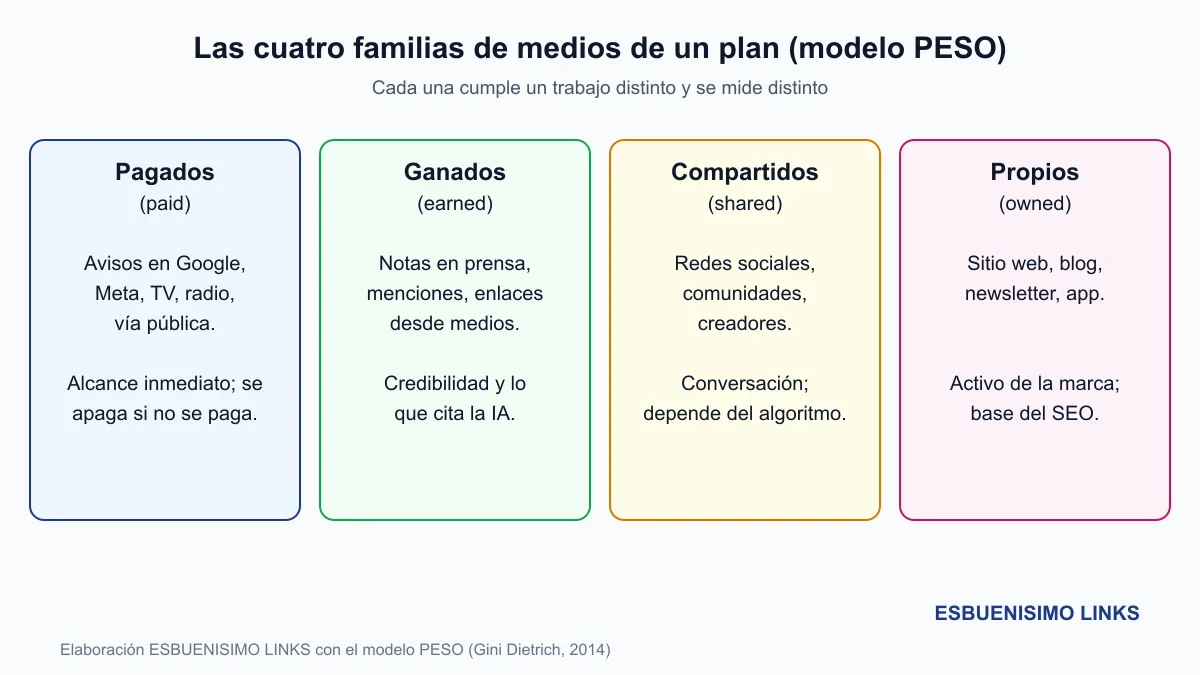
Paid, earned, shared and owned media in a media plan
Most media plans are still built only with paid media, because it is the easiest to buy and measure. The problem is that its effect ends the day the budget runs out. Earned media works differently: a story in a newspaper or a specialist site stays published, keeps sending readers and, if it includes a link, keeps adding authority for Google.
| Media type | What the plan buys | Main KPI | What remains after the campaign |
|---|---|---|---|
| Paid (Google, Meta, TV, radio) | Impressions and clicks | Reach, CPM, CPC, attributed sales | Nothing: traffic stops when you stop paying |
| Earned (press, mentions, links) | Stories and sponsored articles in real outlets | Outlets secured, authority, links, AI citations | Stories and their links stay published |
| Shared (social, creators) | Conversation and community | Engagement, organic reach | Followers, as long as the algorithm allows |
| Owned (website, blog, newsletter) | Brand content | Organic traffic, subscribers, conversions | An asset that grows with every piece |
In 2026 earned media also plays a new role: it is what ChatGPT, Gemini and Perplexity cite most when someone asks about an industry or a brand. That is why the media plan should include a press and links line, not as an extra, but with its own budget and KPIs. That can be done with an in-house press team, a press agency or a link building service that publishes stories with links in Chilean and Latin American outlets.
Common planning mistakes
- Choosing media out of habit rather than audience. A medium that worked five years ago says nothing about today: print newspapers lost 35 points of reach since 2017.
- Measuring everything the same way. An ad is measured by clicks and sales; a press story, by the outlet secured, the link and its effect on brand searches.
- Ignoring timing. Press and SEO take weeks or months to pay off. If they enter at the end of the plan, they do not have time to perform.
- Leaving nothing owned. A plan that only buys ads leaves the brand exactly where it was when the campaign ends.
Looking ahead to 2027
With digital above 55% of spend and AI starting to answer questions that used to go to Google, the 2027 media plan has to cover three fronts: ads for demand that already exists, owned content to be found and presence in real outlets to earn authority and be cited. At ESBUENISIMO LINKS we work on that third front with more than 1,400 Latin American outlets, and we measure its effect on Google and AI.
Frequently Asked Questions
What is a media plan?+
It is the document that defines where a brand will appear, with what message, when, with what budget and how results will be measured. It turns marketing or communication goals into a concrete list of channels and dates.
How do you develop a media plan?+
Start with the objective and the audience, check where that audience spends its attention, choose the media (paid, earned, shared and owned), split the budget, build the calendar and set the KPIs for each channel before launch.
What are the four types of media in a media plan?+
Planners use the PESO model: paid media (ads), earned media (press and mentions), shared media (social) and owned media (website, blog and newsletter). A good plan combines all four.
What is the difference between a media plan and a communication plan?+
The communication plan defines what you want to say, to whom and why. The media plan defines where and when you will say it, and how much you will invest in each channel. The second depends on the first.
How much is spent on media advertising in Chile?+
According to the AAM, media advertising in Chile reached CLP 1.007 trillion in 2025, with 54% going to digital. The AAM projects CLP 1.066 trillion for 2026.
Ready to rank #1 and get mentioned by AI?
Digital PR & Link Building in 1,400+ media outlets across 8 countries. Google and ChatGPT recognize you as an authority source.
See plans and pricing