By Felipe Morales, CEO of ESBUENISIMO LINKS
Brand positioning: what it is, types and how to measure it on Google and in AI
Brand positioning: what it is, the 7 types, how to measure it with share of search and AI share of voice, and a 5-step strategy with data from Chile in 2026.
Brand positioning is the place a brand holds in customers' minds compared with its competitors: the idea that comes up when someone thinks about a category. Volvo means safety; IKEA means good design at a low price. For decades it was built with advertising and press coverage. Today there is one more place where it is decided: the answer Google or an AI tool gives when someone asks "which brand should I choose?".
This guide explains what brand positioning is, its types, how to measure it with data and why media mentions matter more and more, using our own figures from Chile measured in November 2026.
What brand positioning is
Al Ries and Jack Trout popularized the concept in their book Positioning: The Battle for Your Mind (1981): positioning is not what a company does to its product, but what it manages to place in the customer's mind. A well-positioned brand has three things: a clear category (where it competes), a credible difference (why choose it) and consistency (it says the same thing on every channel for years).
Interest in the topic is high across Latin America. On Google, the exact Spanish phrase "posicionamiento de marca" gets 1,000 searches a month in Mexico, 720 in Peru, 480 in Colombia, 210 in Chile and 170 in Argentina, according to Google Ads data queried on November 10, 2026. In the United States, "brand positioning" gets 1,900.
View the data as a table
| Mexico | 1,000 |
| Peru | 720 |
| Colombia | 480 |
| Chile | 210 |
| Argentina | 170 |
The seven types of positioning
There are several ways to own a place in the customer's mind. Most brands combine two, but one should lead.
| Type | What it relies on | Well-known example |
|---|---|---|
| Attribute | A product feature | Volvo and safety |
| Price and value | Paying less or getting more for the same | IKEA: design at a low price |
| Quality or luxury | Exclusivity and a high standard | Rolex |
| Use or occasion | A specific consumption moment | Sports drinks and exercise |
| User | A type of customer | Youth clothing brands |
| Values | A cause or purpose | Patagonia and the environment |
| Against the competition | Being the alternative to the leader | The challenger in a category |
The type depends on where the open space is. If the leader is already "the cheapest", competing on price is expensive; there may be room in service, specialization or a type of customer nobody serves well.
🚀 Digital PR & Link Building
Rank #1 on Google and Get Mentioned by AI
1,400+ media outlets in 8 countries. Backlinks that Google and ChatGPT recognize as trusted authority sources.
See plans and pricing →How to measure brand positioning with data
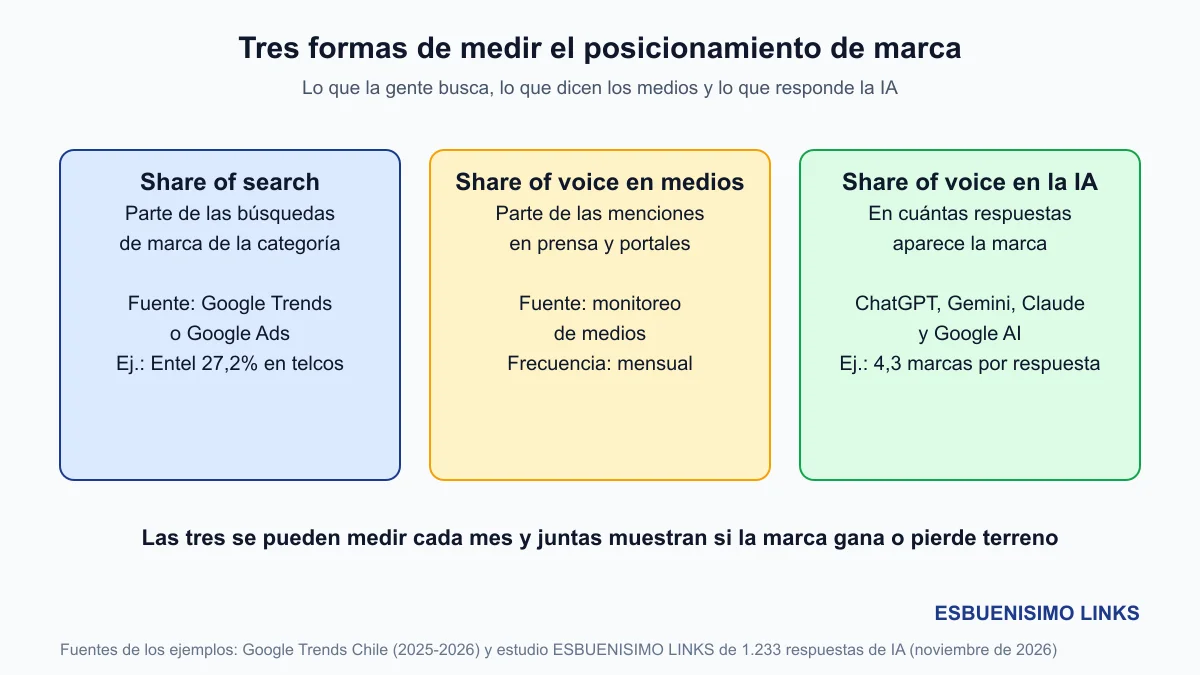
Positioning can be felt, but it can also be measured. These are the metrics we use with brands in Chile, from the cheapest to the most complete:
| Metric | What it measures | How to get it | Suggested frequency |
|---|---|---|---|
| Share of search | Share of the category's brand searches | Google Trends or Google Ads volumes | Monthly |
| Media share of voice | Share of mentions in news sites and portals | Media monitoring | Monthly |
| AI share of voice | How many AI answers mention the brand | Purchase questions to ChatGPT, Gemini, Claude and Google | Monthly |
| Unaided recall | Which brands people name without help | Surveys | Every six or twelve months |
| Associated attributes | Which ideas are linked to the brand | Surveys and review analysis | Yearly |
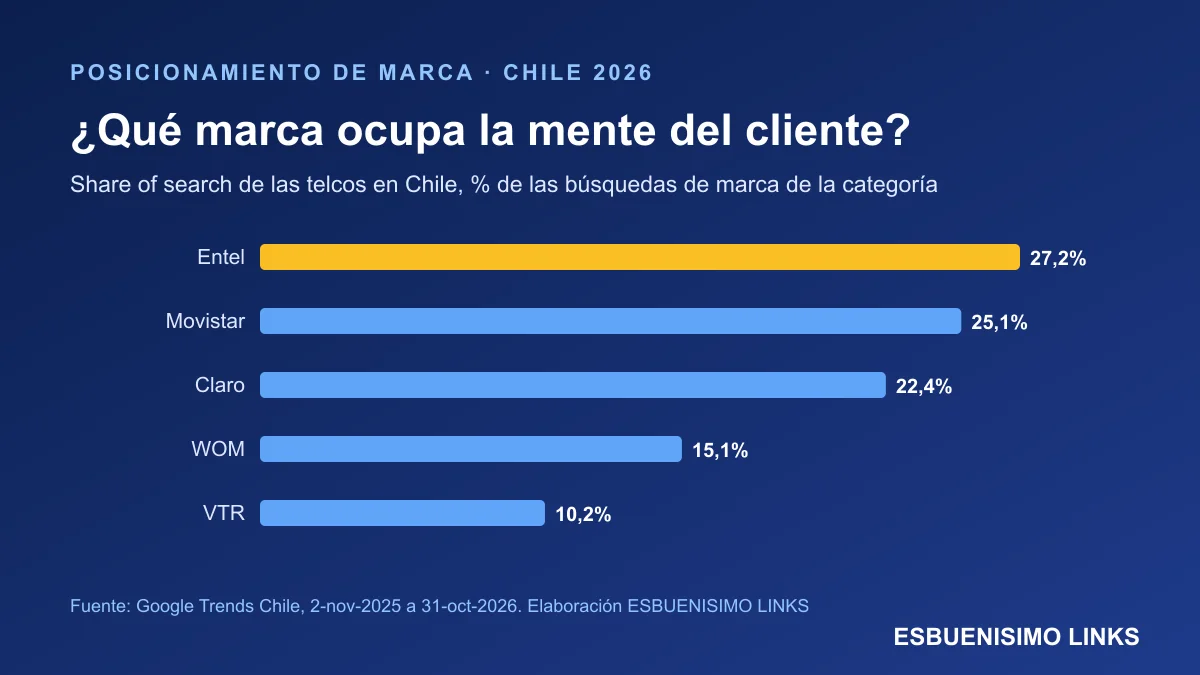
Share of search is the fastest starting point. Les Binet presented it at the IPA's EffWorks conference in October 2020 and showed it correlates with market share in cars, energy and mobile phones, according to the IPA's official summary. We measured it in Chile: among telecom companies, Entel has 27.2% of brand searches, closely followed by Movistar (25.1%) and Claro (22.4%). The full method is in our study on share of search for Chile's most searched brands.
Brand positioning on Google and in AI
When someone asks an AI tool to recommend a bank or a store, a brand that is missing from the answer is simply out of the conversation. In our study of 1,233 answers from six AI tools in Chile, each answer named an average of 4.3 brands from the industry; 8.4% named none. Models differ a lot: Gemini names 5.24 brands per answer and Claude 3.51. The details are in our study on how many brands AI recommends.
What AI says about a brand does not come from advertising: it comes from the sources it reads. Google explains this in its documentation on AI features in Search: answers are built from indexed pages and link to them. In our industry studies, more than half of the citations went to third-party sites (media, comparison sites and portals), not to the brands' own sites. That is why brand positioning is increasingly built with media mentions that AI reads and cites.
A concrete example: in 80 answers from ChatGPT and Google AI Mode about where to shop in Chile, Falabella appeared in 51, as shown in our ranking of the stores ChatGPT recommends in Chile. That is positioning: the brand people and machines associate with the category.
View the data as a table
| brands named on average in each AI answer in Chile | 4.3 |
| of answers named no brand from the industry | 8.4% |
| of answers named five brands or more | 46.6% |
| out of 80 online shopping answers name Falabella | 51 |
A strategy in five steps
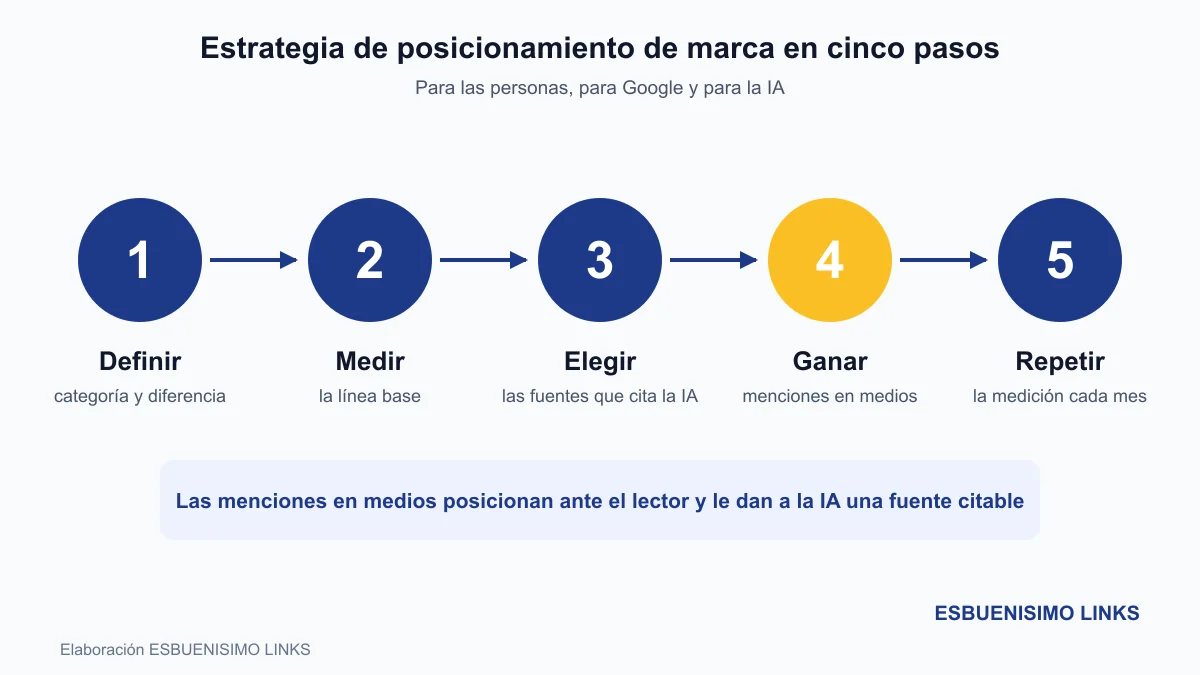
A brand positioning strategy that works in 2026 has to think about people, Google and AI at the same time:
- Define the category and the difference. One sentence saying where the brand competes and why to choose it. If it does not fit in one line, it is not clear yet.
- Measure the starting point. Share of search, media mentions and presence in 30 to 50 purchase questions on ChatGPT, Gemini and Google. Without a baseline there is no way to know if you are moving.
- Pick the sources that matter. Check which media, comparison sites and portals Google and AI cite in the category. Those are the places the brand needs to be.
- Earn mentions with real content. Proprietary data, executive opinions and sponsored articles in media with readers. Mentions in Chilean media with a link do two jobs: they position the brand with readers and give Google and AI a source they can cite.
- Measure again every month. Positioning changes slowly, but it changes. What is not measured gets lost in the routine.
If the brand already has a good name in the media but does not show up in AI answers, the problem is usually technical or about sources. That is the job of a GEO agency, which measures presence in each AI tool and works on the sources that feed it.
Common mistakes when positioning a brand
- Trying to be everything to everyone. A brand that promises price, luxury and service at once ends up associated with nothing.
- Changing the message every campaign. Positioning is built through years of repetition, not with new slogans every quarter.
- Measuring only paid advertising. An ad's reach ends when the campaign stops; an article in a media outlet stays indexed and citable.
- Ignoring what AI says. Many brands do not know whether ChatGPT recommends them, confuses them with another company or recommends the competition.
In short, brand positioning is still a simple idea, owning a clear place in the customer's mind, but today that place is also on Google and in AI answers. Measuring it every month and earning mentions in the right sources is what separates the brands that show up from the ones that do not.
Frequently Asked Questions
What is brand positioning?+
It is the place a brand holds in customers' minds compared with competitors: the idea that comes up when someone thinks about the category, like Volvo and safety. It is built with a clear category, a credible difference and consistency over time.
What are the types of brand positioning?+
The most common are attribute, price and value, quality or luxury, use or occasion, type of user, values and against the competition. Most brands combine two, with one leading.
How do you measure brand positioning?+
With share of search (share of the category's brand searches), media share of voice, AI share of voice, unaided recall surveys and analysis of associated attributes. The first three can be measured monthly.
How does AI affect brand positioning?+
ChatGPT, Gemini and Google answer with specific brands: in Chile they name 4.3 per answer on average, according to an ESBUENISIMO LINKS study from November 2026. A brand that does not appear is left out of the decision, and what AI says comes from the sources it reads, mainly media and comparison sites.
How can a brand improve its positioning?+
Define a clear difference, measure the baseline, identify which media and portals Google and AI cite in the category, earn mentions in those sources with real content and measure again every month.
Ready to rank #1 and get mentioned by AI?
Digital PR & Link Building in 1,400+ media outlets across 8 countries. Google and ChatGPT recognize you as an authority source.
See plans and pricing