By Felipe Morales, CEO of ESBUENISIMO LINKS
Communication plan: what it is, its 10 parts and a step-by-step example (2026)
Communication plan explained: what it is, its 10 parts, a 12-month example calendar, how to measure it and why in 2026 it must include what AI says about you.
A communication plan is the document that sets out what an organization will say, to whom, through which channels, when, and how it will measure whether it worked. It sounds obvious, but many companies communicate on demand: a press release when there is a launch, an interview when a journalist calls, a rushed statement when a crisis breaks. The plan turns that string of reactions into a strategy.
In this guide we explain the ten parts of a communication plan, give an example with timelines and add something most templates still leave out: what artificial intelligence answers when someone asks about your brand.
| Country | “plan de comunicación” (communication plan) | “… interna” (internal) | “… ejemplo” (example) |
|---|---|---|---|
| Mexico | 480 | 70 | 90 |
| Peru | 320 | not measured | not measured |
| Colombia | 260 | 30 | 20 |
| Chile | 110 | 20 | 20 |
| Argentina | 110 | not measured | not measured |
| Spain | 480 | not measured | not measured |
View the data as a table
| Mexico | 480 |
| Peru | 320 |
| Colombia | 260 |
| Chile | 110 |
| Argentina | 110 |
What a communication plan is and what it is for
A communication plan translates business goals into communication goals. If the company wants to enter a new market, the plan defines how to become known there; if it wants to attract talent, how to explain why it is worth working there. It can be external (customers, press, authorities), internal (employees) or both. What matters is that it has an owner, deadlines and a way to measure. In a mid-sized company, the plan usually sits with the communications or marketing department, with the CEO as main spokesperson and an annual budget approved by the board. A good plan fits in ten to fifteen pages: if it needs a hundred, nobody will read it. It should also be reviewed at least once a year, or whenever the business changes direction.
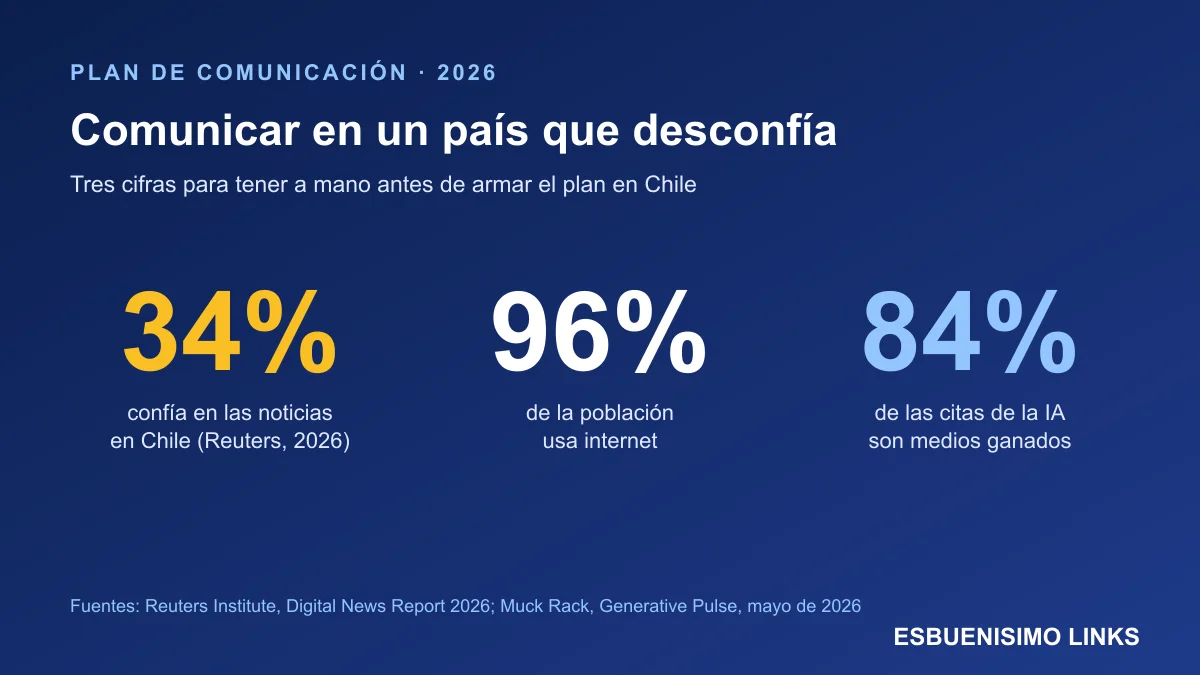
One piece of context is worth keeping in mind in Chile. According to the Reuters Institute Digital News Report 2026, only 34% of Chileans trust the news, two points less than the year before. With low trust, the message needs proof: data, cases, credible spokespeople and a presence in outlets the public actually respects.
View the data as a table
| trust the news in Chile (−2 points in a year) | 34% |
| of Chile's population uses the internet | 96% |
| of AI citations come from earned media | 84% |
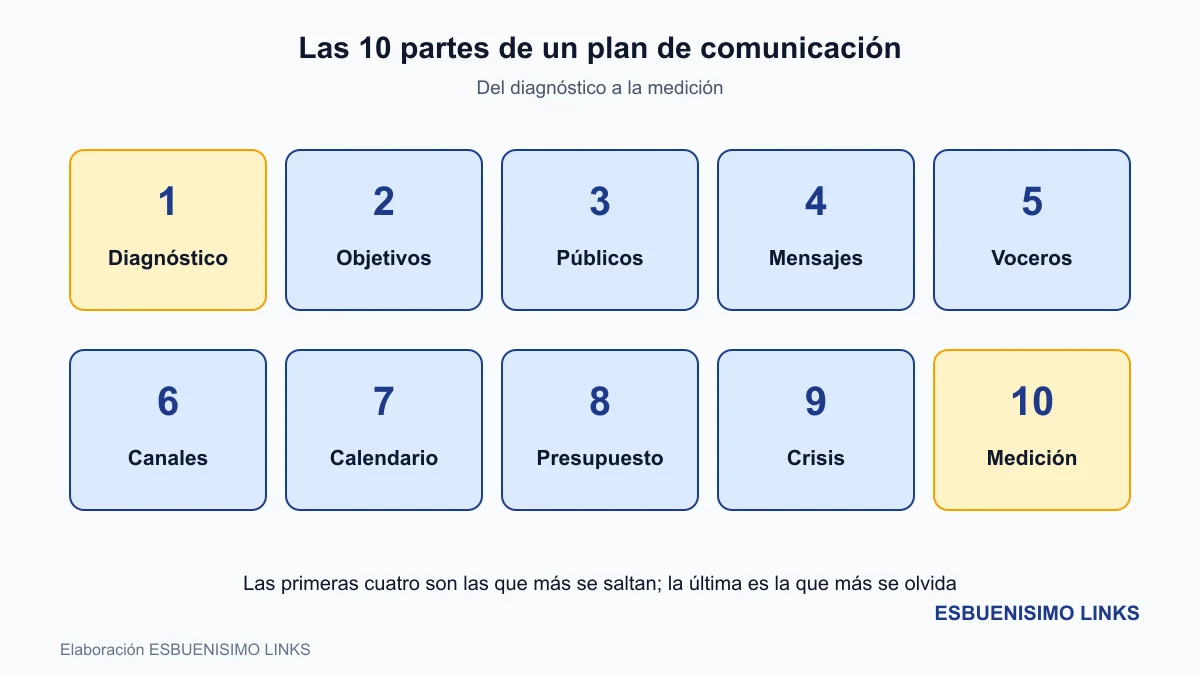
The 10 parts of a communication plan
| Part of the plan | What it answers | Example |
|---|---|---|
| 1. Diagnosis | Where are we? | The brand appears in 4 stories a year and ChatGPT does not name it in its industry |
| 2. Goals | What do we want to achieve? | 12 stories in industry media in 12 months |
| 3. Audiences | Who are we talking to? | Customers, journalists, employees, authorities |
| 4. Messages | What do we say? | One core message and three proof points |
| 5. Spokespeople | Who says it? | CEO and sales director |
| 6. Channels | Where? | Press, website, LinkedIn, newsletter |
| 7. Calendar | When? | One press action a month |
| 8. Budget | With what resources? | In-house team, agency, media |
| 9. Crisis | What if something goes wrong? | Protocol, spokespeople and holding statements |
| 10. Measurement | How will we know it worked? | Stories, links, brand searches, AI mentions |
The first four are the ones most often skipped. Without a diagnosis, goals are made up; without defined audiences, messages become generic. A good exercise is to write the core message in one sentence and test whether a journalist would understand it without context.
A simple matrix helps organize audiences and messages: in the rows, each audience (customers, press, employees, authorities, investors); in the columns, what they need to know, which message they get, who delivers it and through which channel. If two audiences get exactly the same message through the same channel, the plan is probably too generic. If a key audience has no row, the plan has a blind spot. In regulated industries such as energy, health or financial services, the authorities row is usually the most neglected one, and the one that costs most in a crisis.
🚀 Digital PR & Link Building
Rank #1 on Google and Get Mentioned by AI
1,400+ media outlets in 8 countries. Backlinks that Google and ChatGPT recognize as trusted authority sources.
See plans and pricing →How to build a communication plan step by step
Here is a sample calendar for a mid-sized company starting from scratch. Timelines are indicative and depend on the size of the team. What matters is that each stage has an owner and a due date, and that the first measurement arrives before month three, so there is time to correct course. A plan that waits a full year for its first report usually discovers its mistakes too late.
- Month 1DiagnosisAudit of media, social, Google and what ChatGPT and Gemini say about the brand.
- Month 1Goals and audiencesThree measurable goals and an audience map with its message.
- Month 2Messages and spokespeopleCore message, proof points and trained spokespeople.
- Months 2 and 3First actionsA study or proprietary data, a press release, media stories and site content.
- Month 3First measurementStories published, links, brand searches and AI mentions.
- Months 4 to 12Monthly cycleCalendar, adjustments and a board report every quarter.
The step that pays off most is having something to say. A proprietary study, market data or an expert opinion backed by figures gives the journalist a reason to publish, and gives the brand content that keeps being cited for months. It is the foundation of good public relations: fewer press releases without news and more useful information.
In 2026, the diagnosis also includes AI
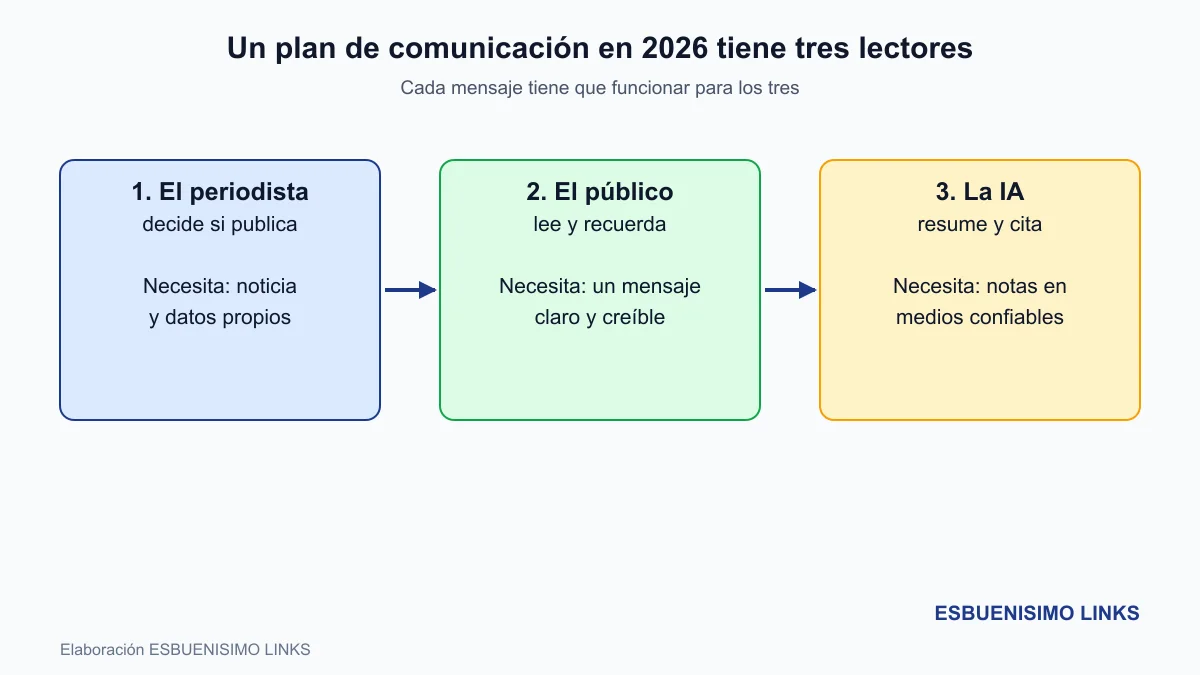
Until recently, the diagnosis in a communication plan covered press, social media and Google. Today you need to add one question: what does ChatGPT answer when someone asks about my brand or my industry? Those answers are built from what third parties publish. According to Muck Rack, 84% of ChatGPT, Claude and Gemini citations come from earned media and only 0.3% from paid content.
That changes two things in the plan. In channels, digital press becomes a priority again, because it is the source AI respects most. And in a crisis, the protocol must include checking what AI says in the hours that follow, because that answer can stay unchanged for weeks unless new stories appear to correct it, as we explain in our guide to crisis management in AI.
How to measure the results
The Barcelona Principles 3.0 from AMEC, the international association for the measurement of communication, call for measuring outcomes rather than activity, and reject advertising value equivalency as a measure of value. In practice, a plan can track these metrics:
| Metric | What it measures | Frequency |
|---|---|---|
| Stories published | Earned media coverage | Monthly |
| Media share of voice | Your presence vs. competitors | Monthly |
| Links from media | Authority for Google | Monthly |
| Brand searches | Whether more people know and search for you | Monthly |
| Mentions in ChatGPT and Gemini | Whether AI names you in your industry | Quarterly |
| Reputation survey | Perception among key audiences | Yearly |
The two metrics in the middle of the table connect communication with SEO: a linked story in an authoritative outlet helps Google trust the brand's site and also gives AI a source to cite. To report progress, follow the logic of a good press release in Chile: every action with a measurable result.
Common mistakes when building the plan
- Goals that cannot be measured, such as “improve our image”. Better: “appear in 12 industry stories and in ChatGPT's answers to three key questions”.
- A single channel. Relying only on social media leaves the brand out of Google and AI.
- No crisis protocol until the crisis arrives.
- Measuring only at year end, when there is no time left to correct course.
- Press releases with no news. If the text is useless to a journalist, it does not get published, and if it is not published, neither Google nor AI reads it.
At ESBUENISIMO LINKS we help execute the media side of the plan: our press agency earns coverage in Chilean and Latin American media, and with esbuenisimolinks.com/link-building-chile that coverage adds links that build authority on Google and in AI.
Frequently Asked Questions
What is a communication plan?+
It is the document that defines what an organization will communicate, to which audiences, through which channels, on what timeline and how it will measure results.
What are the parts of a communication plan?+
Diagnosis, goals, audiences, messages, spokespeople, channels, calendar, budget, crisis protocol and measurement.
Can you provide an example of a communications strategy?+
A mid-sized company can start with a one-month diagnosis, define three measurable goals, publish a proprietary study in month two or three, pitch it to industry media and measure stories, links, brand searches and AI mentions every month.
How do you measure a communication plan?+
With stories published, media share of voice, links from media, brand searches, mentions in ChatGPT and Gemini and reputation surveys. AMEC advises against advertising value equivalency.
Why include AI in a communication plan?+
Because more and more people ask ChatGPT or Gemini about brands and companies, and those answers are built from what the media publish. According to Muck Rack, 84% of AI citations come from earned media.
Ready to rank #1 and get mentioned by AI?
Digital PR & Link Building in 1,400+ media outlets across 8 countries. Google and ChatGPT recognize you as an authority source.
See plans and pricing