By Felipe Morales, CEO of ESBUENISIMO LINKS
Press kit: what it is, what to include and an example for companies (2026)
What a press kit is, how it differs from a media kit, the 10 elements it should include, how to build one step by step and why AI search engines and Google read it too.
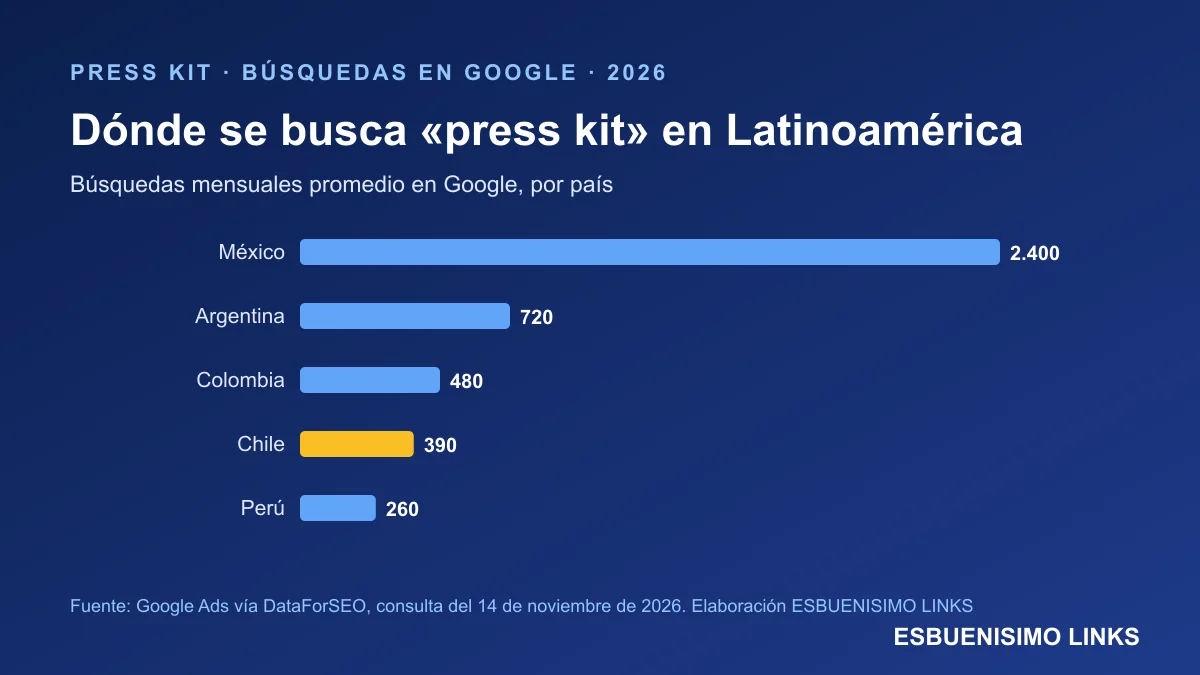
A press kit is the package a company prepares so a journalist can write about it without asking for anything else: the current press release, a company fact sheet, quotable figures, high-resolution photos, logos, spokesperson bios and a contact who actually replies. In Latin America, “press kit” is searched about 4,250 times a month on Google, and Mexico accounts for more than half; in the United States it gets 2,400 searches a month.
This guide explains what a press kit is, how it differs from a media kit and a press release, what it should include, how to build one step by step and why in 2026 it has a new reader: AI search engines that summarize what they find about a brand.
| Country | “press kit” | “media kit” | “sala de prensa” (newsroom) |
|---|---|---|---|
| Mexico | 2,400 | 1,000 | 590 |
| Argentina | 720 | 480 | 90 |
| Colombia | 480 | 480 | 170 |
| Chile | 390 | 170 | 260 |
| Peru | 260 | 320 | 70 |
View the data as a table
| Mexico | 2,400 |
| Argentina | 720 |
| Colombia | 480 |
| Chile | 390 |
| Peru | 260 |
What a press kit is and how it differs from a media kit
The press kit was born on paper: a folder with printed photos, a dossier and the release, handed out at press conferences. Today it is a web page or a shared folder, but the idea is the same. It saves work for journalists, who usually write against the clock, and gives the company some control over the facts that get published.
It is often confused with three other formats. The most common mix-up is the media kit, which gets 4,400 searches a month in the US and is something else entirely: the document an outlet or influencer uses to sell advertising, with audience data and rates. A press kit goes from the company to the journalist; a media kit goes from the outlet to the advertiser.
| Press kit | Press release | Media kit | Online newsroom | |
|---|---|---|---|---|
| What it is | A package with everything a journalist needs about the brand | A text announcing one specific news item | Rates and audience of a media outlet or creator, to sell ads | Website section that hosts the kit and releases |
| Who makes it | The company or its agency | The company or its agency | The outlet or the influencer | The company |
| Audience | Journalists and editors | Journalists and editors | Advertisers | Journalists, investors, search engines and AI |
| Lifespan | Updated every quarter | Valid while the news is news | Updated when rates change | Permanent |
The press release is one piece of the kit, not a substitute for it. We explain how to write one in our guide to the press release in Chile: the kit is what travels with that text so the story comes out complete and accurate.
What a press kit should include: the 10 elements
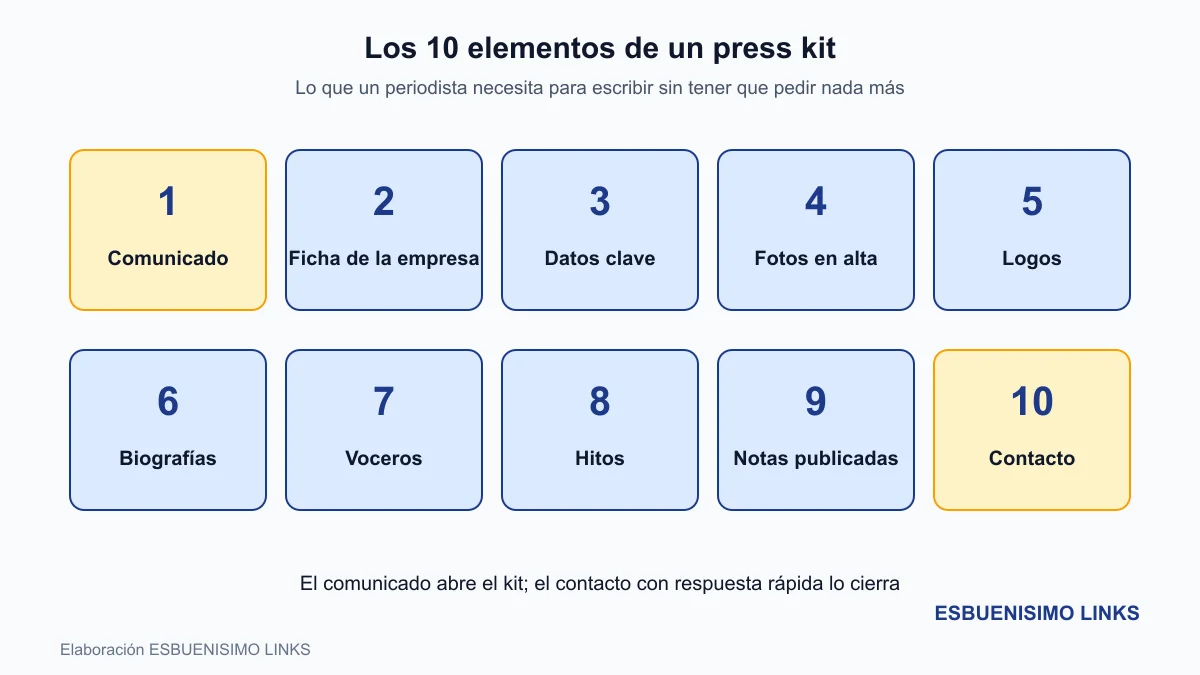
There is no single standard, but the kits journalists actually use share ten pieces. The practical rule: someone who has never heard of the company should be able to write an accurate story in an hour using only what is in the kit.
| # | Element | Why the journalist needs it | Recommended format |
|---|---|---|---|
| 1 | Current press release | The news behind the outreach | On-page text plus PDF |
| 2 | Company fact sheet | One-paragraph context: what, since when, where | 100 to 150 words |
| 3 | Key figures | Quotable numbers: customers, revenue, staff, countries | List with date and source |
| 4 | High-resolution photos | Illustrate the story without asking | JPG, 2,000 px or larger, with credit |
| 5 | Logos | Use the brand without distorting it | PNG and SVG, light and dark versions |
| 6 | Executive bios | Introduce the leadership | One paragraph and photo each |
| 7 | Available spokespeople | Know who to interview and on what | Name, title and topics |
| 8 | Milestones | Build the company's story | Short timeline |
| 9 | Coverage | See what's already been written | Links to outlets |
| 10 | Press contact | Answer questions before deadline | Email and phone that reply the same day |
Two mistakes come up again and again. The first is sending figures without a date or source: the journalist cannot use them, and if they do and the numbers are stale, the brand looks bad. The second is a contact who does not answer. A flawless kit with an inbox that replies three days later is of little use when the deadline is 6 p.m.
🚀 Digital PR & Link Building
Rank #1 on Google and Get Mentioned by AI
1,400+ media outlets in 8 countries. Backlinks that Google and ChatGPT recognize as trusted authority sources.
See plans and pricing →How to build a newsroom-ready kit step by step
- Define its purpose. A product-launch kit is not the same as the permanent corporate kit. The first revolves around one piece of news; the second, around the company.
- Write the fact sheet in one paragraph. What the company does, since when, where it operates and one number that shows scale. Skip words like “leading” or “innovative”, which editors delete.
- Gather verifiable figures. Every number with its date and source. If a figure cannot be published, leave it out.
- Shoot your own photos. Team, offices, product and spokespeople, in high resolution and cleared for use. Stock photos do not work for news coverage.
- Choose spokespeople and topics. Two or three people, each with the subjects they know and their availability.
- Publish it on your site. A “Press” or “Newsroom” section with its own URL, indexable by Google, plus a single downloadable file.
- Update it every quarter. Figures and executives change. A kit listing a manager who has left the company hurts credibility.
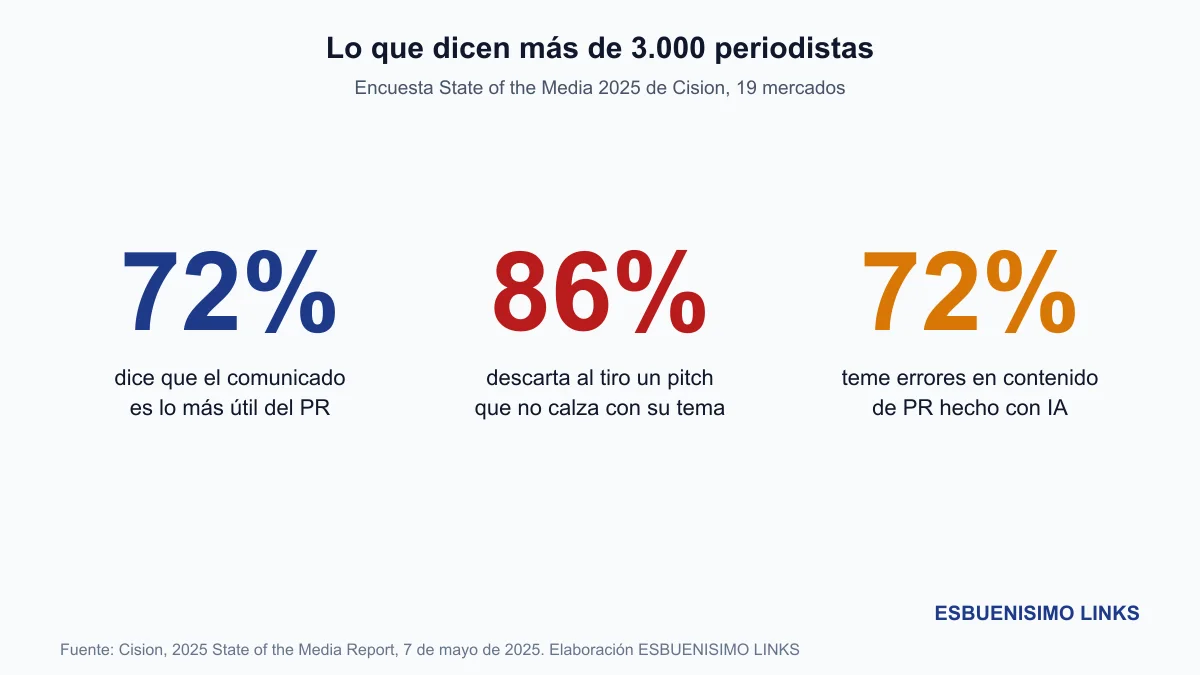
The kit does not replace media relations. In Cision's 2025 State of the Media survey of more than 3,000 journalists in 19 markets, 72% called the press release the most useful resource a PR team can offer, but 86% said they immediately reject a pitch that does not fit their beat or audience. The kit helps the story come out right; picking the right journalist is still the job of public relations.
View the data as a table
| say press releases are the most useful resource PR offers | 72% |
| immediately reject a pitch that doesn't fit their beat | 86% |
| worry about factual errors in AI-generated PR content | 72% |
Press kit example: what a good one looks like
A good press kit for a mid-sized company fits on a single web page, in this order:
- Top: the latest press release with its date and a button to download the full kit as one file.
- Middle: the company fact sheet, five key figures with sources, the photo gallery and the logos.
- Bottom: spokesperson bios, a milestone timeline, links to published coverage and the press contact with name, email and phone.
Large companies usually run a full newsroom with years of archived releases. For a small business or a startup, the short version is enough, as long as it is up to date. In Chile, “sala de prensa” (newsroom) is searched 260 times a month, more than “media kit”.
Why Google and AI read your kit too
In 2026 the kit has a third reader besides journalists and the public: AI search engines. ChatGPT, Gemini and Google AI Mode build their answers about a brand from what they find published, and they weigh media coverage heavily. According to Muck Rack's Generative Pulse report, most links these tools cite come from earned media, not from brands' own websites.
That changes what the kit is worth. If the figures and the fact sheet are clear and consistent, journalists repeat them as written, and those stories are what AI reads later. That is why the newsroom should be an indexable page and not just a PDF, and why the data should match on the website, in the kit and on LinkedIn.
A kit makes coverage easier, but it does not guarantee it. Companies that want to appear in the media regularly combine earned press with clearly labeled paid stories: at ESBUENISIMO LINKS we help brands publish stories with links in Chilean media and across the region, and our digital press agency builds the kit and manages journalist relationships. To organize your messages before building the kit, start with a communication plan.
| Mexico | 2,400 | 1,000 | 590 | 390 |
| Argentina | 720 | 480 | 90 | 90 |
| Colombia | 480 | 480 | 170 | 90 |
| Chile | 390 | 170 | 260 | 70 |
| Peru | 260 | 320 | 70 | 40 |
Frequently Asked Questions
What is a press kit?+
It is the package of information a company prepares for journalists: the current press release, a company fact sheet, sourced figures, high-resolution photos, logos, spokesperson bios and a press contact.
What is the difference between a press kit and a media kit?+
A company makes a press kit so journalists can write about it. An outlet or influencer makes a media kit to sell advertising, with audience data and rates.
What should a press kit include?+
Ten elements: press release, company fact sheet, dated and sourced key figures, photos, logos, bios, available spokespeople, milestones, published coverage and a press contact.
How often should a press kit be updated?+
At least every quarter, or whenever figures or spokespeople change or there is new news. An outdated kit hurts credibility.
Does a press kit help SEO?+
Indirectly. An indexable newsroom with consistent data makes it easier for journalists to cover the brand accurately, and that coverage is what search engines and AI tools rely on.
Ready to rank #1 and get mentioned by AI?
Digital PR & Link Building in 1,400+ media outlets across 8 countries. Google and ChatGPT recognize you as an authority source.
See plans and pricing