By Felipe Morales, CEO of ESBUENISIMO LINKS
What is public relations? Types, metrics and what changes when AI reads the media
What is public relations: how it differs from advertising, its six types, how to measure it and what changes now that ChatGPT and Gemini cite the media.
Public relations is the management of the relationship between an organization and its publics: customers, journalists, authorities, investors and employees. The Public Relations Society of America defines it as a strategic communication process that builds mutually beneficial relationships. In practice, it is the work of getting others, especially the media, to speak well of a brand instead of paying to speak for yourself.
In 2026 that work has a new reader. ChatGPT, Gemini and Google answer with specific brands and rely on what third parties publish. According to Muck Rack, 84% of AI citations come from earned media, meaning content nobody paid for. This guide explains what public relations is, its types, how to measure it and what changes when AI reads the media.
What is public relations, and how is it different from advertising?
The classic difference fits in one sentence: advertising is paid, public relations is earned. An ad says what the brand wants and appears because the space was bought. A news story, an interview or a mention in a ranking appears because a journalist or editor decided it was worth it, and that is why readers trust it more.
Interest in the topic is high across Latin America. The Spanish term “relaciones públicas” gets 6,600 searches a month in Mexico and 1,000 in Chile, according to Google Ads; in the United States, “public relations” gets 22,200.
| Country | “relaciones públicas” | “qué son las relaciones públicas” (what is PR) | Suggested CPC (US$) |
|---|---|---|---|
| Mexico | 6,600 | 1,300 | 2.73 |
| Argentina | 2,900 | 260 | 1.74 |
| Peru | 1,300 | 210 | 2.00 |
| Chile | 1,000 | 90 | 1.98 |
| Colombia | 720 | 210 | 2.20 |
View the data as a table
| Mexico | 6,600 |
| Argentina | 2,900 |
| Peru | 1,300 |
| Chile | 1,000 |
| Colombia | 720 |
Public relations, marketing and corporate communications: who does what
In many companies the three areas overlap, and it helps to separate them. Marketing aims to sell: it defines product, price, channels and campaigns, and almost always works with paid space. Corporate communications looks after the company's institutional voice: the annual report, leadership messages, and relations with trade groups and regulators. Public relations is the tool both use to earn space in media and conversations that cannot be bought.
The difference matters when it comes to measurement. A marketing campaign is judged by sales or cost per customer; public relations work is judged by coverage, reputation and, increasingly, by what search engines and AI say about the brand. When a crisis breaks, the public relations team is the one answering the press, and today it is also the one that has to check what ChatGPT replies when someone asks about the company, because that answer is built from the stories published in the days before. That is a new responsibility for most PR teams, and one few are measuring yet.
🚀 Digital PR & Link Building
Rank #1 on Google and Get Mentioned by AI
1,400+ media outlets in 8 countries. Backlinks that Google and ChatGPT recognize as trusted authority sources.
See plans and pricing →Types of public relations
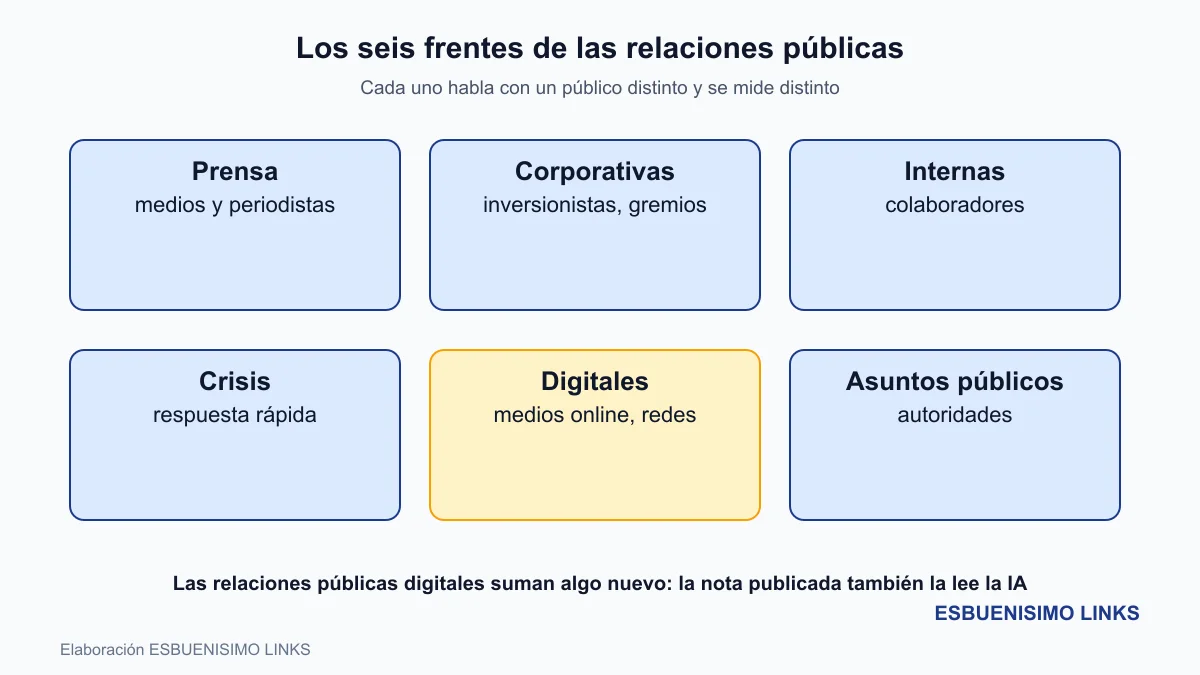
Public relations is usually split by the audience it addresses:
- Media relations: press releases, interviews, spokespeople and stories in the media. It is the core of the craft; the press release in Chile is still its most used tool.
- Corporate and financial: reports, shareholder meetings and relations with investors and trade groups.
- Internal: communication with employees, who are also brand spokespeople.
- Crisis management: the fast response when something goes wrong, now also covering what AI says.
- Digital public relations: online media, creators, social networks and now AI search.
- Public affairs: the relationship with authorities and regulators.
Digital public relations: AI now reads the press release too
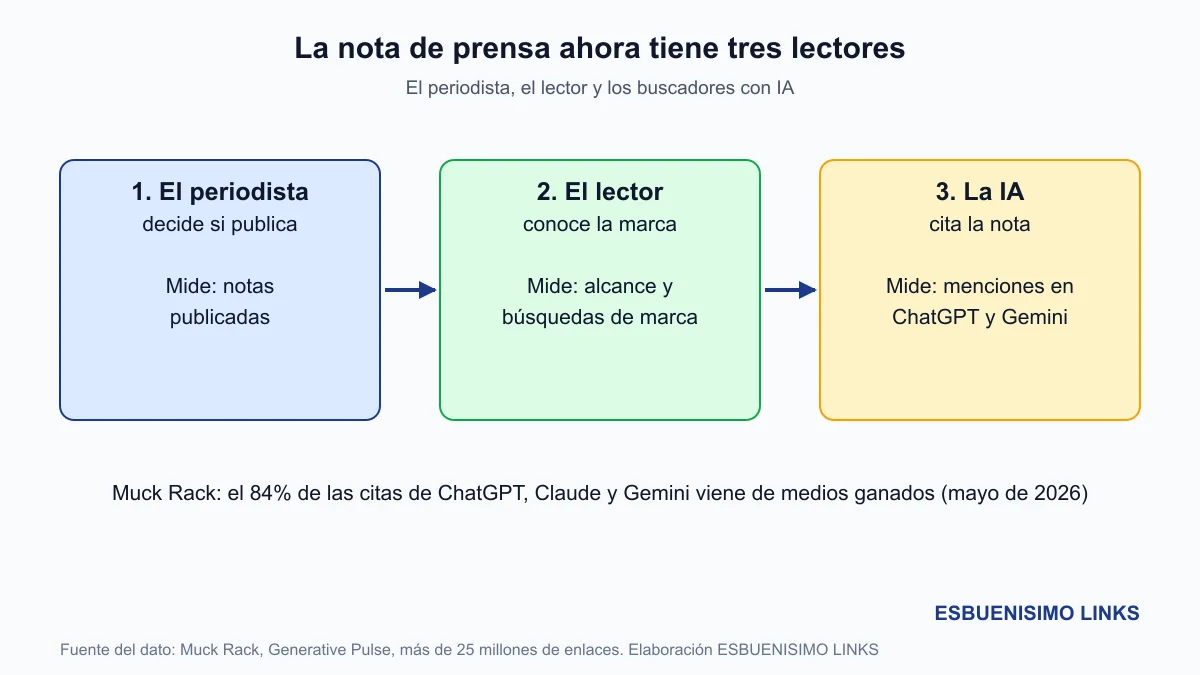
Muck Rack, the media relations platform, regularly analyzes what AI tools cite. In its May 2026 edition, covering more than 25 million links cited by ChatGPT, Claude and Gemini, it found that 84% of citations come from earned media (journalism, academic research, government sources, encyclopedias and third-party content), that professional journalism makes up 27% of links and that paid content barely reaches 0.3%.
View the data as a table
| of AI citations come from earned (unpaid) media | 84% |
| of cited links are professional journalism | 27% |
| of citations are paid or advertorial content | 0.3% |
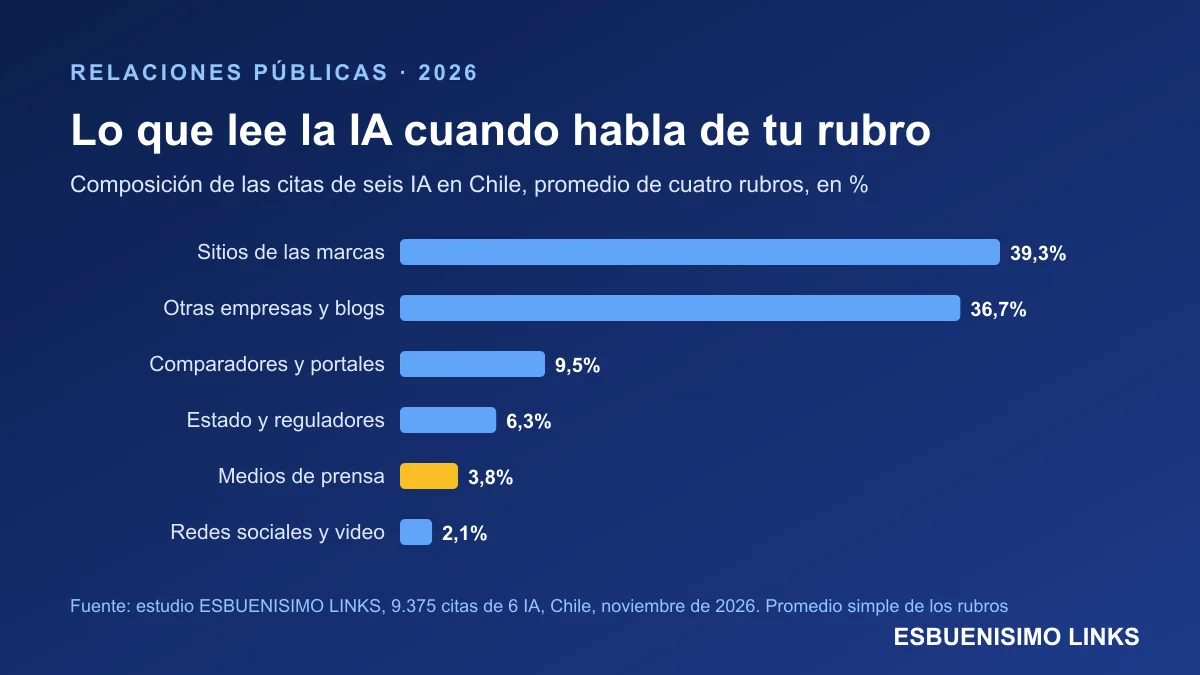
In Chile the picture has nuances. In an ESBUENISIMO LINKS study of 1,233 answers from six AI tools to 222 purchase questions across four industries, news media accounted for between 0.7% and 6.6% of citations, depending on the industry. But more than half of all citations went to sites other than the brands being evaluated: comparison sites, other companies' blogs, regulators and media. The takeaway is not that the press does not matter, but that AI builds its answers from what third parties say, and the press is the most credible third party a brand can realistically earn. The details are in our study of the sources AI cites by industry.
| Source type | Personal banking | Auto parts | Business energy | Higher education |
|---|---|---|---|---|
| Brand websites | 33.5% | 44.6% | 30.9% | 48.2% |
| Other companies and blogs | 29.4% | 50.0% | 43.2% | 24.1% |
| Comparison sites and portals | 18.6% | 2.7% | 1.7% | 14.8% |
| Government and regulators | 9.7% | 0.7% | 9.7% | 4.9% |
| News media | 4.2% | 0.7% | 6.6% | 3.6% |
| Other | 4.7% | 1.2% | 7.9% | 4.3% |
View the data as a table
| Brand websites | Other companies and blogs | Comparison sites and portals | Government and regulators | News media | Other | |
|---|---|---|---|---|---|---|
| Personal banking | 33.5% | 29.4% | 18.6% | 9.7% | 4.2% | 4.7% |
| Auto parts | 44.6% | 50.0% | 2.7% | 0.7% | 0.7% | 1.2% |
| Business energy | 30.9% | 43.2% | 1.7% | 9.7% | 6.6% | 7.9% |
| Higher education | 48.2% | 24.1% | 14.8% | 4.9% | 3.6% | 4.3% |
How to measure public relations without inventing numbers
For years the industry measured public relations with advertising value equivalency: what that space would have cost as an ad. The Barcelona Principles 3.0 from AMEC, the international association for the measurement of communication, have rejected it as a measure of the value of communication since 2010. What you can measure every month:
| Metric | What it measures | Suggested frequency | Data example |
|---|---|---|---|
| Stories published | Coverage earned | Monthly | Number of stories and outlets |
| Media share of voice | Share of the industry's mentions | Monthly | % versus 3-5 competitors |
| Brand searches | Whether people remember the brand | Monthly | Volume in Google Trends or Google Ads |
| Links from media | Authority for Google | Quarterly | Referring domains |
| AI mentions | Whether ChatGPT and Gemini name the brand | Monthly | % of answers naming the brand |
The last two metrics connect public relations with SEO and AI. A story in an authoritative outlet lifts the brand on Google if it carries a link, and adds a source AI can cite even if it does not. Both count, as we explain in our comparison of backlinks and unlinked brand mentions.
Public relations and SEO: how to work on both at once
For a communications manager, the practical shift is to plan every story with three goals: that the journalist publishes it, that the reader remembers it and that AI can cite it. That means choosing outlets AI already reads in the industry, publishing proprietary data a journalist can quote, making sure the story names the brand clearly and, when the outlet allows it, earning a link to the site.
- Measure the baseline: which outlets cover the industry and what ChatGPT and Gemini say about the brand today.
- Choose outlets for what people and AI read, not just for audience size.
- Have something to say: a study, market data or an expert opinion.
- Publish and measure stories, links, brand searches and AI mentions every month.
At ESBUENISIMO LINKS we work on that combination: our press agency earns coverage in Chilean and Latin American media, and our service for linked mentions in Chilean media makes sure that coverage also builds authority on Google and gives AI sources it can cite.
Frequently Asked Questions
What is public relations?+
It is the management of the relationship between an organization and its publics (customers, journalists, authorities, investors and employees) to earn reputation and trust. Unlike advertising, its space is not paid for: it is earned.
What is the difference between public relations and advertising?+
Advertising buys space and controls the message. Public relations gets a media outlet or third party to talk about the brand by its own choice, which brings more credibility but less control.
What are the types of public relations?+
Media relations, corporate and financial, internal, crisis management, digital public relations and public affairs.
How do you measure public relations?+
With stories published, media share of voice, brand searches, links from media and mentions in AI answers. AMEC's Barcelona Principles advise against using advertising value equivalency.
Why does public relations matter for showing up in AI?+
Because AI builds its answers from what third parties publish. According to Muck Rack, 84% of citations by ChatGPT, Claude and Gemini come from earned media, and paid content is only 0.3%.
Ready to rank #1 and get mentioned by AI?
Digital PR & Link Building in 1,400+ media outlets across 8 countries. Google and ChatGPT recognize you as an authority source.
See plans and pricing