By Felipe Morales, CEO of ESBUENISIMO LINKS
Corporate social responsibility: what CSR is, its 7 core subjects and how to communicate it
Corporate social responsibility (CSR): what it is, the 7 ISO 26000 core subjects, how it differs from ESG, data from Chile and how to communicate it in media and AI.
Corporate social responsibility (CSR), known in Spanish-speaking markets as RSE (responsabilidad social empresarial), is a company's commitment to the impact it has on its employees, customers, community and the environment, beyond what the law requires. For two decades it was the name of large companies' social programs. Today it coexists with other terms, such as sustainability, ESG or B Corp, and is measured under increasingly demanding rules.
For a communications manager, CSR poses a double challenge: doing it well and telling it well. In this guide we explain what it is, its seven core subjects under the ISO 26000 standard, how it differs from ESG and sustainability, what the data from Chile shows, and how to communicate it in the media and in artificial intelligence without losing credibility.
What corporate social responsibility means
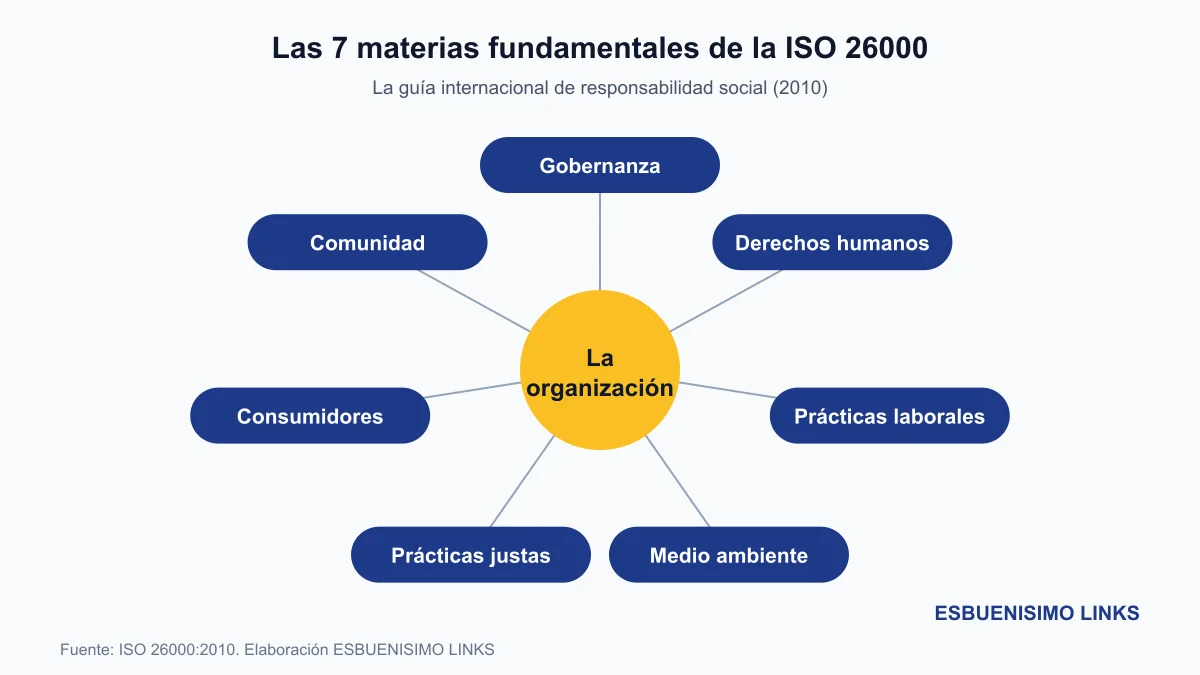
The international reference is the ISO 26000 standard, published in 2010, which defines social responsibility as an organization's responsibility for the impacts of its decisions and activities on society and the environment, through ethical and transparent behavior. It is not a certifiable standard: it is a guide that organizes the topic into seven core subjects.
| Core subject (ISO 26000) | Example practice | What can be communicated |
|---|---|---|
| Organizational governance | Board with independent members and an ethics policy | Integrated report, code of conduct |
| Human rights | Due diligence in the supply chain | Audit results and improvement plans |
| Labor practices | Pay equity, safety, training | Measured gaps and dated targets |
| The environment | Measuring and cutting the carbon footprint | Tonnes reduced, with external verification |
| Fair operating practices | Paying SME suppliers within 30 days | Actual average payment terms |
| Consumer issues | Clear information, complaints resolved | Complaint rate and response times |
| Community involvement and development | Programs with neighbors and local organizations | Beneficiaries, amounts and continuity |
The table makes one thing clear: almost everything a company does has a CSR dimension, from how it pays suppliers to how it handles a complaint. That is why CSR is not an isolated department but a way of managing the relationship with stakeholders.
CSR, sustainability, ESG and B Corp: the differences
The four terms are used as synonyms, but they are not. CSR starts with the company and looks at its stakeholders; ESG comes from investors and demands comparable metrics; sustainability is the underlying goal; and B Corp is a specific certification.
| Concept | What it is | Who asks for it | How it is proven |
|---|---|---|---|
| CSR | A company's voluntary commitment to its social, environmental and economic impact | Customers, employees, community | Policies, programs and reports |
| Sustainability | The ability to create long-term value without depleting resources or harming others | Society as a whole | Measurable targets over time |
| ESG | Environmental, social and governance criteria used to assess a company | Investors and regulators | Standardized metrics (SASB, NCG 461 in Chile) |
| B Corp | Social and environmental impact certification by B Lab | The company itself, by certifying | Score on the impact assessment |
In Chile, the shift from voluntary CSR to mandatory disclosure came with General Rule 461 from the Financial Market Commission (CMF), issued in November 2021, which requires securities issuers to include sustainability and corporate governance in their annual report. According to the CMF, 70 companies published their first integrated report for fiscal 2022, 24% of issuers but 54% of assets, and another 11 did so voluntarily.
View the data as a table
| companies that published their first integrated report with sustainability (2022) | 70 |
| certified B Corps in Chile, the most per capita in Latin America | ~270 |
| people work at Chilean B Corps | +38,500 |
| certified B Corps in Latin America | +1,300 |
🚀 Digital PR & Link Building
Rank #1 on Google and Get Mentioned by AI
1,400+ media outlets in 8 countries. Backlinks that Google and ChatGPT recognize as trusted authority sources.
See plans and pricing →CSR in Chile in numbers
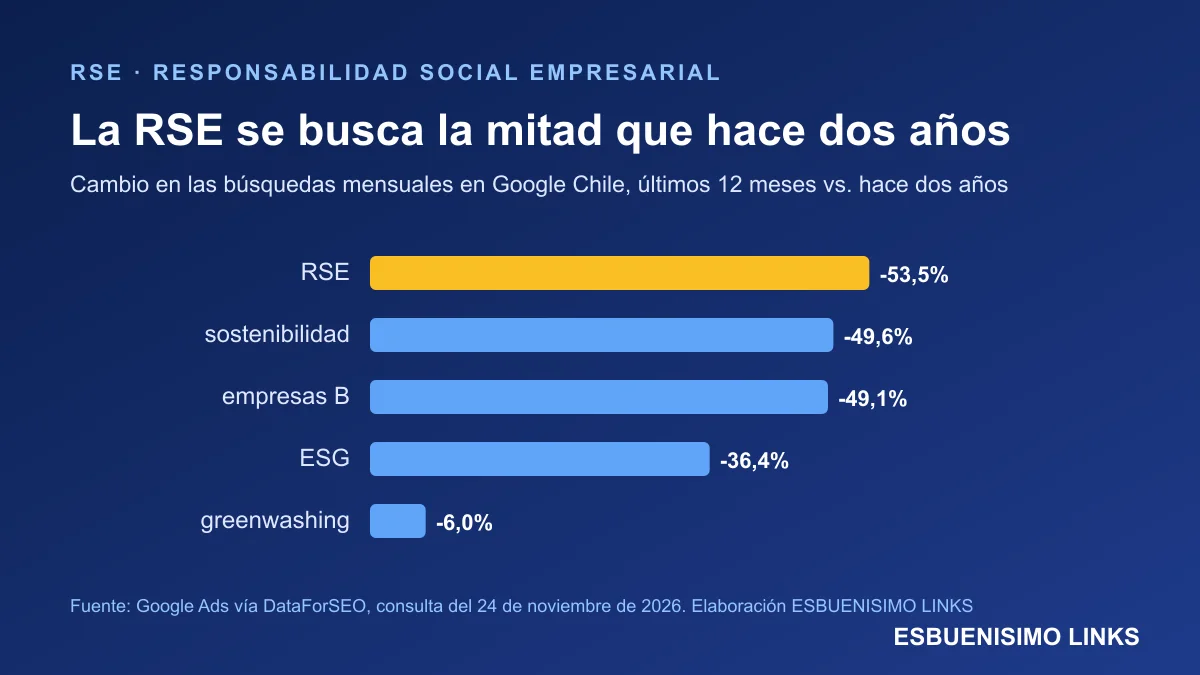
Two signals seem to point in opposite directions. On one hand, the practice is becoming more professional: according to Chócale, Chile has about 270 certified B Corps, employing more than 38,500 people with sales above US$6.4 billion, and it is the Latin American country with the most B Corps per capita. On the other, public interest is falling: on Google, searches for «rse» dropped 53.5% in two years, «sostenibilidad» (sustainability) 49.6% and «ESG» 36.4%. In Mexico, searches for «rse» fell 54.5%. Part of that decline reflects a change in vocabulary, as companies and universities shift toward «sustainability» and «ESG», but those terms are falling too.
View the data as a table
| RSE (Spanish for CSR) | empresas B (B Corps) | ESG | |
|---|---|---|---|
| Nov 23 | 3,600 | 2,400 | 3,600 |
| Dec 23 | 1,900 | 1,600 | 2,400 |
| Jan 24 | 1,300 | 1,600 | 2,900 |
| Feb 24 | 880 | 1,000 | 1,900 |
| Mar 24 | 2,900 | 2,400 | 2,900 |
| Apr 24 | 3,600 | 3,600 | 3,600 |
| May 24 | 3,600 | 2,900 | 2,900 |
| Jun 24 | 2,900 | 1,900 | 2,900 |
| Jul 24 | 2,400 | 1,900 | 2,400 |
| Aug 24 | 2,400 | 2,400 | 2,900 |
| Sep 24 | 2,400 | 1,600 | 1,900 |
| Oct 24 | 2,400 | 2,400 | 2,400 |
| Nov 24 | 2,400 | 1,600 | 2,400 |
| Dec 24 | 1,600 | 1,300 | 1,600 |
| Jan 25 | 1,000 | 1,000 | 1,900 |
| Feb 25 | 720 | 880 | 1,300 |
| Mar 25 | 1,900 | 1,600 | 1,900 |
| Apr 25 | 2,400 | 1,900 | 2,400 |
| May 25 | 1,900 | 1,900 | 2,400 |
| Jun 25 | 2,400 | 1,600 | 2,400 |
| Jul 25 | 1,600 | 1,300 | 1,900 |
| Aug 25 | 1,600 | 1,300 | 1,900 |
| Sep 25 | 1,600 | 1,300 | 1,900 |
| Oct 25 | 1,600 | 1,600 | 1,900 |
| Nov 25 | 1,600 | 1,300 | 2,400 |
| Dec 25 | 1,000 | 880 | 1,900 |
| Jan 26 | 720 | 880 | 1,600 |
| Feb 26 | 480 | 590 | 1,000 |
| Mar 26 | 1,600 | 1,600 | 1,900 |
| Apr 26 | 1,900 | 1,600 | 2,400 |
| May 26 | 1,600 | 1,300 | 1,900 |
| Jun 26 | 1,300 | 1,300 | 1,900 |
| Jul 26 | 1,000 | 880 | 1,300 |
| Aug 26 | 1,000 | 1,000 | 1,600 |
| Sep 26 | 1,000 | 880 | 1,600 |
| Oct 26 | 880 | 880 | 1,300 |
The takeaway for a brand is that the topic is no longer new. Announcing a CSR program is no longer enough to generate interest: people react to concrete results and distrust promises. Searches for «greenwashing» barely changed (-6.0%), a sign that suspicion is still there.
How to build a social program in four steps
1. Run a materiality assessment. Identify which impacts of your business matter most to your stakeholders and to your operations. A transportation company does not have the same priorities as a bank, and a retailer's biggest issues are rarely those of a mining company.
2. Set a few measurable, dated targets. It is better to commit to three indicators you can meet than to ten nobody reviews. Each target should have an owner inside the company and a baseline to compare against.
3. Work with partners. Foundations, universities or local governments bring knowledge of the territory and also verify what you do, which matters when you later tell the story.
4. Report even when results are not perfect. Showing partial progress honestly builds more trust than a report where everything went well. Journalists and AI systems alike tend to treat flawless self-assessments with skepticism.
How to communicate it without losing credibility
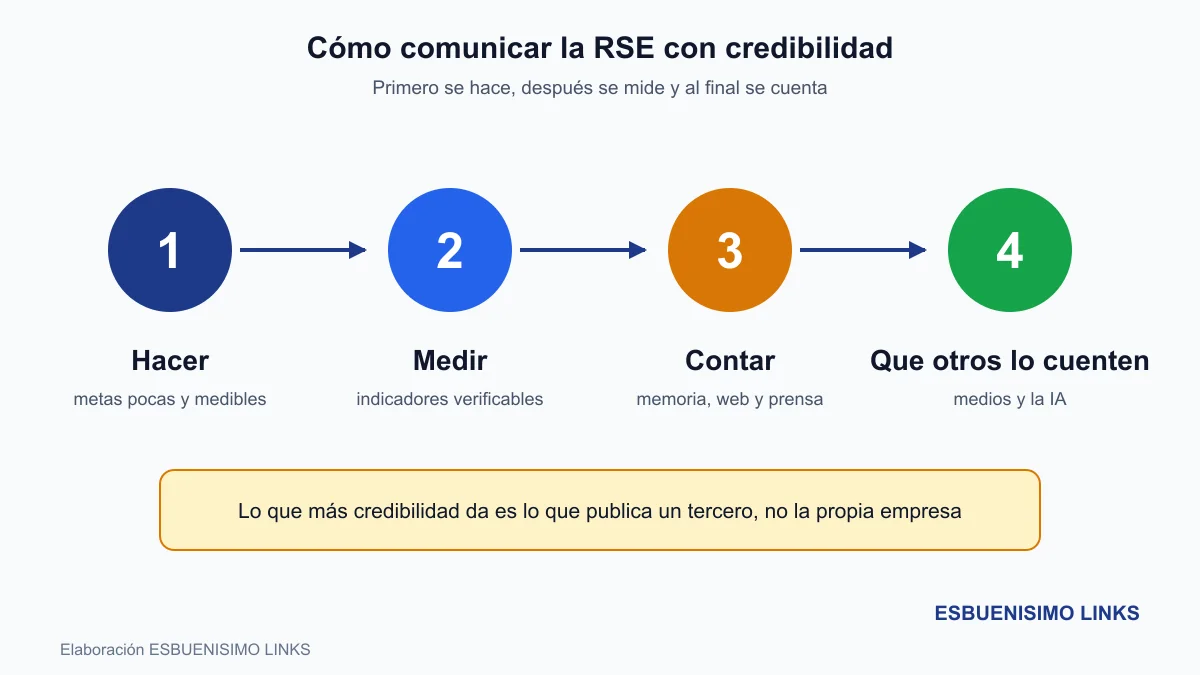
The rule is simple: do it first, measure it next and tell it last. And what earns the most credibility is not what the company says about itself, but what others say: a media outlet, a third party that verifies, a partner organization. That is why public relations is key to CSR: it turns your own data into news that someone else publishes.
| Channel | What to publish | Mistake to avoid |
|---|---|---|
| Annual or sustainability report | Indicators with methodology and year-over-year comparison | Only photos and testimonials |
| Website | A permanent page with targets, progress and contact | A hidden PDF nobody finds |
| Press | New data, verifiable partnerships, measured results | Self-congratulatory pieces with no figures |
| Social media | Stories of real people, with their consent | Campaigns that promise more than they deliver |
| Artificial intelligence | Clear information repeated in trusted sources | Letting AI repeat outdated data or unanswered criticism |
Perception can be measured too. Cadem's Citizen Brands study evaluates hundreds of brands in Chile every six months on seven attributes, two of them tied to CSR: whether the brand makes the world a better place and whether it contributes to society. Measurements like that, combined with press monitoring, show whether the effort translates into corporate image.
What ChatGPT says about your company's social commitment
More and more journalists, investors and job applicants ask ChatGPT or Gemini how a company behaves. The answer is built from what the AI finds in media, reports and forums. If your CSR program does not appear in trusted sources, AI does not know about it; and if the only thing published is criticism, that is what it will repeat.
That is why CSR communication today has two audiences: people and the AI models that inform them. Our press agency turns your progress into articles in real media outlets, and with ESBUENISIMO LINKS link building (esbuenisimolinks.com/link-building-chile) those mentions also build authority on Google, so anyone searching for your company finds your version first, backed by data.
Frequently Asked Questions
What is CSR?+
Corporate social responsibility is a company's voluntary commitment to the impact it has on employees, customers, community and the environment, beyond what the law requires. The ISO 26000 standard organizes it into seven core subjects.
What are the 7 core subjects of CSR?+
Under ISO 26000, the seven core subjects are organizational governance, human rights, labor practices, the environment, fair operating practices, consumer issues, and community involvement and development.
What is the difference between CSR and ESG?+
CSR is a commitment that starts with the company and looks at its stakeholders. ESG refers to the environmental, social and governance criteria investors and regulators use to assess a company, with standardized metrics.
Is CSR mandatory in Chile?+
CSR as such is voluntary. But since the CMF's General Rule 461 (2021), securities issuers must include sustainability and corporate governance information in their annual report, phased in by company size.
How many B Corps are there in Chile?+
About 270, according to Sistema B as cited by Chócale in May 2026. They employ more than 38,500 people, and Chile has the most B Corps per capita in Latin America.
Ready to rank #1 and get mentioned by AI?
Digital PR & Link Building in 1,400+ media outlets across 8 countries. Google and ChatGPT recognize you as an authority source.
See plans and pricing