By Felipe Morales, CEO of ESBUENISIMO LINKS
Stakeholders: what they are, types and how to build a stakeholder map
Stakeholders explained: definition, types, how to build a power-interest map and why media and AI are key stakeholders in 2026, with Edelman trust data.
For a communications manager, stakeholders are the map of the job: who to inform, who to persuade and who to listen to before a problem becomes a crisis. This guide explains what stakeholders are, their types, how to build a map with the power-interest grid and why there are now two players missing from the classic manuals: digital media and artificial intelligence assistants.
What are stakeholders
The most cited definition comes from R. Edward Freeman in Strategic Management: A Stakeholder Approach (1984): a stakeholder is any group or individual who can affect or is affected by the achievement of an organization's objectives.
The idea changed how companies are managed: besides answering to shareholders, a company depends on the trust of employees, customers, suppliers, authorities and communities. If one of those groups withdraws its support, the business suffers, even if the quarter's numbers look fine.
Stakeholders vs. shareholders
Shareholders own part of the company. Stakeholders are a broader group that includes them. A bank, for example, answers to its shareholders, but also to its financial regulator, millions of customers, its employees and the public opinion shaped by the media.
🚀 Digital PR & Link Building
Rank #1 on Google and Get Mentioned by AI
1,400+ media outlets in 8 countries. Backlinks that Google and ChatGPT recognize as trusted authority sources.
See plans and pricing →Types of stakeholders
The most common classification separates internal stakeholders (employees, managers, shareholders) from external ones (customers, suppliers, regulators, communities). Two intermediaries belong on that list too: they neither buy nor invest, but they explain the company to everyone else.
| Stakeholder | Type | What they expect | Main channel |
|---|---|---|---|
| Employees | Internal | Stability, purpose, timely information | Internal communications |
| Shareholders and investors | Internal | Returns and risk management | Annual report, meetings, investor relations |
| Customers | External | Good product, fair price, good service | Marketing, customer service, reviews |
| Suppliers | External | On-time payment and a stable relationship | Commercial management |
| Regulators and authorities | External | Compliance | Public affairs |
| Communities | External | Respect for the environment and local benefits | Community relations |
| News media | External (intermediary) | Reliable information and available spokespeople | Public relations and press |
| AI assistants | External (intermediary) | Clear, consistent sources they can cite | Media mentions, website, reviews |
Media being a stakeholder is not new: public relations exists to manage that relationship. What is new is that ChatGPT, Gemini and Perplexity answer questions about companies every day, and those answers are built from what they find in news outlets, official sites and reviews.
How to build a stakeholder map
The most widely used tool is the power-interest grid proposed by Aubrey Mendelow in 1991. Each group is placed according to how much power it has over the company and how interested it is in its decisions, which sets the strategy:
- High power, high interest: manage closely. Shareholders, major customers and, in a crisis, the media.
- High power, low interest: keep satisfied. Regulators or banks that only step in when something goes wrong.
- Low power, high interest: keep informed. Neighboring communities, small suppliers.
- Low power, low interest: monitor. The general public, which can move quadrants in a crisis.
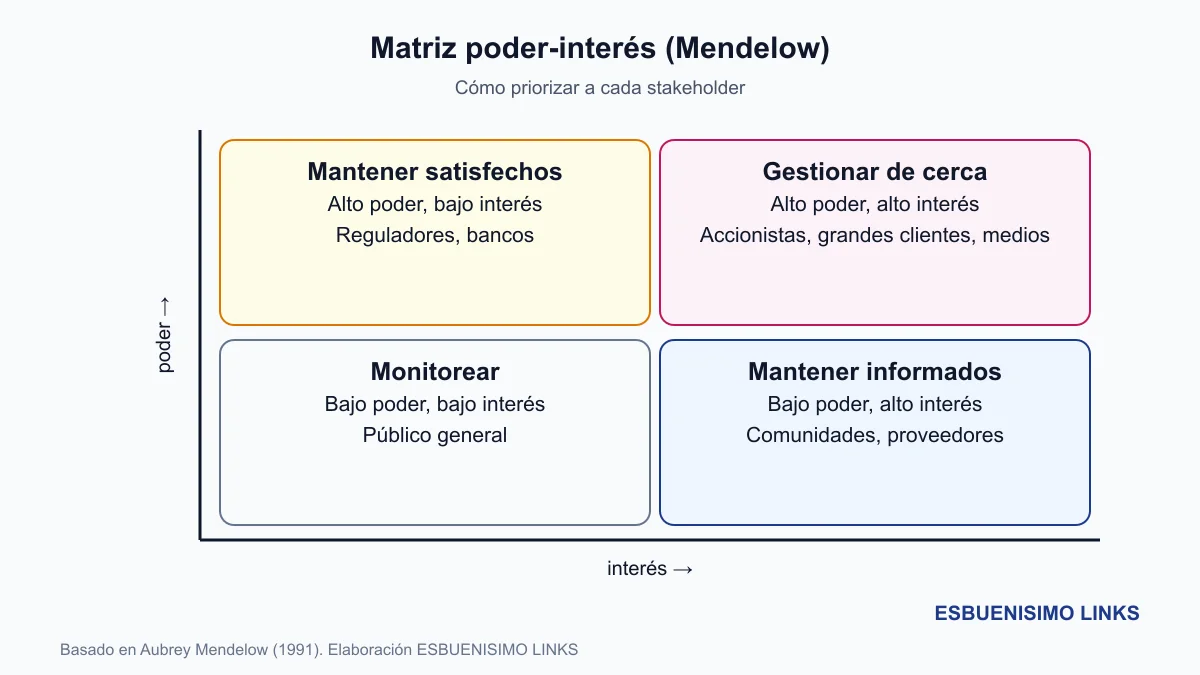
The map is not static. A low-interest group can move to the critical quadrant within hours if a news story or viral video mobilizes it. That is why the map should be reviewed at least once a year and before any major announcement, and should be the basis of the communication plan.
Who stakeholders trust in 2026
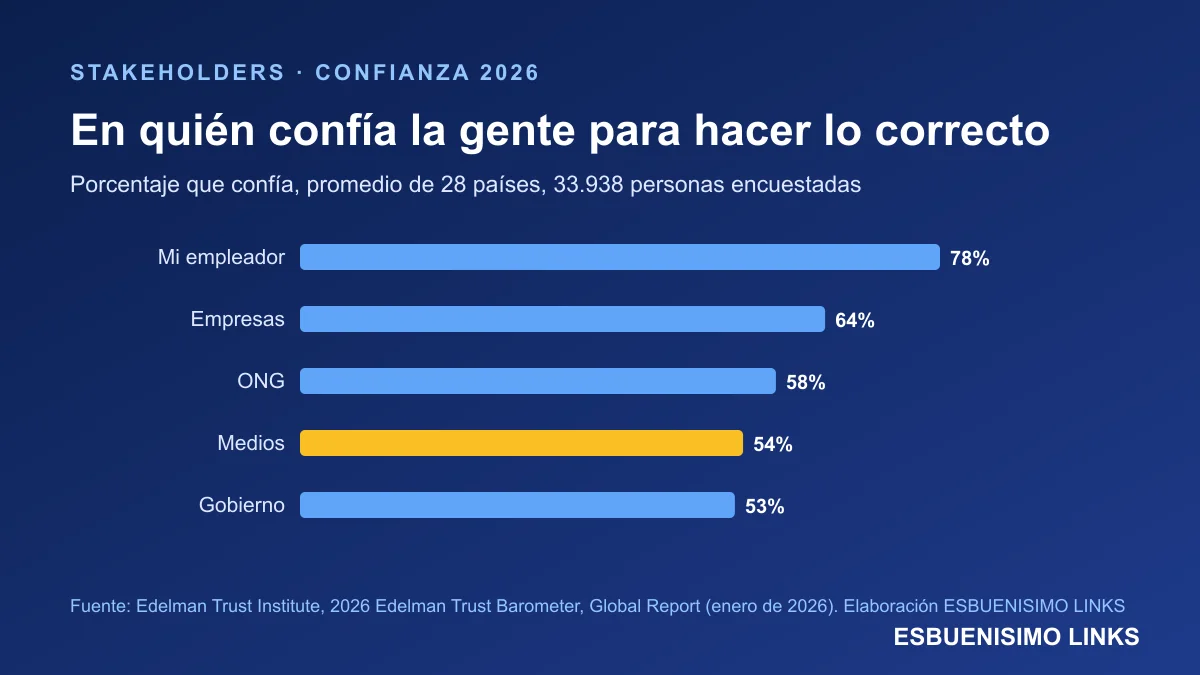
Managing stakeholders is, at bottom, managing trust. The 2026 Edelman Trust Barometer, which surveyed 33,938 people in 28 countries in October and November 2025, shows one's own employer is the most trusted institution (78%), followed by business (64%). Media sit at 54% and government at 53%.
View the data as a table
| trust their employer, the internal stakeholder | 78% |
| trust business in general | 64% |
| trust the media | 54% |
| countries surveyed | 28 |
| Institution | Trust (2026) | Change vs. 2025 |
|---|---|---|
| My employer | 78% | +2 pts |
| Business | 64% | +2 pts |
| NGOs | 58% | 0 pts |
| Media | 54% | +2 pts |
| Government | 53% | +1 pts |
For Chile, the most relevant data comes from the Reuters Institute Digital News Report 2026: trust in news has hovered around a third of the population since 2020. We break it down in our analysis of Chile's news media and the trust they generate. The takeaway for a company is twofold: media are still the channel that shapes opinion, but appearing in a trusted outlet is worth more than appearing anywhere.
Media and AI as stakeholders that shape opinion
When an investor, a journalist or a prospective customer wants to know about a company, they now ask Google or an AI assistant. What they find depends on which sources talk about the company and with what authority. In our study of the sources AI cites by industry in Chile, between 51.8% and 69.1% of citations from ChatGPT, Gemini, Perplexity, Claude and Google went to third-party sites (other companies, comparison sites, government, media and social networks), not to the brands asked about. News outlets weigh differently by industry: 6.6% of citations in energy and 0.7% in car parts.
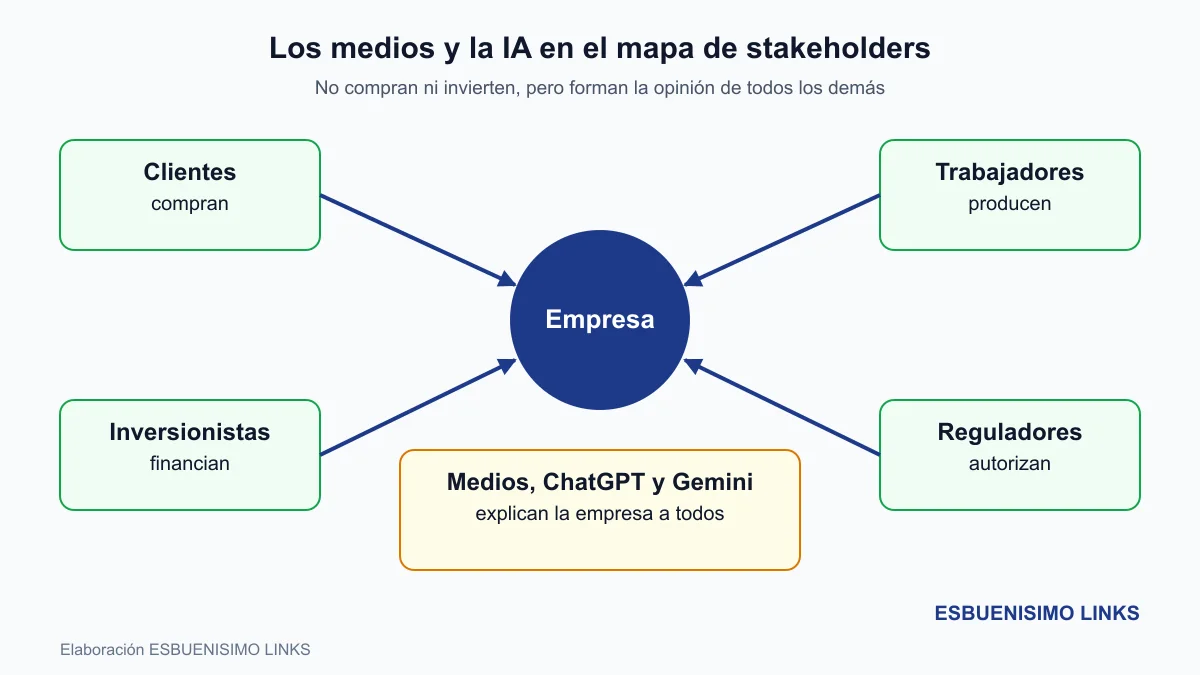
That makes AI, and the media and portals it reads, high-power stakeholders: they do not make the purchase, but they influence everyone else's decision. Practical management has three steps: monitor what is said about the company, correct sources with outdated or wrong information, and publish the information you want circulating in authoritative outlets.
How much Latin America searches for stakeholders
The concept is in daily use across the region. Mexico has 14,800 monthly searches for “stakeholders”; Colombia and Peru 9,900 each; Chile 6,600. Basic questions (“qué son los stakeholders”) add hundreds more searches in each country.
View the data as a table
| Mexico | 14,800 |
| Colombia | 9,900 |
| Peru | 9,900 |
| Chile | 6,600 |
| Argentina | 5,400 |
| Country | “stakeholders” | “qué son los stakeholders” |
|---|---|---|
| Mexico | 14,800 | 720 |
| Colombia | 9,900 | 480 |
| Peru | 9,900 | 590 |
| Chile | 6,600 | 390 |
| Argentina | 5,400 | 260 |
Common mistakes in stakeholder management
- Building the map once and filing it away. Groups gain or lose power and interest with every project, regulatory change or crisis.
- Using the same message for everyone. An employee, a regulator and a journalist need different information through different channels.
- Remembering the media only in a crisis. Press relationships are built beforehand; mid-crisis, journalists already have other sources.
- Ignoring what AI says. If an assistant repeats outdated or wrong information about the company, every stakeholder who asks gets that version.
From the stakeholder map to action
A good stakeholder map ends in a plan: one message per group, a channel, a spokesperson and a way to measure. For media and AI, measurement is concrete: how many stories mention the company, in which outlets, with which link, and what assistants answer when asked about the brand.
If your team needs to reach journalists, see our press agency. And to earn linked mentions in Chilean and Latin American media, which Google and AI also read, visit esbuenisimolinks.com/link-building-chile.
Frequently Asked Questions
Who are the five main stakeholders?+
In most companies they are employees, shareholders, customers, suppliers and the communities or regulators where the company operates. News media and AI assistants increasingly act as intermediaries that shape what all of them think.
What are the four main types of stakeholders?+
A common split is internal (employees, managers, owners), external (customers, suppliers, regulators, communities), primary (direct relationship with the company) and secondary (influence without a contract, such as media).
Is a CEO a stakeholder?+
Yes. The CEO and the management team are internal stakeholders: they affect the company's results and are affected by them.
What is a stakeholder management plan?+
A document that lists each stakeholder group, its power and interest, what it expects, the message for it, the channel and the person in charge. It is updated at least once a year and before any crisis or major announcement.
What is the difference between stakeholders and shareholders?+
Shareholders own part of the company. Stakeholders are a broader group that includes shareholders but also employees, customers, suppliers, authorities and communities.
Ready to rank #1 and get mentioned by AI?
Digital PR & Link Building in 1,400+ media outlets across 8 countries. Google and ChatGPT recognize you as an authority source.
See plans and pricing