By Felipe Morales, CEO of ESBUENISIMO LINKS
CPM: what cost per mille is, how to calculate it and when a media article is the better buy
CPM guide: what cost per thousand impressions is, how to calculate it, benchmarks by industry and format, CPM vs. CPC and CPA, and how it compares with a media article.
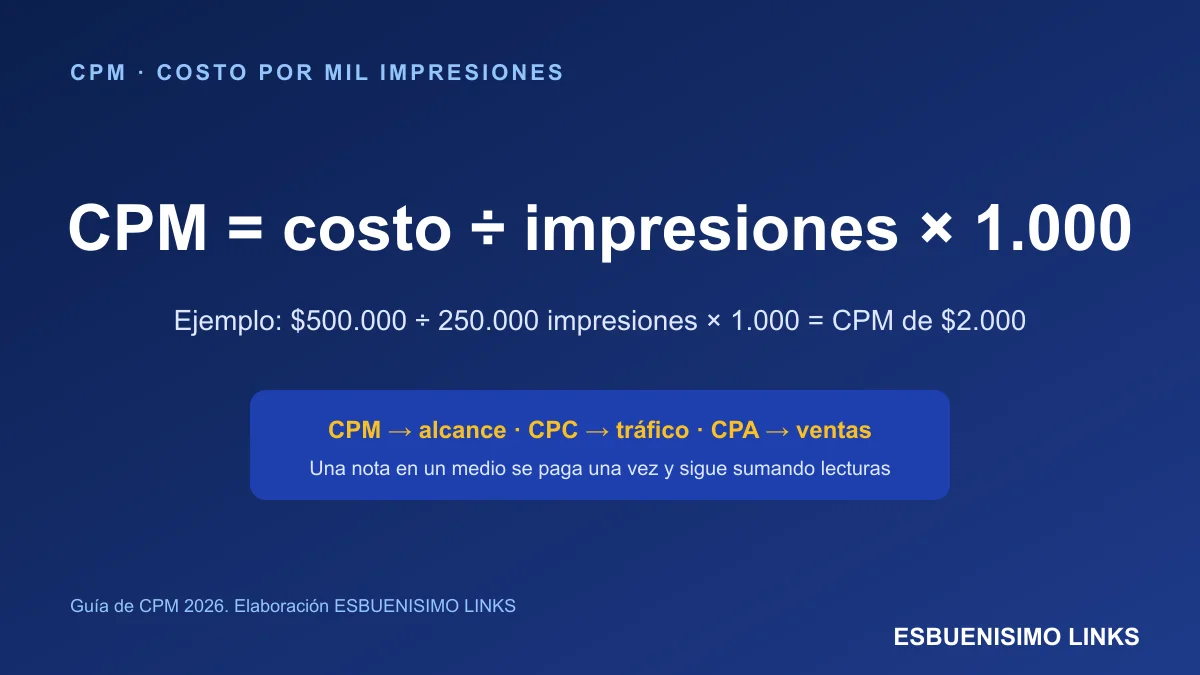
CPM (cost per mille, or cost per thousand impressions) is what an advertiser pays each time an ad is shown a thousand times. The M comes from «mille», Latin for thousand. It is the unit used to buy most reach advertising on Meta, YouTube, TikTok, programmatic display and the homepages of digital newspapers, and it is the metric marketing managers use to compare how much it costs to reach an audience across channels.
In this guide we explain what CPM is, how to calculate it with examples, how much it costs by industry and format, how it differs from CPC and CPA, and how to compare it with an article in a media outlet, which is not priced by impressions but keeps working after the campaign ends.
What CPM means in marketing
CPM is a buying model: you pay for exposure, not results. If a platform charges you a US$4 CPM, every thousand times your ad appears on a screen you pay US$4, even if nobody clicks. That is why it is used for campaigns whose goal is for many people to see the brand: launches, awareness campaigns or seasons such as Black Friday.
It helps to separate two uses. As a pricing model, CPM is the rate set by the platform or publisher. As a metric, it lets you compare any campaign, even one not bought on CPM: just divide spend by impressions. In the United States, «cpm» gets about 74,000 searches a month, and «cpm marketing» about 1,600, according to Google Ads.
| Model | You pay for | Formula | Best for |
|---|---|---|---|
| CPM | Every thousand impressions | Cost ÷ impressions × 1,000 | Reach and brand recall |
| CPC | Every click | Cost ÷ clicks | Traffic to the site |
| CPV | Every video view | Cost ÷ views | Video and branding |
| CPL | Every contact or form | Cost ÷ leads | Lead generation |
| CPA | Every sale or action | Cost ÷ conversions | Direct sales |
| Flat fee | One published piece (article, weekly banner) | Price ÷ reads | Media content and SEO |
How to calculate CPM
The formula is simple: CPM = total cost ÷ impressions × 1,000. With it you can also work out how many impressions a budget buys, or convert CPM into cost per click if you know the click-through rate (CTR). Here are four examples with round numbers, just to illustrate the math:
| Case (illustrative example) | Data | Calculation | Result |
|---|---|---|---|
| Campaign CPM | $500,000 and 250,000 impressions | 500,000 ÷ 250,000 × 1,000 | CPM of $2,000 |
| Impressions a budget buys | $1,000,000 at a $2,500 CPM | 1,000,000 ÷ 2,500 × 1,000 | 400,000 impressions |
| From CPM to CPC | US$5 CPM and 1% CTR | 5 ÷ (1,000 × 0.01) | CPC of US$0.50 |
| Equivalent CPM of an article | Price P and 20,000 reads in a year | P ÷ 20,000 × 1,000 | P ÷ 20, and it keeps falling every month |
The third example is the one most often forgotten. A low CPM is useless if hardly anyone clicks: with a 0.1% CTR, that same US$5 CPM means paying US$5 per click. That is why CPM should always be read alongside CTR, which we explain in our CTR guide.
🚀 Digital PR & Link Building
Rank #1 on Google and Get Mentioned by AI
1,400+ media outlets in 8 countries. Backlinks that Google and ChatGPT recognize as trusted authority sources.
See plans and pricing →How much CPM costs by industry and format
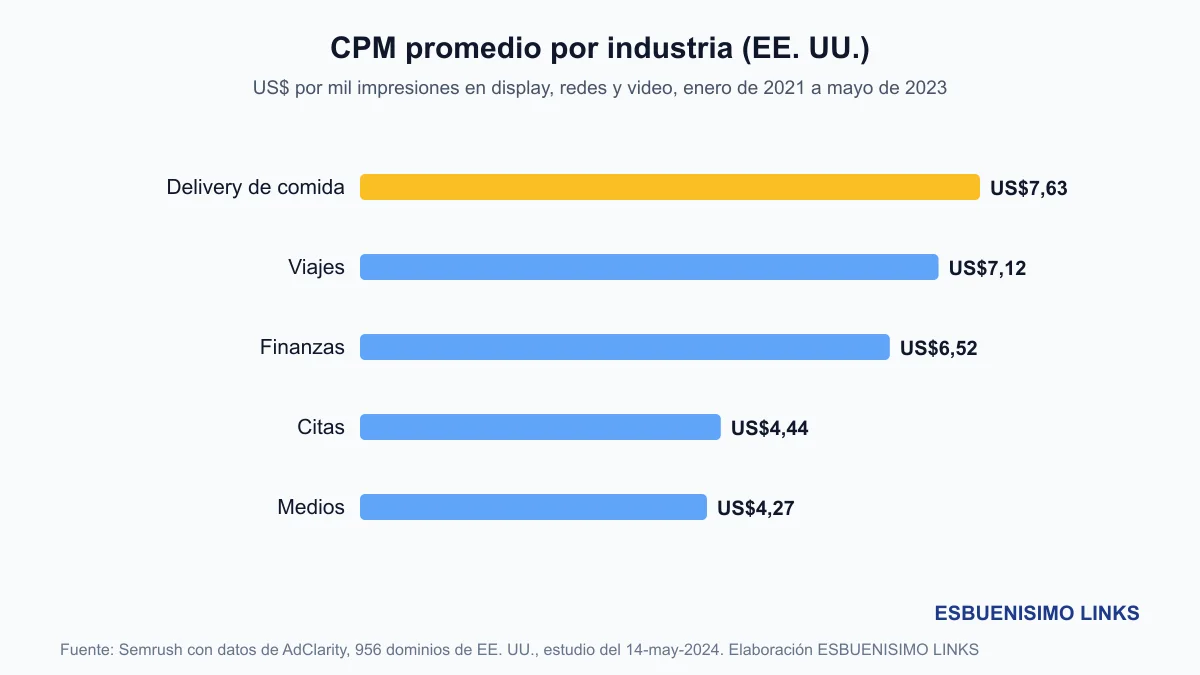
CPM rises when many advertisers compete for the same audience. A Semrush study using AdClarity data on 956 domains across 13 U.S. industries, between 2021 and 2023, found that food delivery paid the highest CPM, US$7.63, followed by travel (US$7.12) and finance (US$6.52). Media and dating apps were among the lowest, at around US$4.3 to US$4.4.
Format matters even more than industry. In the same study, mobile video had an average CPM of US$11.10 and in-app and social video US$9 or more, while desktop display was the cheapest at US$2.50. These are U.S. benchmarks: CPMs in Chile and Latin America are usually lower, and each account should look at its own data.
View the data as a table
| CPM of mobile video, the most expensive format | US$11.10 |
| CPM of desktop display, the cheapest | US$2.50 |
| domains analyzed with AdClarity | 956 |
| industries compared | 13 |
To size the Chilean market, the Media Agencies Association (AAM) reported that between January and September 2026 media investment totaled 733,683 million pesos, up 4.9% from a year earlier, with digital taking 55.8%. A large part of that digital spend is bought on CPM. We review the full series in our article on advertising spend in Chile 2026.
View the data as a table
| million pesos invested in media between January and September 2026 | $733,683 |
| of that investment went to digital | 55.8% |
| growth versus the same period of 2025 | +4.9% |
Paying per click or per sale: which model to choose
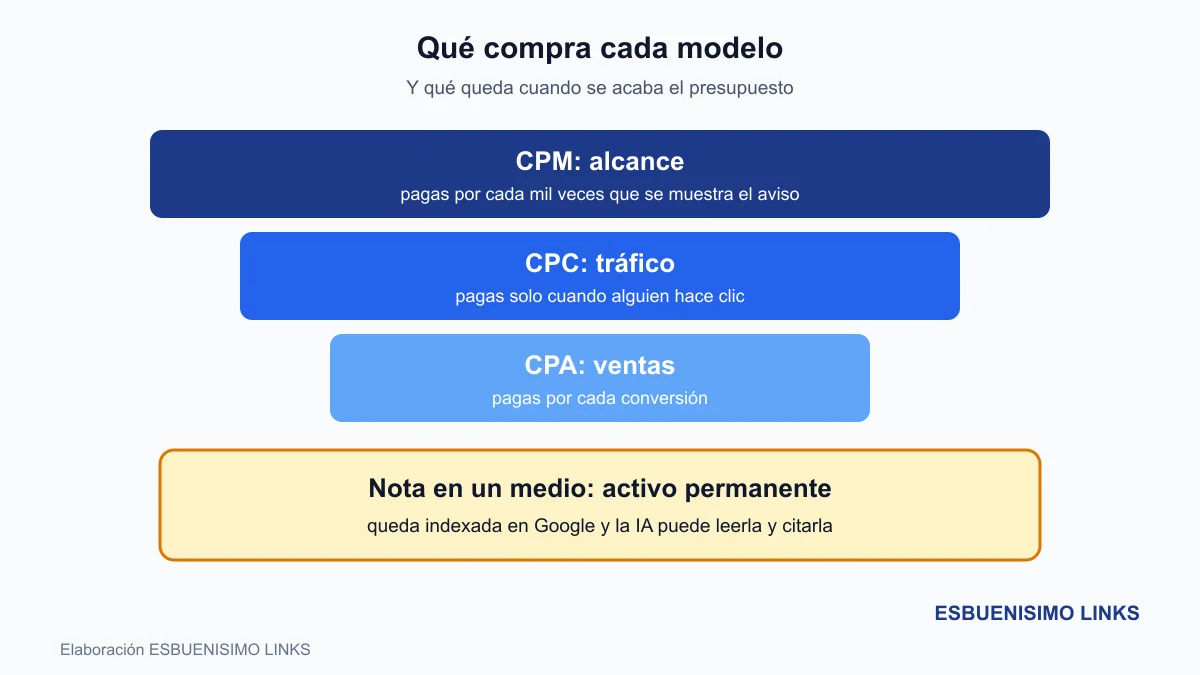
The choice depends on the goal. If you want to be seen, CPM is efficient; if you want visits, CPC protects you from paying for screens nobody looks at; if you want sales, CPA shifts the risk to the platform in exchange for a higher unit cost. Many campaigns combine all three: CPM to create demand and CPC or CPA to capture it.
The blind spot of all three models is the same: the result disappears when the budget runs out. No paid impression improves your Google ranking or makes ChatGPT recommend you the next time someone asks about your industry.
Common mistakes when buying per thousand impressions
Comparing CPMs across formats. A display CPM and a video CPM do not buy the same thing: video holds more attention, which is why it costs more. Compare within the same format.
Ignoring viewability. An impression counts even if the ad sits below the fold and nobody sees it. Ask for the share of viewable impressions before celebrating a low CPM.
Looking at CPM without frequency. A million impressions can mean a million people or a hundred thousand people seeing the ad ten times. For recall, unique reach is what matters, and a cheap CPM achieved by hammering the same users is not a bargain.
Using another country's average as a target. U.S. benchmarks help you understand the logic, not set goals in Chile or the rest of Latin America, where competition for each audience is different. Build your own baseline from your account history and update it every quarter.
A media article versus a paid ad
An article published in a digital newspaper is paid once, at a flat fee, but its reads accumulate over months or years. To compare it with an ad, calculate its equivalent CPM: article price ÷ reads × 1,000. Unlike a campaign, that number falls over time, because reads keep coming without paying more. The deeper differences go beyond cost:
| Criterion | Ad bought on CPM | Article in a digital outlet |
|---|---|---|
| How long it lasts | While you pay | Stays published and indexed |
| What it leaves on Google | Nothing for SEO | A mention and, depending on the case, a link |
| What AI sees | It does not read ads | It can read and cite the article |
| How it is measured | Impressions, clicks, CPM | Reads, referral traffic, rankings, mentions |
| When it pays off | Launches, promotions, fast reach | Authority, reputation and long-term visibility |
So the decision is not CPM or articles, but what share of the budget buys reach that switches off and what share buys assets that stay. We compare paid media formats, from banners to sponsored content, in our guide to digital media advertising.
At ESBUENISIMO LINKS we place articles in more than 1,400 real media outlets in Chile and Latin America, chosen by authority, traffic and topic. Each article adds a mention of your brand that Google indexes and AI can read and cite, something no CPM can buy.
Frequently Asked Questions
What does CPM mean in advertising?+
Cost per mille, or cost per thousand impressions. It is what an advertiser pays each time an ad is shown a thousand times, whether or not anyone clicks. The M comes from «mille», Latin for thousand.
How do you calculate CPM?+
Divide the total campaign cost by the number of impressions and multiply by 1,000. For example, $500,000 for 250,000 impressions gives a CPM of $2,000.
What is a good CPM?+
It depends on format, industry and country. As a reference, Semrush estimated U.S. CPMs of US$2.50 for desktop display and US$11.10 for mobile video. A good CPM is one that, combined with CTR and conversion, leaves a profitable cost per result.
What is the difference between CPM and CPC?+
With CPM you pay for every thousand times the ad is shown; with CPC you pay only when someone clicks. CPM is for reach and recall; CPC is for driving traffic.
Is a media article priced on CPM?+
Usually not: you pay a flat fee to publish it. You can calculate an equivalent CPM by dividing its price by its reads, and that number falls over time because the article keeps getting visits.
Ready to rank #1 and get mentioned by AI?
Digital PR & Link Building in 1,400+ media outlets across 8 countries. Google and ChatGPT recognize you as an authority source.
See plans and pricing