By Felipe Morales, CEO of ESBUENISIMO LINKS
Customer experience: what it is, how to measure it and what Chile's 2026 data shows
Customer experience (CX) explained: how to measure it and 2026 Chile data: record satisfaction of 67 points, and -38 when a problem goes unresolved.
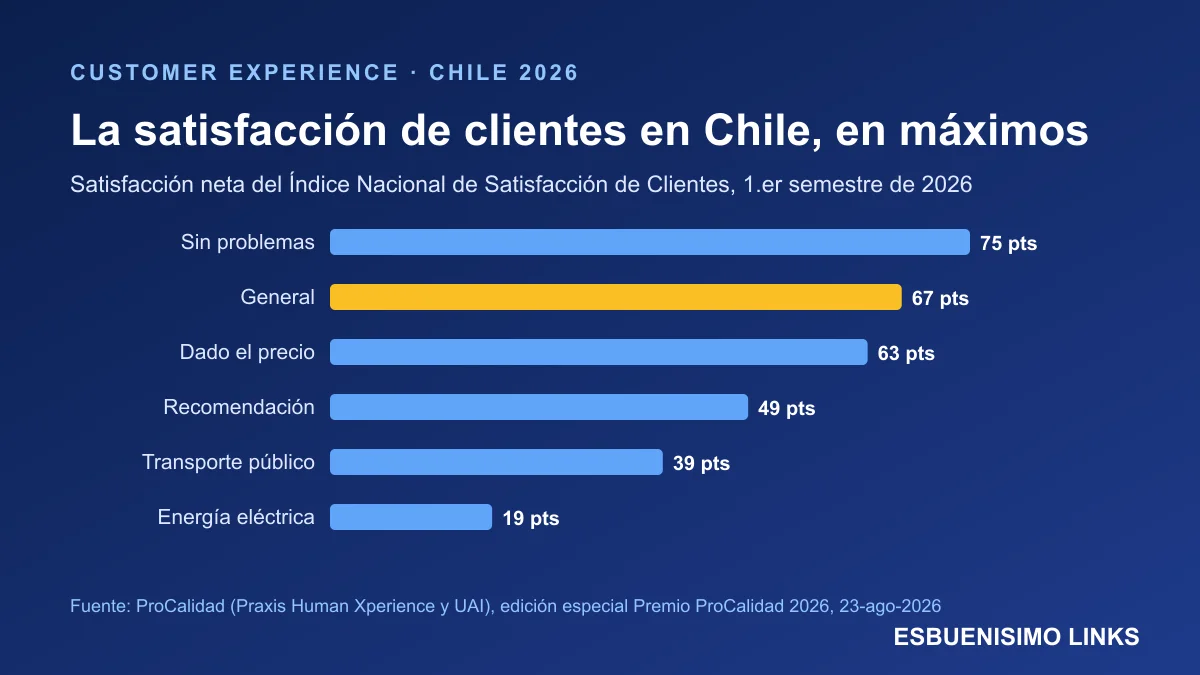
Customer experience is the perception a person forms of a brand from everything they go through with it: the ad, the website, the purchase, the delivery, after-sales and what they read from other customers. Chile has a 25-year-old measurement that puts numbers on it. The ProCalidad National Customer Satisfaction Index, with more than 23,000 surveys per half-year among customers of more than 120 brands, hit a record high of 67 points of net satisfaction in 2026. It also showed something more useful for any manager: a badly handled problem erases almost everything else.
View the data as a table
| points of overall net satisfaction, the highest on record | 67 |
| of customers report having a problem (18% in 2021) | 9% |
| of those with a problem reported it to the company | 78% |
| of those who reported it feel it was resolved | 42% |
What customer experience is
Customer experience (CX) is the sum of a customer's interactions with a brand and the impression they leave. It is not the same as customer service: service is the function that answers questions and complaints; experience also includes the product, the price, how easy it is to buy, delivery and what customers see before they arrive, such as reviews, press coverage and AI answers.
The basic tool to manage it is the journey map. We explain it in our customer journey guide: stages, touchpoints and the moments where the experience breaks. Customer experience is the verdict on that whole journey.
Interest in the topic spans the region. According to Google Ads, "customer experience" is searched about 1,300 times a month in Argentina, 1,000 in Mexico, 720 in Peru, 590 in Colombia and 320 in Chile, while in the United States it reaches about 5,400 monthly searches with a cost per click above US$15.
View the data as a table
| Argentina | 1,300 |
| Mexico | 1,000 |
| Peru | 720 |
| Colombia | 590 |
| Chile | 320 |
Customer experience in Chile: what the 2026 data says
The ProCalidad index, run by Praxis Human Xperience and Universidad Adolfo Ibáñez, tracks five indicators through phone surveys of a random sample, without using customer lists supplied by the companies. In the first half of 2026 the results were the best in the series.
| Indicator | First half of 2026 | What it measures |
|---|---|---|
| Overall satisfaction | 67 points | Overall rating of the service (record high) |
| Satisfaction given price | 63 | Whether what you get is worth what you pay (record high) |
| Intention to stay or repurchase | 62 | Whether the customer plans to stay |
| Net recommendation | 49 | Whether they would recommend the brand |
| Problem incidence | 9% to 10% | Customers who had some issue |
The average hides large gaps. ProCalidad identifies four "desert sectors," where no brand reaches the excellence standard: electricity, water utilities, pharmacies and public transport. Electricity scores just 19 points and public transport 39. Customer experience does not depend only on the company: it also depends on the type of service and how visible a failure is.
🚀 Digital PR & Link Building
Rank #1 on Google and Get Mentioned by AI
1,400+ media outlets in 8 countries. Backlinks that Google and ChatGPT recognize as trusted authority sources.
See plans and pricing →The badly handled problem, the great destroyer
The clearest finding of 2026 appears when customers are split by whether they had a problem. Those who had none reach 75 points of net satisfaction; those who had one fall to -13. That is an 88-point gap. Resolution decides the rest: if the problem was resolved well, satisfaction rises to 15 points; if not, it falls to -38.
| What the customer experienced | Net satisfaction |
|---|---|
| No problem at all | 75 points |
| Had a problem that was resolved well | 15 points |
| Had some problem (average) | -13 points |
| Had a problem that was not resolved | -38 points |
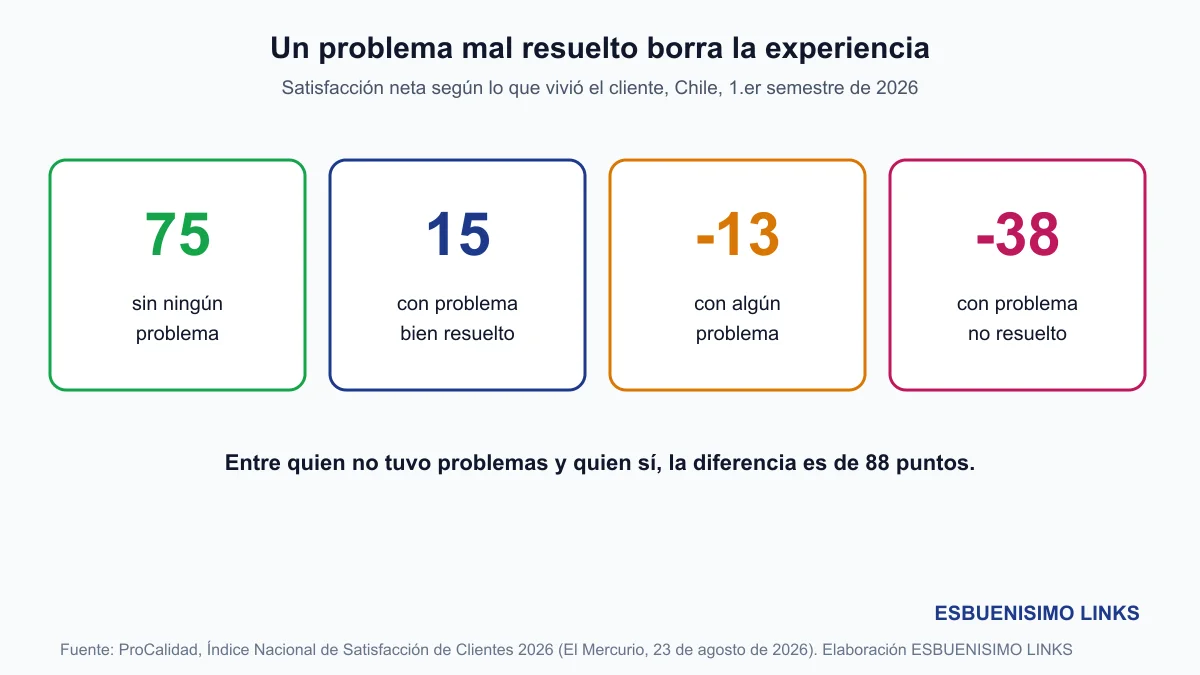
There is good news and bad news. The good: the share of customers reporting a problem fell from 18% in 2021 to 9% in 2026, and 78% of those who have one tell the company. The bad: only 42% of those who complain feel the problem was resolved. When complaining stops working, customers simply leave, and the company loses the information it needed to avoid losing the next one.
Formal complaints show the same map. According to SERNAC's 2026 public accounts report, Chile's consumer protection agency received about 655,000 complaints in 2025, as reported by Radio Agricultura, and three markets accounted for more than half:
| Market | Share of complaints filed with SERNAC, 2025 |
|---|---|
| Retail | 22% |
| Financial services | 18% |
| Telecommunications | 15% |
And complaints do not stay at SERNAC: people also search for them on Google. In our study of the brands with the most complaint searches in Chile we measured 45,590 monthly searches for "reclamo" (complaint) next to the names of 64 brands.
How to measure CX
There is no single customer experience metric. The most common are satisfaction (CSAT), which asks how satisfied the customer was; net promoter score (NPS), which subtracts those who would not recommend the brand from those who would; and customer effort (CES), which measures how hard it was to get what they needed. Two operational metrics that the Chilean data shows to be decisive come on top: the problem rate and the resolution rate. A brand can score well on satisfaction surveys and still lose customers quietly if it does not track how many problems it creates and how many it actually closes.
ProCalidad offers a named example. In its 2026 edition it singled out Copec, Metro de Santiago and Farmacias Ahumada for a decade of sustained improvement in the share of customers who give the top score of 7, on Chile's 1-to-7 grading scale. For Copec, at its service stations, the problem rate was 9% and resolution 62%: a short, standardized experience can also build good scores consistently.
Experience starts before the purchase: reviews, press and AI
A growing part of customer experience happens before the customer talks to the company. BrightLocal's Local Consumer Review Survey 2026, of 1,002 US consumers, found that 97% read reviews before choosing a business, 68% only use businesses with four stars or more and 45% already ask ChatGPT or another AI for recommendations, up from 6% the year before.
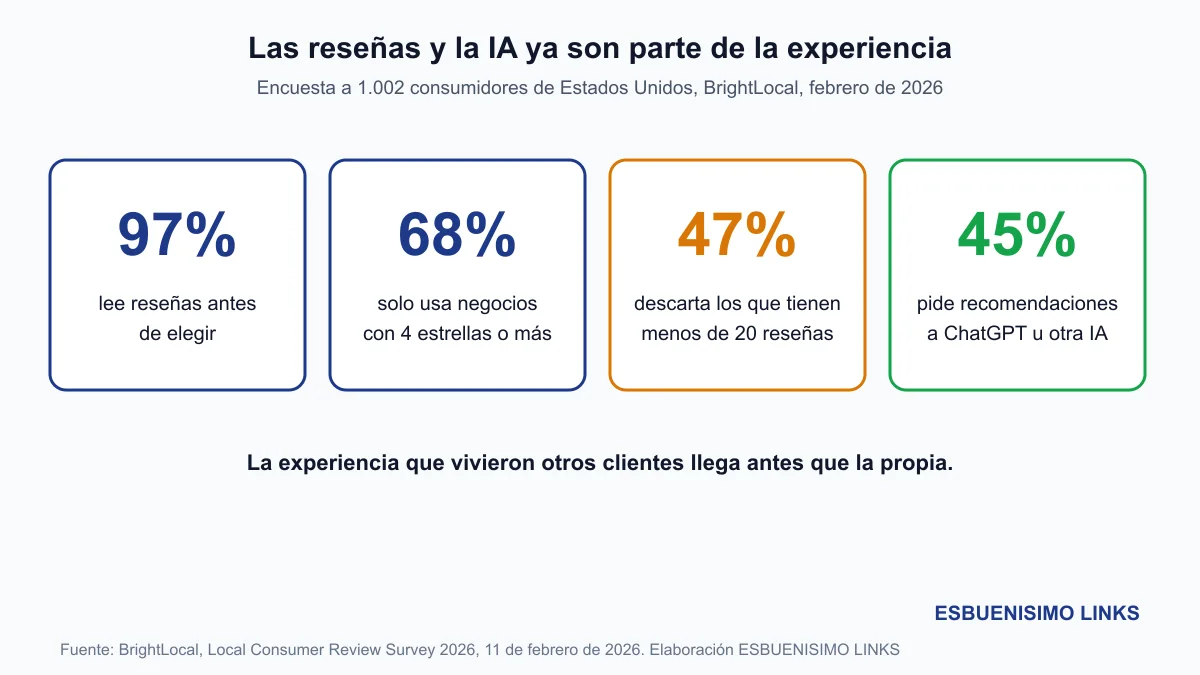
That means the experience other customers had, told in reviews, forums and media, arrives before the customer's own. We analyze this in our guide to user-generated content. And when AI builds a recommendation, it mixes those reviews with what media outlets publish: a brand with good press coverage and consistent reviews has a better chance of being named. Working on that layer is part of what a GEO agency does, and earning stories with links in real outlets is what we offer at esbuenisimolinks.com/link-building-chile.
How to improve customer experience in 5 steps
- Measure with method. A survey answered only by app users does not represent the whole customer base. Use a random sample large enough for the level where decisions are made.
- Prevent before you serve. Every problem avoided is worth more than one well resolved: the gap between no problems and one problem is 88 points.
- Resolve, do not just respond. A case number is not a solution. The metric that matters is whether the customer feels the problem is over.
- Look after the pre-purchase experience. Answer reviews, correct wrong information and be present in trusted outlets, because that is what customers and AI read.
- Measure after acting. Every improvement should have an expected indicator and a date to check whether it worked.
Customer experience is no longer decided only at the branch or the call center. It is also decided on Google, in reviews and in what ChatGPT answers when someone asks about the brand, and there the reputation built by media coverage weighs as much as service.
Frequently Asked Questions
What is CX in customer experience?+
CX is the abbreviation of customer experience: the sum of every interaction a person has with a brand, from first hearing about it to after the purchase, and the perception those interactions leave.
What is the difference between customer service and customer experience?+
Customer service is a function that answers questions and complaints. Customer experience covers the whole journey: advertising, website, purchase, delivery, use, after-sales and what others say about the brand. Customer service is one part of the experience.
What is CX vs CRM?+
CRM (customer relationship management) is the software and process a company uses to record and manage its relationship with customers. CX is how customers perceive that relationship. A CRM can help improve CX, but it does not measure it on its own.
How is customer experience measured?+
With indicators such as satisfaction (CSAT), net promoter score (NPS), customer effort (CES), problem rate and resolution rate. In Chile, the ProCalidad index tracks satisfaction, satisfaction given price, recommendation, retention and problems across more than 120 brands.
What are good customer experience examples?+
Companies that prevent problems and fix the ones that happen. In Chile's 2026 ProCalidad index, Copec service stations stood out with a 9% problem rate and 62% resolution, and the index found that satisfaction drops from 75 to -38 points when a problem is not resolved.
Ready to rank #1 and get mentioned by AI?
Digital PR & Link Building in 1,400+ media outlets across 8 countries. Google and ChatGPT recognize you as an authority source.
See plans and pricing