By Felipe Morales, CEO of ESBUENISIMO LINKS
Customer journey: what it is, its stages and how it changes when customers ask AI
Customer journey: what it is, its five stages, how to build a map and what changes now that customers ask ChatGPT and Gemini for a brand shortlist. With 2026 data.
The customer journey is the path a person follows from spotting a need to buying and buying again. Mapping it shows where the customer is at each moment, what they need and what makes them move forward or drop out. In 2026 that path has a new step, and it keeps getting shorter: asking AI. ChatGPT, Gemini and Google answer “which is the best store to buy a TV?” with specific names, and a brand that does not appear is out before the customer visits a single website.
This guide covers the stages of the customer journey, how to build a map and what changes when AI enters the path, with data from Adobe, Gartner and ESBUENISIMO LINKS studies in Chile.
View the data as a table
| growth in AI traffic to US retail sites in the 2025 holiday season | +693% |
| higher conversion for visits coming from AI | +31% |
| of B2B buyers prefer to buy without talking to a sales rep | 61% |
| brands named on average per AI answer in Chile | 4.3 |
What is the customer journey, and why does everyone search for it?
The concept comes from services marketing and spread with the idea that a purchase is not a moment but a sum of contacts: an ad, a search, a review, a conversation with a friend, a store visit. Each contact is a “touchpoint” the brand can design or, at the very least, measure.
Interest is high: in the United States “customer journey map” gets 6,600 monthly searches and “customer journey” 2,900. In Latin America, the English term itself gets 3,600 searches a month in Mexico and 1,600 in Chile, and in Peru the map is searched more than the concept.
| Country | “customer journey” | “customer journey map” | Suggested CPC (US$) |
|---|---|---|---|
| Mexico | 3,600 | 2,400 | 7.83 |
| Peru | 2,400 | 3,600 | 2.47 |
| Colombia | 1,900 | 1,900 | 2.74 |
| Chile | 1,600 | 1,000 | 1.23 |
| Argentina | 1,000 | 720 | 1.03 |
View the data as a table
| Mexico | 3,600 |
| Peru | 2,400 |
| Colombia | 1,900 |
| Chile | 1,600 |
| Argentina | 1,000 |
The five stages of the customer journey
There are models with three, five or seven stages. The most common has five, and each calls for a different metric:
| Stage | What the customer does | Where they look | What to measure | Reference data |
|---|---|---|---|---|
| 1. Discovery | Spots a need | Google, social, media, AI | Brand searches, reach | 4.3 brands per AI answer in Chile |
| 2. Consideration | Compares options | Comparison sites, reviews, AI | AI mentions, share of voice | Falabella in 51 of 80 purchase answers |
| 3. Decision | Picks brand and store | Brand site, prices | Conversion rate | +31% conversion from AI traffic (Adobe) |
| 4. Purchase | Pays and receives | Website, app, store | Average order, abandonment | Varies by industry |
| 5. Post-purchase | Uses, reviews, buys again | Support, email, reviews | Repeat purchase, NPS | Varies by industry |
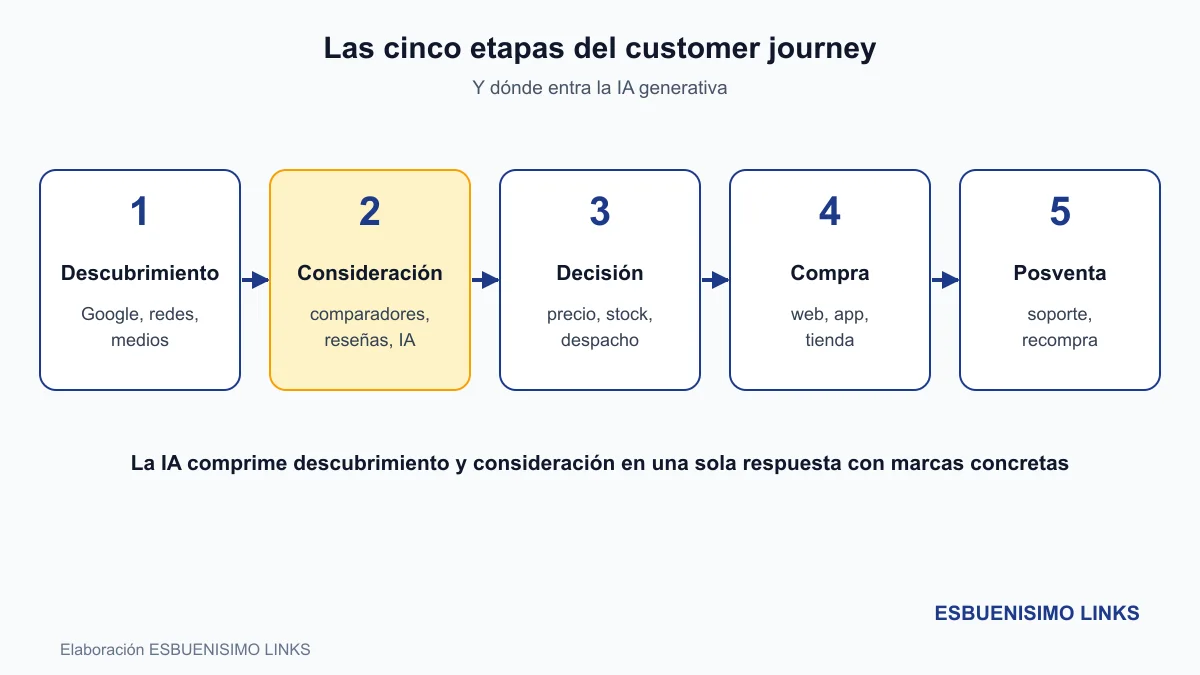
The stage that changed the most is consideration. Customers used to open ten tabs, read comparison sites and reviews, and build a shortlist. Now they ask AI for that list. Business purchases follow the same pattern: according to Gartner, 61% of B2B buyers prefer to buy without talking to a sales rep and do the research on their own, as we explain in our B2B marketing guide.
🚀 Digital PR & Link Building
Rank #1 on Google and Get Mentioned by AI
1,400+ media outlets in 8 countries. Backlinks that Google and ChatGPT recognize as trusted authority sources.
See plans and pricing →How the customer journey changes when customers ask AI
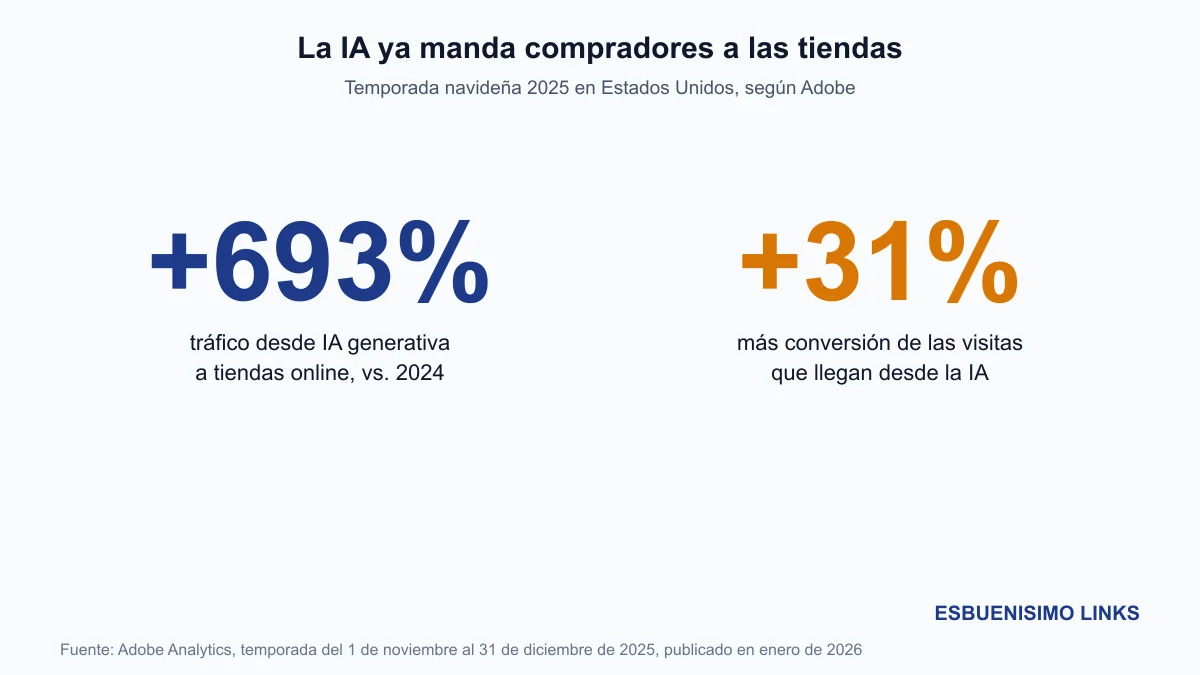
US data shows how fast this is moving. Adobe Analytics found that in the 2025 holiday season (November 1 to December 31), traffic from generative AI tools to US retail sites grew 693% over 2024, and those visits converted 31% better than other sources. The base is still small, but the customer arriving from AI is more decided: consideration already happened in the conversation.
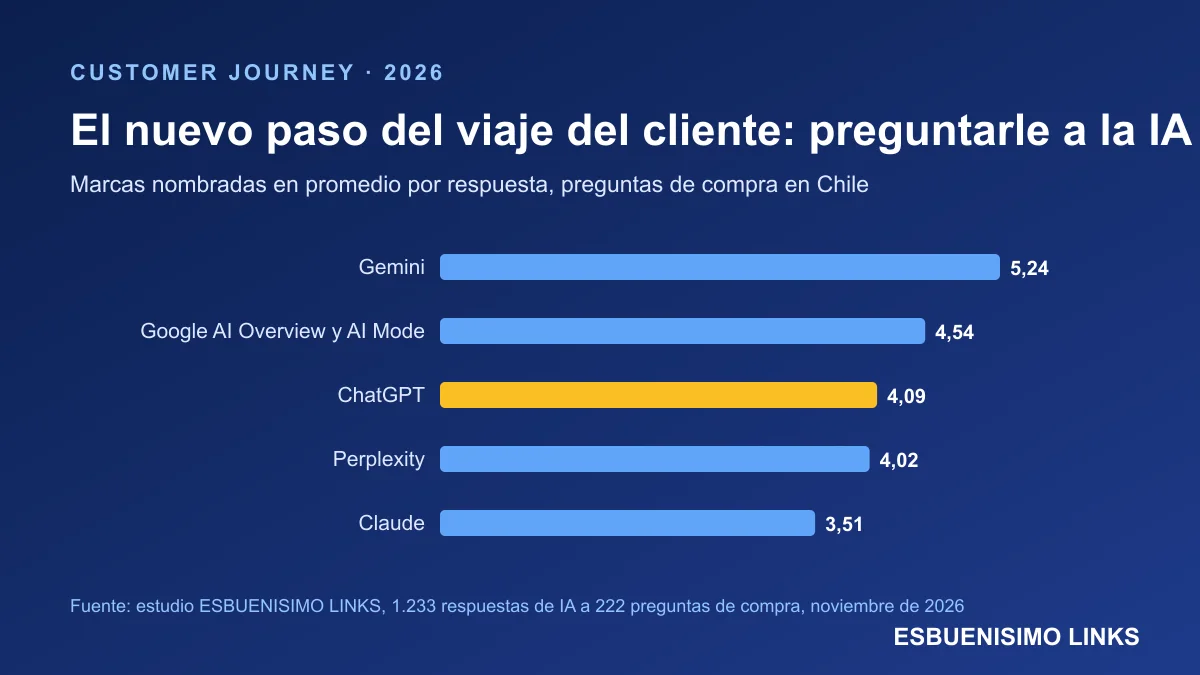
In Chile we measured what happens inside that conversation. Across 1,233 answers from six AI tools to purchase questions in four industries, each answer named an average of 4.3 brands. That is a very short shortlist, and it varies by tool: Gemini names 49% more brands than Claude. The details are in our study of how many brands AI recommends.
| AI tool | Brands named per answer | Difference vs. Claude |
|---|---|---|
| Gemini | 5.24 | +49% |
| Google AI Overview and AI Mode | 4.54 | +29% |
| ChatGPT | 4.09 | +17% |
| Perplexity | 4.02 | +15% |
| Claude | 3.51 | - |
The second question is where those brands come from. In 40 purchase questions in Chile, 55% of the sources ChatGPT cited were large retailers' own websites, while Google AI Mode cited more news media (10.1%) and social networks, according to our study of the stores ChatGPT recommends in Chile. To show up at the consideration stage, a brand needs clear information on its own site and a presence in the outside sources each AI reads.
View the data as a table
| Large store websites | Comparison sites | News media | Other | |
|---|---|---|---|---|
| ChatGPT | 55.1% | 6.9% | 1.8% | 36.2% |
| Google AI Mode | 31.3% | 5.1% | 10.1% | 53.5% |
Two customer journey examples from Chile
Ecommerce: a TV on Black Friday. Discovery starts weeks ahead: in 2025, “cuándo es el black friday” (when is Black Friday) had 125,570 searches in Chile, and “black friday televisores” (TVs) had 1,000 in November alone. During consideration, the customer compares models on a comparison site or asks AI which store is best; only a few brands appear there, almost always the big ones. At the decision stage price, stock and delivery matter, and after the purchase, installation and warranty. A mid-sized store that only runs ads on the day of the event arrives late to the first two stages.
B2B: payroll software. The path is longer and a committee makes the call. The search “software de remuneraciones” (payroll software) has the highest cost per click in our study of Google Ads keywords in Chile (US$26.06), a sign of how valuable it is to reach that buyer. Before asking for a demo, the team reads comparisons, business press and, increasingly, asks AI for a list of vendors. A vendor that is missing from that list does not get the call. In both cases, the work that decides the sale happens before the customer ever fills out a form.
How to build a customer journey map in 2026
- Pick one specific customer (a buyer persona) and one specific purchase. A map for “all customers” is useless.
- List the real touchpoints at each stage, with data: Google searches, visits, calls, reviews. Include the questions that customer would ask ChatGPT.
- Ask AI those questions and note which brands appear, in what order and with which sources. It is the new “moment of truth”.
- Mark where customers drop off: pages with high exits, questions where the brand does not appear, unanswered reviews.
- Assign an owner and a metric to each stage, and review the map every quarter.
Customer journey and visibility: what to do with the map
A well-built map almost always reveals the same gap: the brand invests in the decision stage (ads, promotions, the website) and neglects the early stages, where the shortlist takes shape. Today those stages are won with presence on Google and in the sources AI reads: media stories, comparison sites, reviews and links that give the site authority.
At ESBUENISIMO LINKS we measure which questions a brand appears in and which sources it competes with, and we work to get it into those sources. Our GEO agency handles visibility in ChatGPT, Gemini and Google, and our link building in Chile adds stories in real media that work for both Google and AI.
Frequently Asked Questions
What is the customer journey?+
It is the path a customer follows from spotting a need to buying and buying again, with every touchpoint with the brand along the way: searches, ads, reviews, the store and post-purchase support.
What are the stages of the customer journey?+
The most common model has five: discovery, consideration, decision, purchase and post-purchase. Each needs a different metric, from brand searches to repeat purchases.
How do you build a customer journey map?+
Pick a specific customer and purchase, list the real touchpoints at each stage with data, check what AI answers to their questions, mark where they drop off and assign an owner and a metric to each stage.
How does AI affect the customer journey?+
AI compresses discovery and consideration into a single answer: in Chile it names an average of 4.3 brands per purchase answer. According to Adobe, AI traffic to US retail sites grew 693% in the 2025 holiday season and converted 31% better.
What is the difference between a customer journey and a sales funnel?+
The sales funnel looks at the process from the company's side (how many prospects become customers). The customer journey looks at it from the customer's side: what they do, where they look and what they feel at each stage.
Ready to rank #1 and get mentioned by AI?
Digital PR & Link Building in 1,400+ media outlets across 8 countries. Google and ChatGPT recognize you as an authority source.
See plans and pricing