By Felipe Morales, CEO of ESBUENISIMO LINKS
Inbound marketing: what it is, its stages and what it costs vs. Google Ads (2026)
Inbound marketing explained: what it is, its three stages, how it differs from outbound, what it costs vs. Google Ads in Chile and how to attract AI in 2026.
Inbound marketing is a way of attracting customers in which the brand does not chase them with ads but lets itself be found: it publishes useful content, shows up on Google when someone has a question and earns trust before selling. It was popularized by the software company HubSpot, which defines it as a methodology that attracts customers by creating valuable content. The term gets about 2,400 searches a month in the United States, and the Spanish-speaking markets add thousands more.
For a marketing manager the question is practical: should part of the budget move from paid media to content and authority? In this guide we explain what it is, how it differs from outbound, what it costs compared with Google Ads using data from Chile and what changed in 2026, when much of search begins in ChatGPT and in Google's AI summaries.
| Country | “inbound marketing” | “qué es inbound marketing” (what is inbound marketing) | Suggested CPC (US$) |
|---|---|---|---|
| Mexico | 2,400 | 390 | 1.41 |
| Colombia | 1,300 | 320 | 1.10 |
| Peru | 1,000 | 210 | 0.87 |
| Argentina | 720 | 140 | 0.91 |
| Chile | 590 | 110 | 1.20 |
| Spain | 1,900 | 390 | 4.49 |
View the data as a table
| Mexico | 2,400 |
| Colombia | 1,300 |
| Peru | 1,000 |
| Argentina | 720 |
| Chile | 590 |
What inbound marketing is and how it works
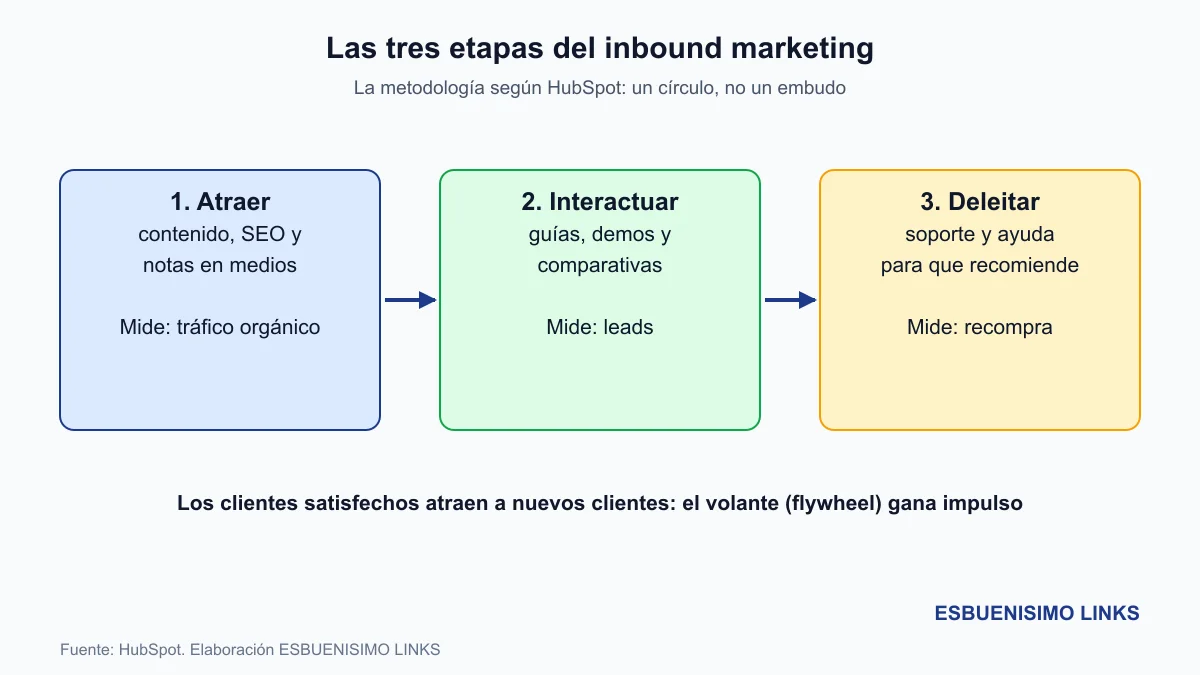
The core idea is simple: instead of paying to interrupt someone with an ad, the brand creates content that answers what that person is already looking for. HubSpot organizes the methodology into three stages:
- Attract: content and conversations that draw in the right people and establish the brand as a trusted advisor. This is where the blog, SEO and media stories come in.
- Engage: solutions aligned with that person's pain points and goals, so they are more likely to buy. Downloadable guides, demos, comparisons.
- Delight: help and support so the customer succeeds with the product and recommends it.
When the three stages work together, HubSpot calls it a flywheel: satisfied customers bring new ones and the system gains momentum. It is the same logic as the sales funnel, seen as a loop rather than a funnel that ends at the purchase.
Inbound vs. outbound marketing: the difference in one table
Outbound is traditional push marketing: ads, cold calls, mass emails and paid advertising. It is not bad, and most companies combine both. The difference lies in how cost behaves over time.
| Inbound marketing | Outbound marketing | |
|---|---|---|
| How it reaches the customer | The customer finds the brand while searching | The brand interrupts the customer |
| Typical channels | SEO, blog, media stories, newsletters, social | Ads, cold calls, paid advertising |
| Cost over time | High at first, falls over the months | Constant: you pay for every impression or click |
| If investment stops | Content keeps bringing visits | The flow stops the next day |
| Time to results | 3 to 12 months | Immediate |
When does each one make sense? Outbound works for a launch with a fixed date, a short promotion or a market where nobody searches for the category yet. Inbound pays off when people already search for the problem the company solves, when the sales cycle is long and the customer researches before deciding (software, education, financial services, health) and when cost per click is high. In practice, many companies run Google Ads while their content gains rankings, then cut paid spend as organic traffic grows. The two approaches are less rivals than stages: paid traffic buys time, and content builds the asset that keeps working once the budget runs out.
🚀 Digital PR & Link Building
Rank #1 on Google and Get Mentioned by AI
1,400+ media outlets in 8 countries. Backlinks that Google and ChatGPT recognize as trusted authority sources.
See plans and pricing →What inbound marketing costs compared with Google Ads
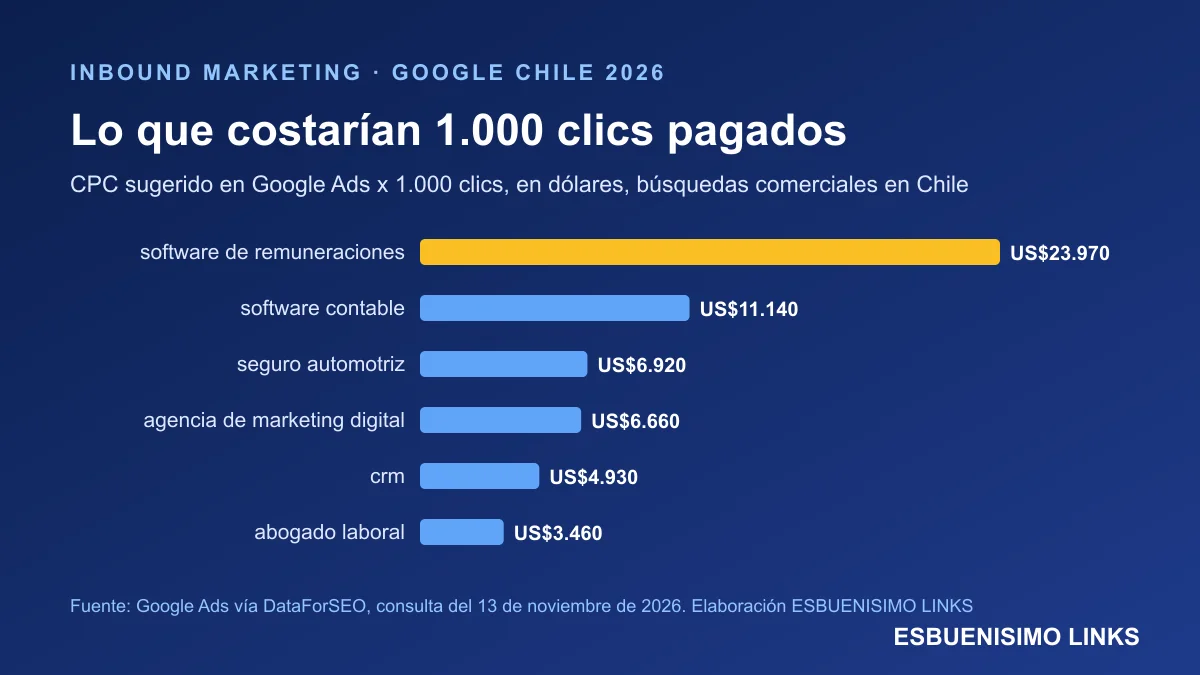
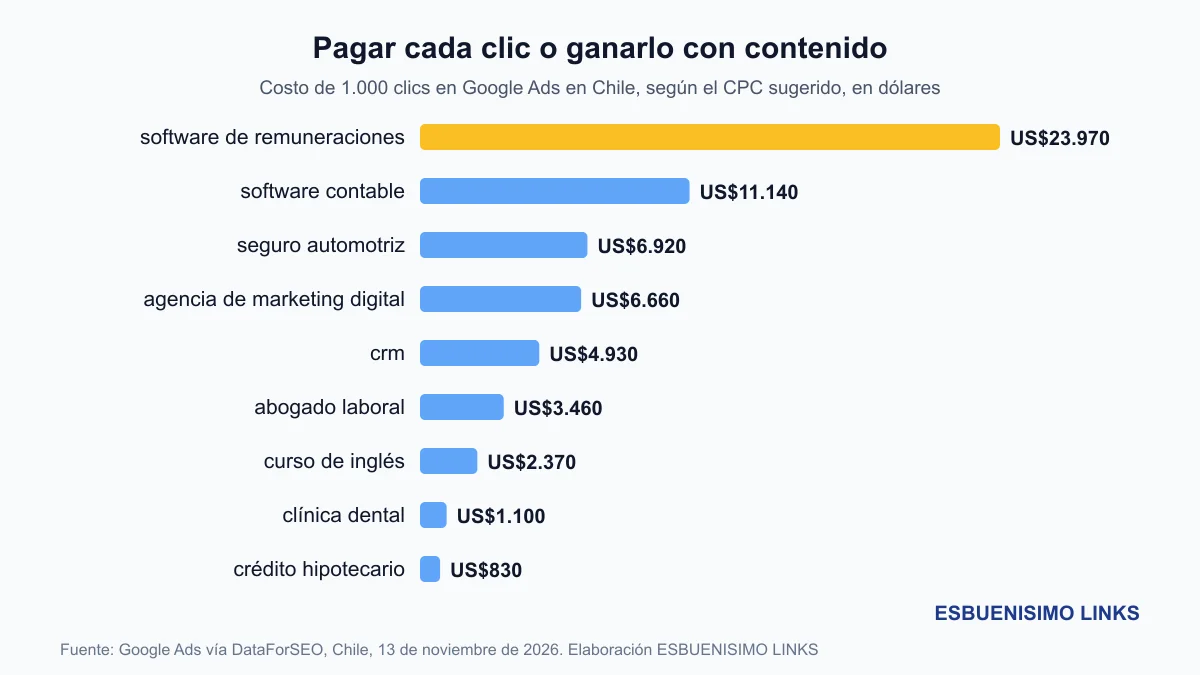
The clearest way to see the value of inbound is to look at the cost of the traffic it replaces. On Google Chile, a click on “software de remuneraciones” (payroll software) has a suggested cost of US$23.97; on “seguro automotriz” (car insurance), US$6.92. A company that ranks organically for those searches gets those clicks without paying for each one.
| Search on Google Chile | Searches per month | Suggested CPC (US$) | Cost of 1,000 clicks (US$) |
|---|---|---|---|
| payroll software | 140 | 23.97 | 23,970 |
| accounting software | 480 | 11.14 | 11,140 |
| car insurance | 18,100 | 6.92 | 6,920 |
| digital marketing agency | 590 | 6.66 | 6,660 |
| crm | 9,900 | 4.93 | 4,930 |
| employment lawyer | 5,400 | 3.46 | 3,460 |
| English course | 8,100 | 2.37 | 2,370 |
| dental clinic | 9,900 | 1.10 | 1,100 |
| mortgage | 22,200 | 0.83 | 830 |
With a thousand clicks a month on “software contable” (accounting software), the Google Ads bill would reach about US$11,000 a month. Inbound is not free, because it takes content, time and authority, but the cost does not repeat with every visit. We go deeper into these figures in our study of the most expensive Google Ads keywords in Chile.
The five building blocks of an attraction strategy
An inbound marketing strategy for a B2B company or an ecommerce store usually has five pieces:
- Buyer persona: who we are talking to, what they search for and what worries them.
- Content for each stage: articles that answer early questions, comparisons for those evaluating and case studies for those about to decide. The foundation is content marketing.
- SEO: getting that content to show up on Google. Without rankings, the best article goes unread.
- External authority: links and mentions from other sites, especially media. That is what tells Google, and now AI, that the brand is trustworthy.
- Conversion and follow-up: forms, emails and a CRM so you do not lose those who already arrived.
The most overlooked piece is the fourth. Many companies publish good content on their blog and expect Google to reward it on its own, but in competitive searches content without external links rarely reaches the first page. A link from an established outlet works like a recommendation: it tells Google that someone independent considers that content valuable.
In 2026 you also have to attract AI
The attract stage has changed. Part of the audience no longer clicks through ten blue links: it reads Google's AI summary or asks ChatGPT. And those answers are built mostly from what third parties say. According to Muck Rack's Generative Pulse, 84% of ChatGPT, Claude and Gemini citations come from earned media, meaning content the brand neither paid for nor published on its own site.
View the data as a table
| of ChatGPT, Claude and Gemini citations come from earned media | 84% |
| of links cited by AI are journalism | 27% |
| Chilean industries where AI cites third parties more than brands | 4 of 4 |
We saw the same in Chile in our own study of 9,375 citations from six AI tools: in all four industries analyzed, more than half of the sources were sites other than the brands being evaluated. For inbound, that means your own blog is no longer enough. You also need to be in the media, comparison sites and lists that AI consults.
How to get started in 90 days
- Weeks 1 and 2: define the buyer persona and list the 30 searches they make before buying, with real volumes.
- Weeks 3 to 8: publish the first 8 to 12 pieces, starting with those with commercial intent.
- Weeks 4 to 12: earn links and mentions in industry media pointing to those pieces.
- Week 12: measure rankings, organic traffic, leads and mentions in ChatGPT and Gemini.
At ESBUENISIMO LINKS we handle the part that is hardest to do in-house: authority. With our link building service in Chilean media we publish linked stories in real media across the region, and if you need the full ranking plan, our SEO agency builds it with you.
Frequently Asked Questions
What is inbound marketing?+
It is attraction marketing: the brand draws in customers with useful content that shows up when people search, instead of interrupting them with ads. It was popularized by HubSpot.
What are the four stages of inbound marketing?+
HubSpot now uses three: attract, engage and delight. Older versions listed four (attract, convert, close and delight). Both describe the same path from stranger to promoter.
What is the difference between inbound and outbound marketing?+
Inbound attracts customers while they search and its cost falls over time; outbound interrupts them with ads or calls and is paid per impression or click.
How long does inbound marketing take to work?+
Between 3 and 12 months, depending on competition and the site's authority. Content without external links takes longer to rank.
Does inbound marketing help you show up in ChatGPT?+
Yes, if it includes third-party content. According to Muck Rack, 84% of ChatGPT, Claude and Gemini citations come from earned media, not from the brand's site.
Ready to rank #1 and get mentioned by AI?
Digital PR & Link Building in 1,400+ media outlets across 8 countries. Google and ChatGPT recognize you as an authority source.
See plans and pricing