By Felipe Morales, CEO of ESBUENISIMO LINKS
Strategic communication: what it is, how to build a plan and why it now includes AI
Strategic communication explained: key elements, a 6-stage plan and what 2026 data from Edelman, Reuters and Muck Rack say about trust and AI citations.
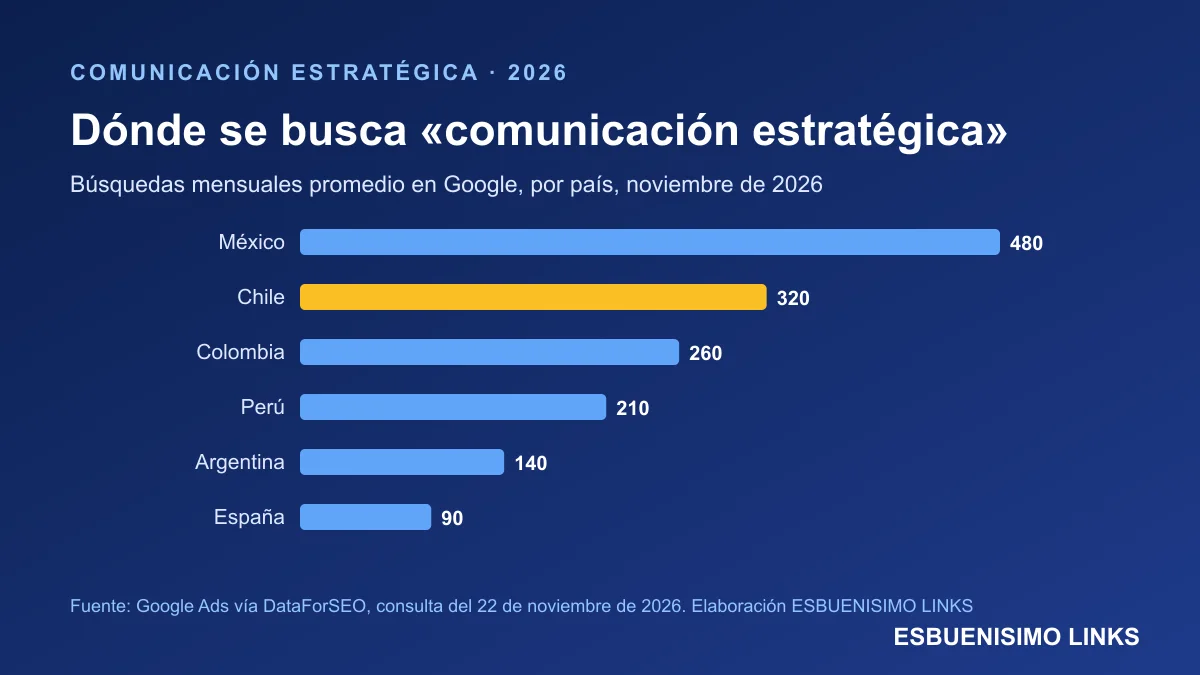
Strategic communication is what separates a company that reacts from one that leads its own conversation. It is not about communicating more, but about communicating with a goal: every story, interview or post should move a number that matters to the business. In 2026 that job has a new audience. When a customer, an investor or a journalist wants to know something about a company, they often ask ChatGPT, and the answer depends on what others have published about it. This guide explains what strategic communication is, how to build a plan and what trust and AI data say.
What strategic communication is
It is communication an organization plans to meet a concrete business or reputation goal. It has four traits: it starts from a measurable goal, it prioritizes audiences (it does not speak to "everyone"), it sustains a core message with proof points and it measures the result. The opposite is tactical communication: the press release that goes out because something has to go out, or the interview accepted without knowing what it is for.
The difference from public relations is one of scope. PR is one of the tools; strategic communication decides when to use it, alongside internal communication, owned content, social media, advertising and executive spokespeople.
Why everything starts with trust
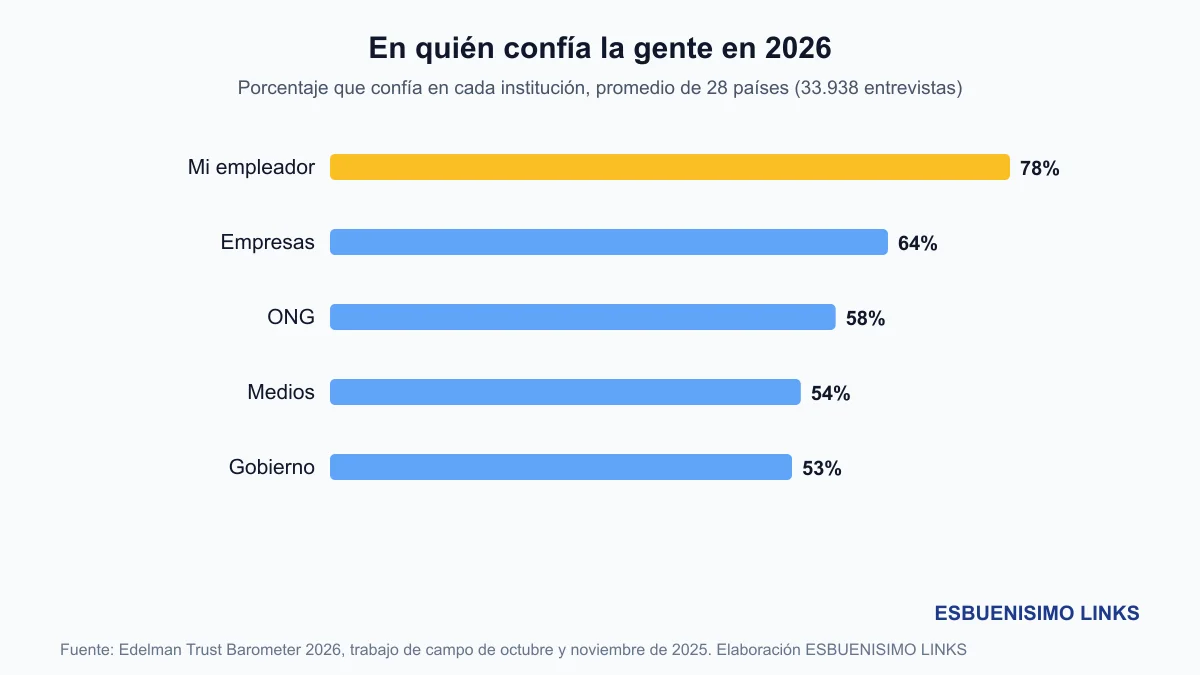
The starting point of any strategy is knowing whom people believe. The 2026 Edelman Trust Barometer, which interviewed 33,938 people in 28 countries, shows that one's own employer is the most trusted institution (78%), followed by business (64%). Media sits at 54% and government at 53%.
| Institution | Trust 2026 | Change vs. 2025 |
|---|---|---|
| My employer | 78% | +2 pts |
| Business | 64% | +2 pts |
| NGOs | 58% | 0 pts |
| Media | 54% | +2 pts |
| Government | 53% | +1 pts |
For a company this has two readings, and both matter for how a communication budget is spent. The first is that it holds its own trust capital, especially through its spokespeople and employees. The second is that this capital is not enough on its own: people still check what a company says against what third parties say. That is why strategy combines the company's own voice with external validation, and why the first step is identifying the company's stakeholders and which sources each of them consults.
🚀 Digital PR & Link Building
Rank #1 on Google and Get Mentioned by AI
1,400+ media outlets in 8 countries. Backlinks that Google and ChatGPT recognize as trusted authority sources.
See plans and pricing →The Chilean case: low trust in news, high trust in some outlets
In Chile, according to the Reuters Institute Digital News Report 2026, only 34% trust most news most of the time. That is 2 points lower than in 2025 and 13 lower than in 2017. Even so, the country ranks near the top of the region, behind only Brazil.
View the data as a table
| Brazil | 36% |
| Chile | 34% |
| Peru | 32% |
| Mexico | 31% |
| Argentina | 26% |
| Colombia | 25% |
The overall figure hides large gaps between outlets: Bío Bío Chile reaches 65% trust among those who know it and CNN Chile 64%. For a strategic communication plan, that changes the question. "Getting press" is not enough: the outlet matters, because one story in a credible outlet does far more work than ten in outlets nobody reads.
How to build a strategic communication plan
A strategic communication plan fits in a few pages if it answers six questions in order. This is the framework we use to organize work with marketing and communication teams.
| Stage | Question it answers | Deliverable |
|---|---|---|
| 1. Diagnosis | What is said about the company today, in media, social and AI? | Reputation and mentions audit |
| 2. Goals | What has to change, and by when? | 2 or 3 measurable goals |
| 3. Audiences | Who must be convinced first? | Stakeholder map |
| 4. Messages | What idea do we want others to repeat? | Core message and 3 proof points |
| 5. Channels and spokespeople | Who says it, and where? | Press, content and spokesperson plan |
| 6. Measurement | Did it work? | Dashboard with outlets, links, share of voice and AI citations |
Two practical tips. First, a third party must be able to repeat the core message without the company's help; if a journalist or an AI assistant cannot sum it up in one sentence, it is too complex. Second, every goal needs an indicator that does not depend on the team's opinion, such as the number of outlets that published, links earned, share of voice against competitors or how often AI names the brand.
Strategic communication in the age of AI
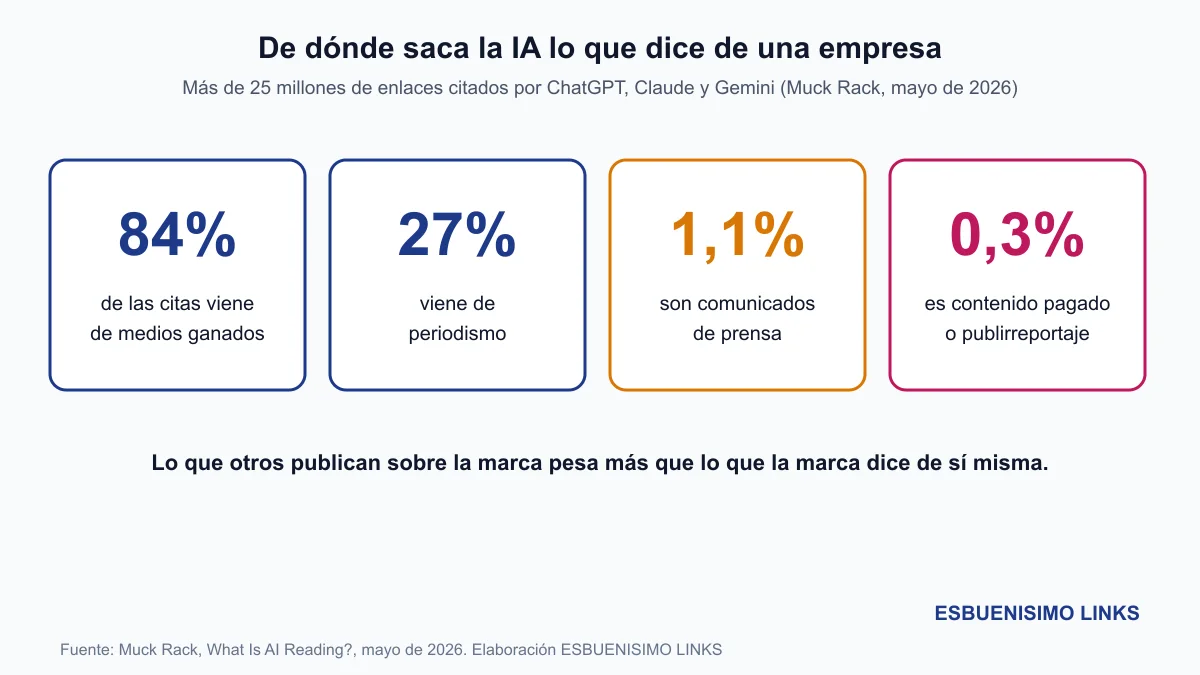
AI assistants have become another reputation channel, and one the company does not control directly. The Muck Rack What Is AI Reading? report (May 2026) analyzed more than 25 million links cited by ChatGPT, Claude and Gemini. 84% came from earned media: journalism, academic research, public sources, encyclopedias, social platforms and third-party sites. Paid content was just 0.3%.
View the data as a table
| of ChatGPT, Claude and Gemini citations come from earned media | 84% |
| come from journalism | 27% |
| are press releases | 1.1% |
| is paid or advertorial content | 0.3% |
| Assistant | Responses that cite sources | Average citations per response |
|---|---|---|
| ChatGPT | 96% | 5 |
| Gemini | 82% | 8 |
| Claude | 55% | 13 |
The consequence for strategy is direct: what AI says about a company is built from what others publish. Modern strategic communication therefore includes a workstream in real outlets with links, because those stories feed both Google and the assistants. That is what we do at ESBUENISIMO LINKS: we publish stories in more than 1,400 Latin American outlets and measure how the brand's presence changes. If the goal is managing spokespeople and journalist relations, the tool is a press agency; if it is earning authority and links, it is link building from ESBUENISIMO LINKS.
AI also changes crisis management. When something goes wrong, ChatGPT's answer can keep showing the negative version for months if no new sources correct it. We covered this in detail in our analysis of crisis management in AI.
An example, step by step
Think of a services company entering a new region of Chile. Without a strategy, the team would send an opening press release and wait. With a strategy, the goal would be different: within six months, the brand appears in the regional outlets its audience reads, its brand searches in that region rise and ChatGPT mentions it when someone asks about the service in that city. The priority audiences would be potential customers and local authorities; the core message, a single idea with three proof points (coverage, price, local service); the channels, stories with links in regional news sites, a local spokesperson and owned content on the website. And measurement, a monthly dashboard with outlets secured, links earned and AI mentions. Each element answers one of the six questions of the plan, and each has an owner and a date, which is what turns a list of good intentions into a strategy that can be reviewed, corrected and defended in front of management.
Common mistakes
- Confusing activity with results. Ten press releases sent is not an achievement; three stories in outlets your audience reads is.
- Talking to everyone at once. A message aimed at customers, regulators and employees at the same time ends up convincing none of them.
- Forgetting spokespeople. With 78% trust in employers, executives and employees are the most credible channel, and many companies do not use it.
- Not measuring in AI. If nobody checks what ChatGPT says about the company, nobody knows what the public is learning that way.
Strategic communication is not a document filed away in March: it is a cycle of diagnosis, action and measurement repeated every quarter, with trust and AI presence as two of its main indicators.
Frequently Asked Questions
What is strategic communication?+
It is communication an organization plans to meet a concrete business or reputation goal. It defines which audiences to address, with what messages, through which channels and spokespeople, and how to measure whether the goal was met.
What are the key elements of strategic communication?+
A measurable goal, prioritized audiences, a core message with proof points, the right channels and spokespeople, a calendar and measurement. If one is missing, communication becomes reactive.
What is the meaning of communication strategy?+
A communication strategy is the plan that sets what an organization will say, to whom, where and when, to reach a specific goal. Strategic communication is the practice of running communication that way.
How is strategic communication different from corporate communication?+
Corporate communication is the function that manages the company's voice. Strategic communication is a way of working: every message serves a goal and is measured. All corporate communication should be strategic, but it often is not.
Why does AI matter for strategic communication?+
Because ChatGPT, Gemini and Claude now answer what a company is and whether to trust it. According to Muck Rack, 84% of what they cite comes from earned media, such as press and third-party sites, so what others publish about a brand shapes what AI says.
Ready to rank #1 and get mentioned by AI?
Digital PR & Link Building in 1,400+ media outlets across 8 countries. Google and ChatGPT recognize you as an authority source.
See plans and pricing