By Felipe Morales, CEO of ESBUENISIMO LINKS
Influencer marketing: what it is, types, how to measure it and what AI cites (2026)
What influencer marketing is, the types of influencers, how to run a measurable campaign, what the FTC and Chile's SERNAC require and why AI cites media more than social posts.
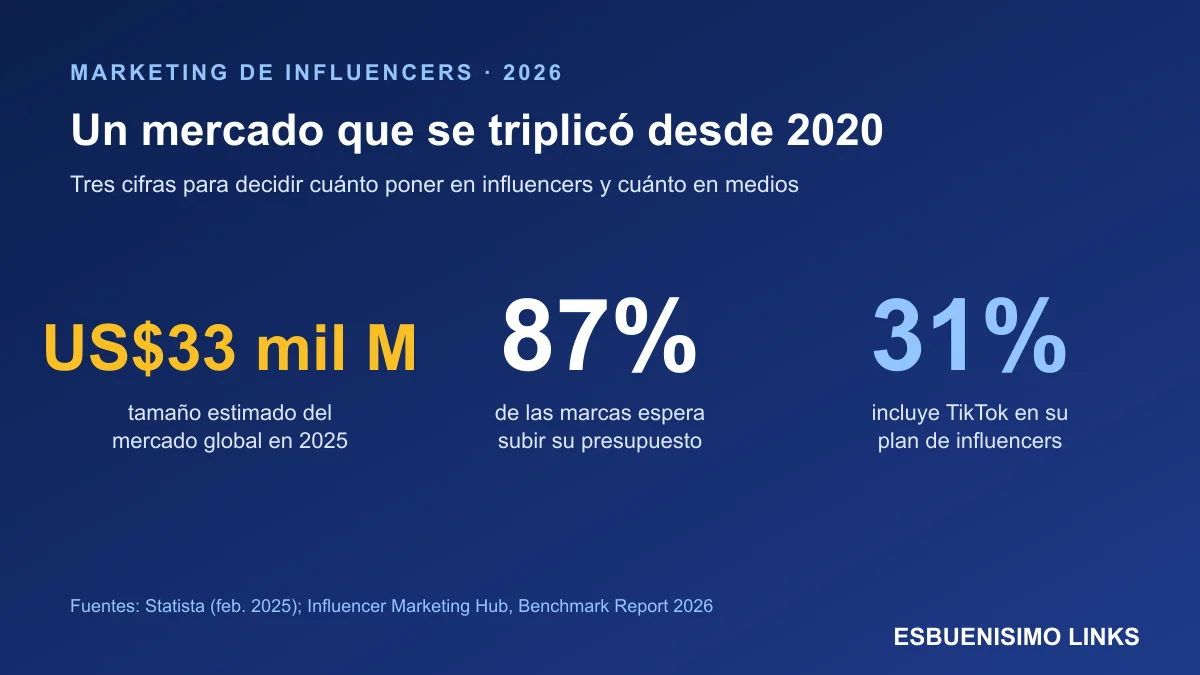
Influencer marketing is a strategy in which a brand pays or partners with content creators who have their own audience on social media, so they talk about its product. It is a large and growing market: according to Statista, citing Influencer Marketing Hub, it reached about US$33 billion in 2025 worldwide, more than triple its 2020 size. In the United States, “influencer marketing” is searched 4,400 times a month.
This guide explains what it is, the types of influencers, how to run a measurable campaign, what the law requires in Chile and the US, and what influencers cannot do that media coverage can, especially now that a growing share of searches goes through ChatGPT and Gemini.
View the data as a table
| of respondents expect their influencer budget to rise | 87.5% |
| run influencer marketing entirely in-house | 66.3% |
| include TikTok in their plans, the top platform | 31% |
What influencer marketing is and how it works
It is word of mouth at scale. Someone who follows a recipe creator trusts her recommendation of a frying pan more than an ad from the brand. The brand pays that creator (in cash, product or a sales commission) and she works it into her content.
The most common formats are paid posts, discount codes with commission, product seeding for reviews, event coverage and long-term brand ambassadors. According to Influencer Marketing Hub's Benchmark Report 2026, 87.5% of respondents expect to raise their budget, TikTok is the most-used platform (31%) and two out of three companies run their programs without an agency.
View the data as a table
| Mexico | 650 |
| Colombia | 260 |
| Peru | 250 |
| Argentina | 160 |
| Chile | 130 |
| Country | “marketing de influencers” | “influencer marketing” | “agencia de influencers” (agency) |
|---|---|---|---|
| Mexico | 260 | 390 | 170 |
| Peru | 140 | 110 | 50 |
| Colombia | 90 | 170 | 50 |
| Argentina | 50 | 110 | 70 |
| Chile | 40 | 90 | 170 |
In Latin America, Mexico searches the topic the most, with 650 monthly searches across “marketing de influencers” and “influencer marketing”. Chile's numbers are lower, but “agencia de influencers” (influencer agency) gets 170 searches a month there, as many as in Mexico: more people are ready to hire than are learning what it is.
Types of influencers: nano, micro, macro and mega
Influencers are usually grouped by follower count. There is no official cutoff, but the industry uses these four tiers.
| Type | Followers | Best for | Main risk |
|---|---|---|---|
| Nano | 1,000 to 10,000 | Local or niche communities, product trials | Low reach; many creators to coordinate |
| Micro | 10,000 to 100,000 | High-trust niches: parenting, sport, tech | Audience quality varies widely |
| Macro | 100,000 to 1 million | Launches and reach campaigns | High cost, less loyal audience |
| Mega | Over 1 million | Mass awareness, celebrities | High price and reputational risk |
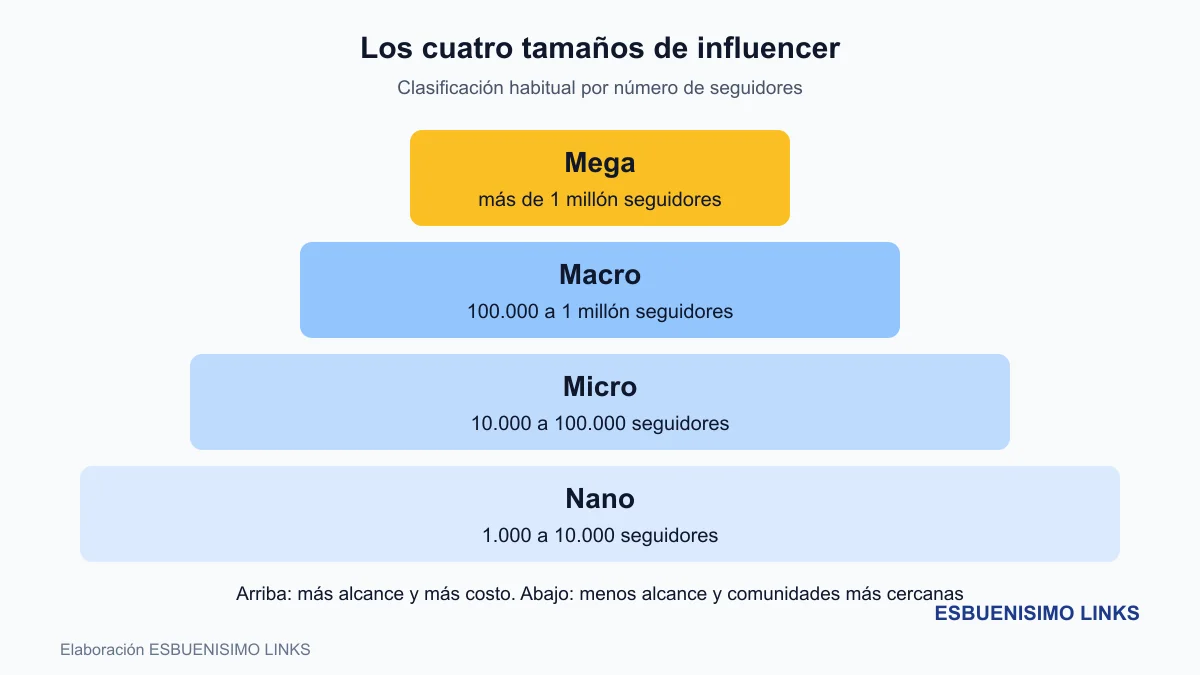
More followers does not mean more sales. Nano and micro influencers tend to have closer communities and higher engagement, and in Influencer Marketing Hub's report more than half of respondents say they want to work with them more. The trade-off is coordination: a campaign with 30 micro influencers takes far more work than one with a single celebrity.
🚀 Digital PR & Link Building
Rank #1 on Google and Get Mentioned by AI
1,400+ media outlets in 8 countries. Backlinks that Google and ChatGPT recognize as trusted authority sources.
See plans and pricing →How to run an influencer marketing campaign step by step
- Set a measurable goal. Sales via code, visits to a page or growth in brand searches. Without a goal, results shrink to likes.
- Choose by audience, not fame. Ask for follower data by country, age and gender. A creator with 40,000 followers in Chile is worth more to a Chilean brand than one with 400,000 spread worldwide.
- Check quality. Sudden follower spikes or generic comments are signs of bought audiences.
- Allow creative freedom. Content that sounds like an ad performs worse. Provide key messages and let the creator say them their way.
- Require ad disclosure. It is a legal obligation, not a detail.
- Track with your own links and codes. A UTM-tagged link and a code per creator show who actually sold.
To see how it fits into the broader brand strategy, read our guide to brand awareness: influencers mostly work on recognition and recall.
What the law requires: labeled advertising
In the US, the FTC's Disclosures 101 guide asks influencers to disclose any brand relationship, even a free product, right next to the content rather than buried among hashtags, using plain words like “ad” or “sponsored”.
In Chile, SERNAC issued an interpretive circular on native advertising and influencers in 2022. It requires advertising to be identified “clearly and prominently”, the commercial tie between brand and influencer to be visible, product features to be explained properly and special care with content aimed at children. Liability falls on the advertiser; influencers answer for it when they sell their own products.
- Nov. 2019FTC publishes “Disclosures 101”US guide: disclose any brand relationship, next to the content, in plain words such as “ad” or “sponsored”.
- Feb. 2022SERNAC: general advertising circularExempt resolution 176, whose principles also apply to native advertising and influencers.
- Jun. 2022SERNAC: circular on native ads and influencersExempt resolution 534, dated June 16; announced July 20, 2022.
- Jul. 2022What Chile requiresAdvertising must be identified clearly and prominently, and the commercial tie between brand and influencer made visible.
When influencer marketing makes sense, and when it doesn't
It works best for consumer products that can be shown on camera: beauty, fashion, food, travel, personal tech. A creator using the product in front of her audience does something an ad cannot. It also helps with launches, when a brand needs a burst of conversation in a few days.
It makes less sense for B2B services, for financial or health products with strict advertising rules and for categories where buyers research for weeks before deciding. There, comparisons, stories in specialized media and what Google or ChatGPT answer when someone asks for the best option carry more weight. The most common mistake is measuring reach alone: a campaign with millions of views and no code, no tracked link and no rise in brand searches leaves nothing to evaluate. Before signing a creator, agree on what success looks like and how you will see it in your own data, not only in the screenshots the creator sends after the campaign ends.
Influencers vs. media: what AI cites
This is the difference many brands miss. Influencer content lives on social media: it lasts a few days in the feed, stories vanish in 24 hours and its links add no authority on Google. There is one major exception: YouTube, which appeared in 68% of Google's AI Overviews in our Latin America study. Media stories, by contrast, stay indexed for years, earn links and are among the favorite sources of ChatGPT, Gemini and Google AI Mode.
| Influencers | Media coverage | |
|---|---|---|
| What it brings | Fast reach and direct sales with codes | Third-party credibility and authority |
| How long it lasts | Days: the post sinks in the feed | Years: the story stays indexed on Google |
| SEO effect | Almost none: social links don't pass authority | A link from an outlet adds domain authority |
| AI effect | It depends: YouTube videos show up in Google's AI summaries; 24-hour stories don't | High: in Chile, more than half of AI citations go to third-party sites |
| How to measure | Reach, engagement, sales via codes | Visits, rankings, AI mentions |
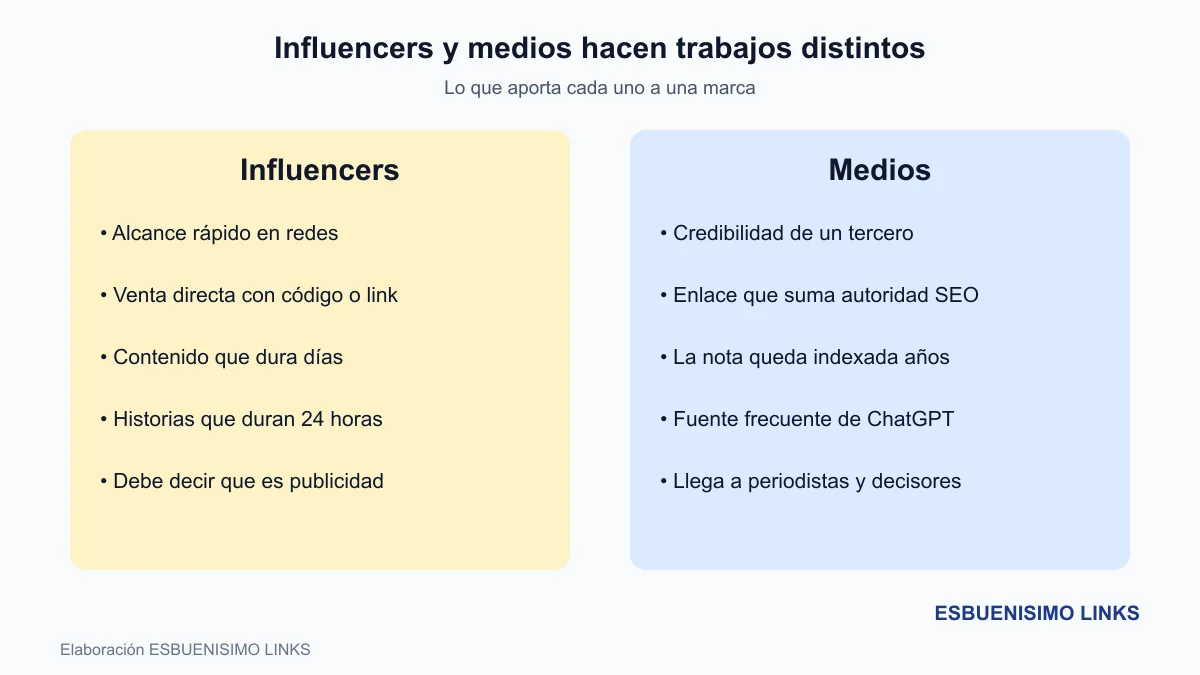
We measured it in Chile. In our study of the sources AI cites by industry, covering more than 9,000 citations from six tools, more than half of citations went to third-party sites, not to brands themselves, in all four industries studied. A brand that wants AI to mention it needs others writing about it on sites AI reads.
The practical takeaway is to combine both. Influencers drive short-term sales and awareness; media build the credibility that Google and AI read later. For the second part, our press agency secures stories in outlets across the region, and at ESBUENISIMO LINKS we also run link building with Chilean media so those stories add authority. If your campaign already includes paid content in outlets, see how it should be labeled in our guide to public relations.
| Mexico | 260 | 390 | 40,500 | 170 | 320 |
| Peru | 140 | 110 | 6,600 | 50 | 140 |
| Colombia | 90 | 170 | 14,800 | 50 | 140 |
| Argentina | 50 | 110 | 14,800 | 70 | 110 |
| Chile | 40 | 90 | 8,100 | 170 | 110 |
Frequently Asked Questions
What is influencer marketing?+
It is a strategy in which a brand pays or partners with content creators who have their own social media audience so they recommend or show its product.
What are the types of influencers?+
By follower count: nano (1,000 to 10,000), micro (10,000 to 100,000), macro (100,000 to 1 million) and mega (over 1 million). There is no official cutoff, but the industry uses these tiers.
Do influencers have to disclose ads?+
Yes. In the US, the FTC requires disclosing any brand relationship next to the content. In Chile, SERNAC's 2022 circular requires advertising to be identified clearly and prominently.
How do you measure an influencer campaign?+
With a goal set beforehand and your own tracking: a UTM-tagged link and a discount code per creator, plus reach and engagement.
Does influencer marketing help a brand appear in ChatGPT?+
It depends on the format. YouTube videos often appear in Google's AI Overviews, but stories and ephemeral posts do not. For AI to name a brand, media stories and third-party sites carry more weight.
Ready to rank #1 and get mentioned by AI?
Digital PR & Link Building in 1,400+ media outlets across 8 countries. Google and ChatGPT recognize you as an authority source.
See plans and pricing