By Felipe Morales, CEO of ESBUENISIMO LINKS
Marketing mix: what it is, the 4Ps of marketing and examples from Chilean companies
Marketing mix explained: the 4Ps of marketing (product, price, place, promotion) with examples from Chilean companies, Gartner budget data and the role of media and AI in promotion.
The marketing mix is the set of decisions a company uses to take a product to market. The best-known version is the 4Ps of marketing: product, price, place and promotion. The model is more than 60 years old, but it's still the simplest way to organize a marketing plan and spot where it's failing.
This guide explains what the marketing mix is, each of the 4Ps with examples from Chilean companies, what changed in promotion with digital media and artificial intelligence, and how to build your own.
What the marketing mix is
The term was popularized by Harvard professor Neil Borden, who explained it in his article “The Concept of the Marketing Mix” (1964). Borden talked about a dozen ingredients. In 1960, E. Jerome McCarthy had grouped them into four in his book Basic Marketing, and the 4Ps were born. Variants followed: the 7Ps for services and the 4Cs, which look at the same thing from the customer's side.
| Model | Author and year | Elements | When to use it |
|---|---|---|---|
| 4Ps | E. Jerome McCarthy, 1960 | 4: product, price, place, promotion | Physical products and general planning |
| 7Ps | Booms and Bitner, 1981 | 7: adds people, process and physical evidence | Services: clinics, banks, education, software |
| 4Cs | Robert Lauterborn, 1990 | 4: customer, cost, convenience, communication | Looking at the mix from the customer's side |
Which one should you use? For a consumer product, the 4Ps are enough. For a service, add Booms and Bitner's three extra Ps, because the experience depends on who serves the customer and how the process works: at a bank or a clinic, the account manager and the waiting time are part of the product. And to check whether the plan makes sense for the customer, the 4Cs force you to translate every decision into their point of view: price becomes total cost and place becomes convenience.
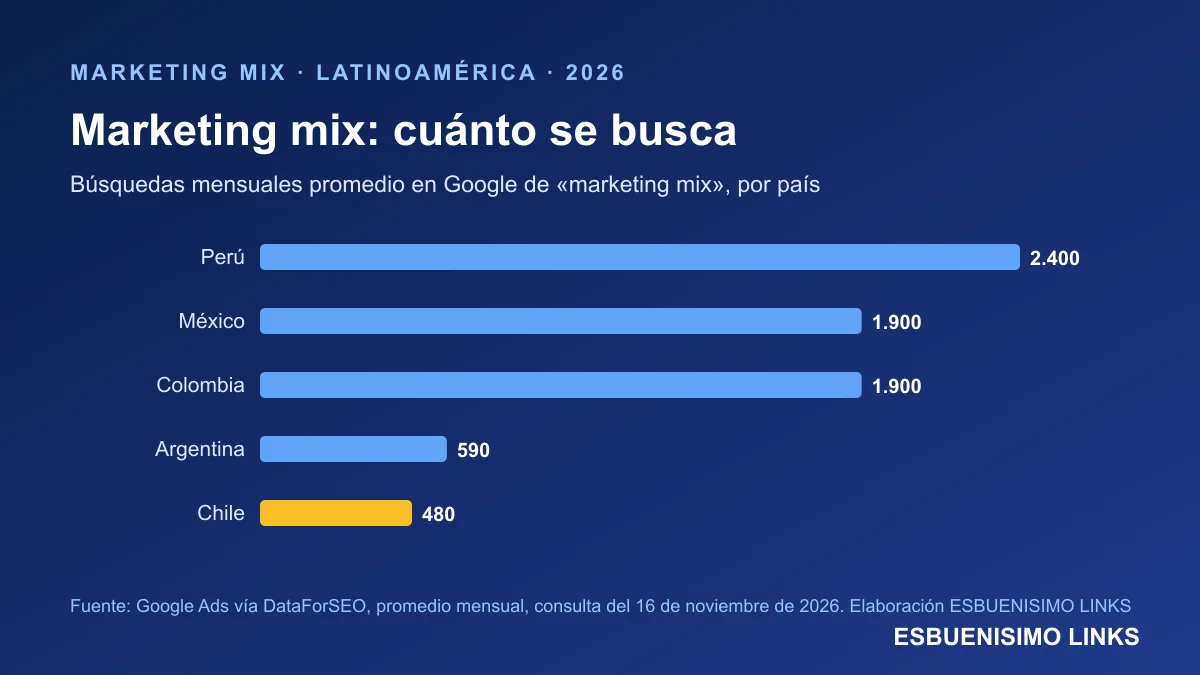
Interest in the concept is high across Latin America. “Marketing mix” gets 2,400 searches a month in Peru, 1,900 in Mexico and Colombia and 480 in Chile, and “las 4P del marketing” adds another 1,000 in Peru and Mexico. In the United States, “marketing mix” reaches 12,100 monthly searches.
View the data as a table
| Peru | 2,400 |
| Mexico | 1,900 |
| Colombia | 1,900 |
| Argentina | 590 |
| Chile | 480 |
| Peru | 2,400 | 480 | 1,000 |
| Mexico | 1,900 | 1,000 | 1,000 |
| Colombia | 1,900 | 390 | 480 |
| Argentina | 590 | 390 | 480 |
| Chile | 480 | 210 | 210 |
The 4Ps of marketing with examples from Chilean companies
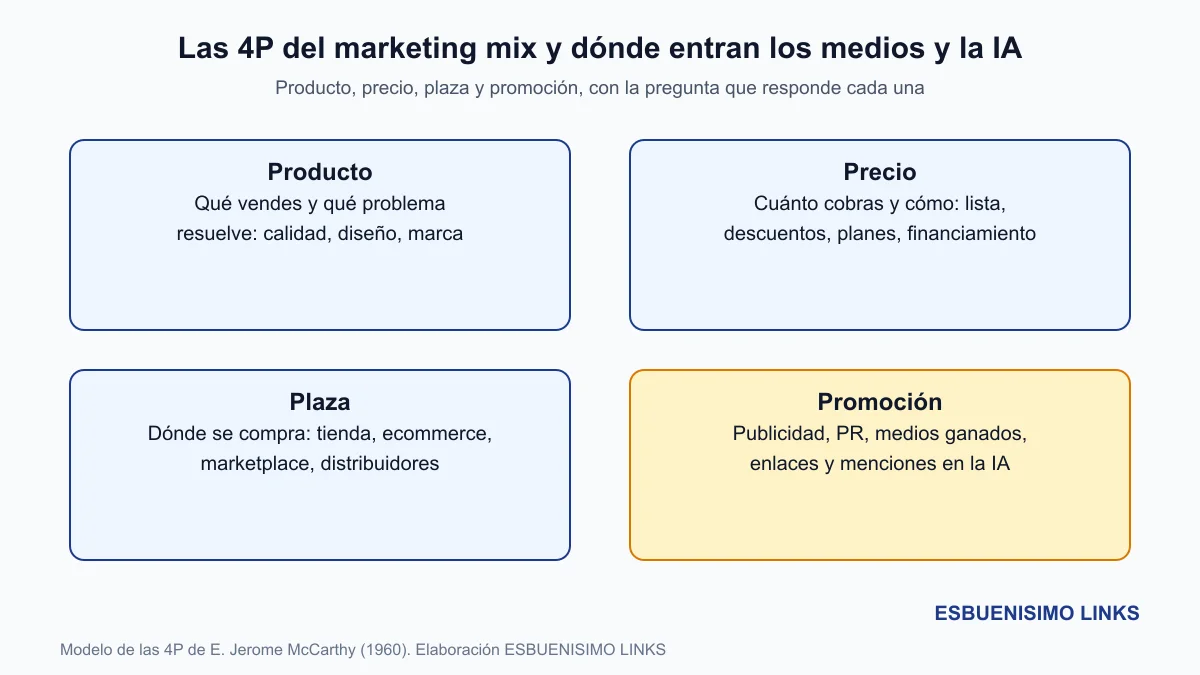
Each P answers a question. If one of the four answers is weak, the other three can't make up for it: a great product with poor distribution won't sell, and neither will a great campaign for an expensive product that's hard to buy.
| P | Question it answers | Real example in Chile | How it's measured |
|---|---|---|---|
| Product | What do I sell and what problem does it solve? | NotCo: “the food you love, but better,” made from plants | Sales by product, repeat purchase, reviews |
| Price | How much do I charge and how? | Fintual: investing “with no minimums” as a pricing argument | Margin, conversion, average order value |
| Place | Where and how do people buy? | Falabella and Mercado Libre, the most-searched online stores: 2.17 and 1.82 million searches a month | Coverage, share by channel |
| Promotion | How do people hear about me and why do they believe me? | Advertising, press, links in media and mentions in AI | Reach, brand searches, share of voice |
Sources: NotCo and Fintual websites reviewed in November 2026; brand searches from Google Ads via DataForSEO, average November 2025 to October 2026.
Product. It isn't just what gets made: it includes design, brand, packaging and warranty. NotCo built its product around an objection, taste, and tackles it in the first line of its website.
Price. It's the only P that brings in revenue; the others are costs. It isn't just a number: it includes discounts, plans, installments and how you charge. Fintual uses the absence of minimum amounts as part of its proposition, not as fine print.
Place. It's where and how people buy. In Chile, ecommerce passed US$10 billion in 2025 and is now about 12.6% of retail, according to the Santiago Chamber of Commerce (CCS via Chócale). That's why place now includes marketplaces, delivery and the search engine: we measured the most-searched stores in our study of ecommerce in Chile in 2026.
🚀 Digital PR & Link Building
Rank #1 on Google and Get Mentioned by AI
1,400+ media outlets in 8 countries. Backlinks that Google and ChatGPT recognize as trusted authority sources.
See plans and pricing →Promotion in the marketing mix: earned media, links and AI
The fourth P is the one that changed the most. In 1960, promotion meant advertising, salespeople and sales promotions. Today it includes paid, owned and earned media, and budgets are tighter: according to Gartner's survey of 402 marketing leaders, marketing budgets stood at 7.7% of company revenue in 2025, down from 9.5% three years earlier, and 30.6% of that budget goes to paid media (Gartner via MarTech).
View the data as a table
| of company revenue goes to marketing in 2025 (it was 9.5% three years earlier) | 7.7% |
| of the marketing budget is spent on paid media | 30.6% |
| of CMOs say they lack the budget to execute their strategy | 59% |
| of Chilean retail is now ecommerce (2025) | 12.6% |
With less money, promotion that accumulates is worth more. An ad disappears when the media buy ends; a story in an outlet with a link to your site keeps sending visits, raises your authority on Google (the trust the search engine gives your domain) and stays available for AI tools to read.
That last point is no longer minor. In our study of 222 purchase questions asked to six AI tools in Chile, more than half of the citations went to third-party sites, not brand sites: media, comparison sites, rankings and forums. The details are in the sources AI cites by industry in Chile.
So promotion now has two jobs: reaching people and getting others to talk about the brand. The second is done with link campaigns in Chilean media and with strategies to appear in ChatGPT or Gemini answers, known as GEO; we explain it on our GEO agency page.
How to build your company's marketing mix in 5 steps
- Define the customer and the proposition. The mix is built for a segment. If it isn't clear who you're selling to, each P will point in a different direction. It helps to have your brand positioning defined.
- Review each P with data. Sales by product, margin by price, sales by channel and reach by promotional action.
- Find the weakest P. It's usually the one nobody measures. In many companies it's digital place or earned promotion.
- Adjust one P at a time. If you change price and promotion in the same month, you won't know what worked.
- Measure what promotion leaves behind. Beyond reach, track brand searches on Google, media mentions and what AI tools answer when people ask about your category.
Common mistakes with the 4Ps
- Confusing promotion with advertising. Press, links and reviews are promotion too, and they tend to last longer.
- Cutting price to hide a place problem. If customers can't find the product, a discount won't help them.
- Using the 4Ps for services without the other three. At a clinic or a software company, people and processes matter as much as price.
- Building it once and filing it away. The mix changes with the market: ecommerce, AI and media inflation moved all four Ps in just a few years.
Frequently Asked Questions
What is the marketing mix?+
It's the set of decisions a company uses to take a product to market. The classic version is the 4Ps: product, price, place and promotion.
What are the 4Ps of marketing?+
Product (what you sell), price (how much and how you charge), place (where and how people buy) and promotion (how customers hear about you and why they believe you). E. Jerome McCarthy grouped them in 1960.
What's the difference between the 4Ps and the 7Ps?+
The 7Ps, proposed by Booms and Bitner in 1981, add people, process and physical evidence, and are used mostly by service companies.
What does promotion include today?+
Paid advertising, owned content and earned media: press stories, links from other sites, reviews and mentions in AI answers.
How much do companies spend on marketing?+
According to Gartner's 2025 survey, marketing budgets averaged 7.7% of company revenue, and 30.6% of that budget went to paid media.
Ready to rank #1 and get mentioned by AI?
Digital PR & Link Building in 1,400+ media outlets across 8 countries. Google and ChatGPT recognize you as an authority source.
See plans and pricing