By Felipe Morales, CEO of ESBUENISIMO LINKS
Slogan: what it is, slogan vs. claim, real examples and how to create one
Slogan guide: what it is, slogan vs. claim vs. tagline, real examples from Chile and the world, and how to create a slogan that the press, Google and AI repeat.
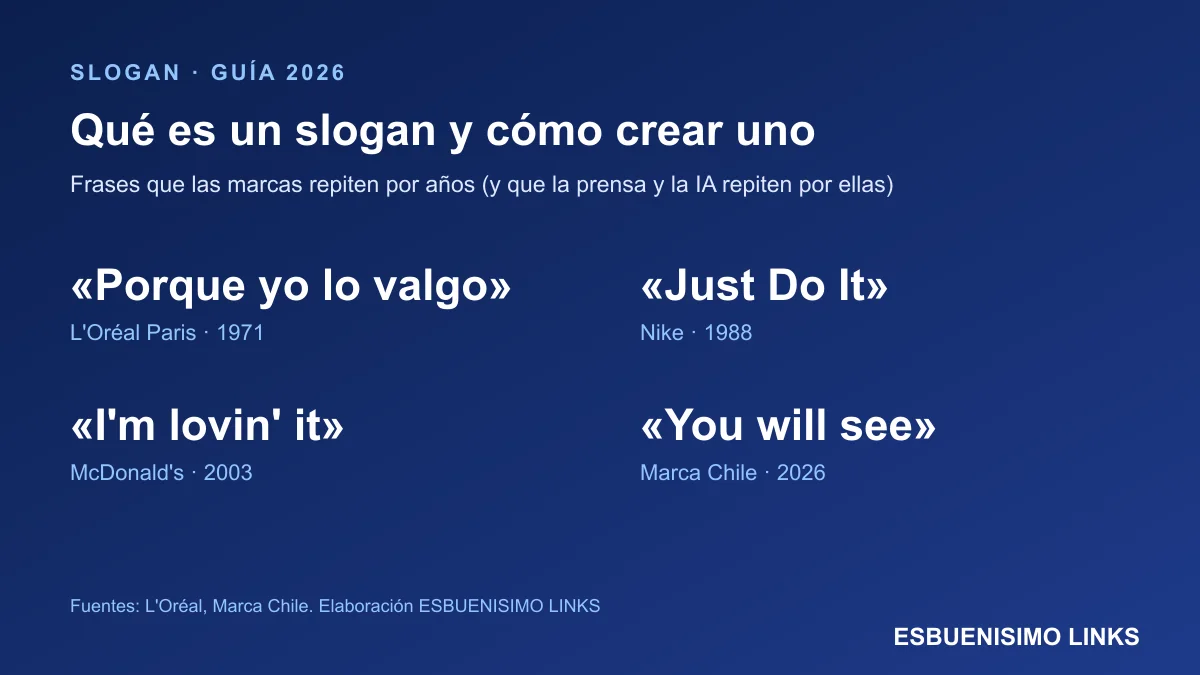
A slogan is a short phrase that sums up what a brand promises or how it wants to be remembered. Done well, it lasts for decades: L'Oréal has used «Because I'm worth it» since 1971. Done badly, it makes news for the wrong reasons, as happened to Chile's new government in March 2026.
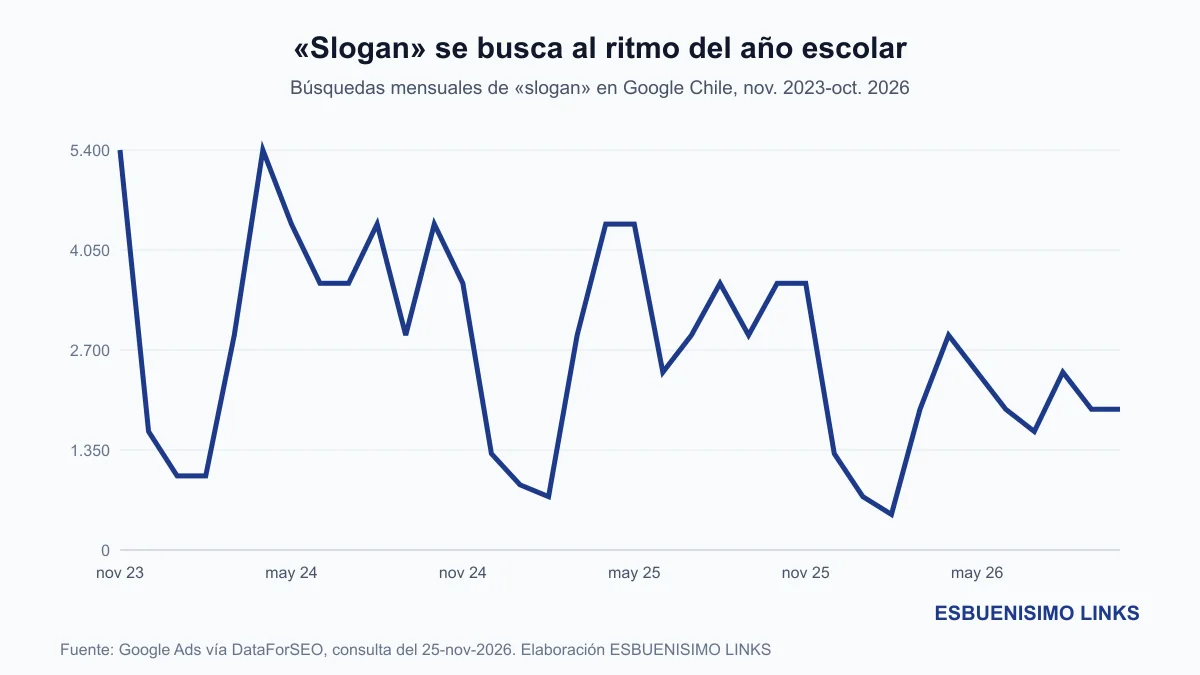
In Chile, «slogan» is searched 1,900 times a month on Google, with a curious pattern: it rises in April and November and collapses in January and February. Students with homework, but also entrepreneurs and marketing teams who need a line for their brand. This guide is for them: what a slogan is, how it differs from a claim, real examples and how to create one that the press, Google and AI will repeat.
View the data as a table
| slogan | |
|---|---|
| Nov 23 | 5,400 |
| Dec 23 | 1,600 |
| Jan 24 | 1,000 |
| Feb 24 | 1,000 |
| Mar 24 | 2,900 |
| Apr 24 | 5,400 |
| May 24 | 4,400 |
| Jun 24 | 3,600 |
| Jul 24 | 3,600 |
| Aug 24 | 4,400 |
| Sep 24 | 2,900 |
| Oct 24 | 4,400 |
| Nov 24 | 3,600 |
| Dec 24 | 1,300 |
| Jan 25 | 880 |
| Feb 25 | 720 |
| Mar 25 | 2,900 |
| Apr 25 | 4,400 |
| May 25 | 4,400 |
| Jun 25 | 2,400 |
| Jul 25 | 2,900 |
| Aug 25 | 3,600 |
| Sep 25 | 2,900 |
| Oct 25 | 3,600 |
| Nov 25 | 3,600 |
| Dec 25 | 1,300 |
| Jan 26 | 720 |
| Feb 26 | 480 |
| Mar 26 | 1,900 |
| Apr 26 | 2,900 |
| May 26 | 2,400 |
| Jun 26 | 1,900 |
| Jul 26 | 1,600 |
| Aug 26 | 2,400 |
| Sep 26 | 1,900 |
| Oct 26 | 1,900 |
What a slogan is
The word comes from Scottish Gaelic sluagh-ghairm, a clan's battle cry. The idea is still the same: a short phrase that is shouted, repeated and rallies a group around a brand. In marketing, the slogan accompanies the logo and sums up one of three things: the benefit («what you get»), the personality («who we are») or the purpose («why we exist»).
It is part of branding, not a one-off campaign. That is why it gets confused with similar terms:
| Concept | What it is | How long it lasts | Example |
|---|---|---|---|
| Slogan | A short phrase that sums up the brand's promise or personality | Years or decades | «Because I'm worth it» (L'Oréal) |
| Claim | A campaign or product line, sometimes with a concrete benefit | As long as the campaign | «You will see» (Marca Chile 2026 campaign) |
| Tagline | The line that accompanies the logo; in practice, almost a synonym of slogan | Years | «Just Do It» (Nike) |
| Motto | A statement of an institution's principles rather than a sales line | Very long | «Por la razón o la fuerza» (Chile's coat of arms) |
Slogan examples from real brands
The most studied slogan is L'Oréal Paris's. According to the company itself, it was written in 1971 by Ilon Specht, a 23-year-old copywriter at McCann in New York, and it has been translated into 40 languages. It worked because it changed the voice: beauty ads were narrated by men, and this line was spoken by a woman about herself.
| Brand or institution | Slogan | Year | What it does well (or badly) |
|---|---|---|---|
| L'Oréal Paris | «Because I'm worth it» | 1971 | Speaks in the first person and turns the product into self-esteem |
| Nike | «Just Do It» | 1988 | Three words, one verb, an attitude that fits any sport |
| McDonald's | «I'm lovin' it» | 2003 | It is sung: the five-note jingle works without words |
| Marca Chile | «You will see» | 2026 | Invites discovery and leaves room for each market to complete the sentence |
| Government of Chile | «Trabajando para usted» (Working for you) | 2026 | Criticized by experts: the change of institutional identity was read as a strategic mistake |
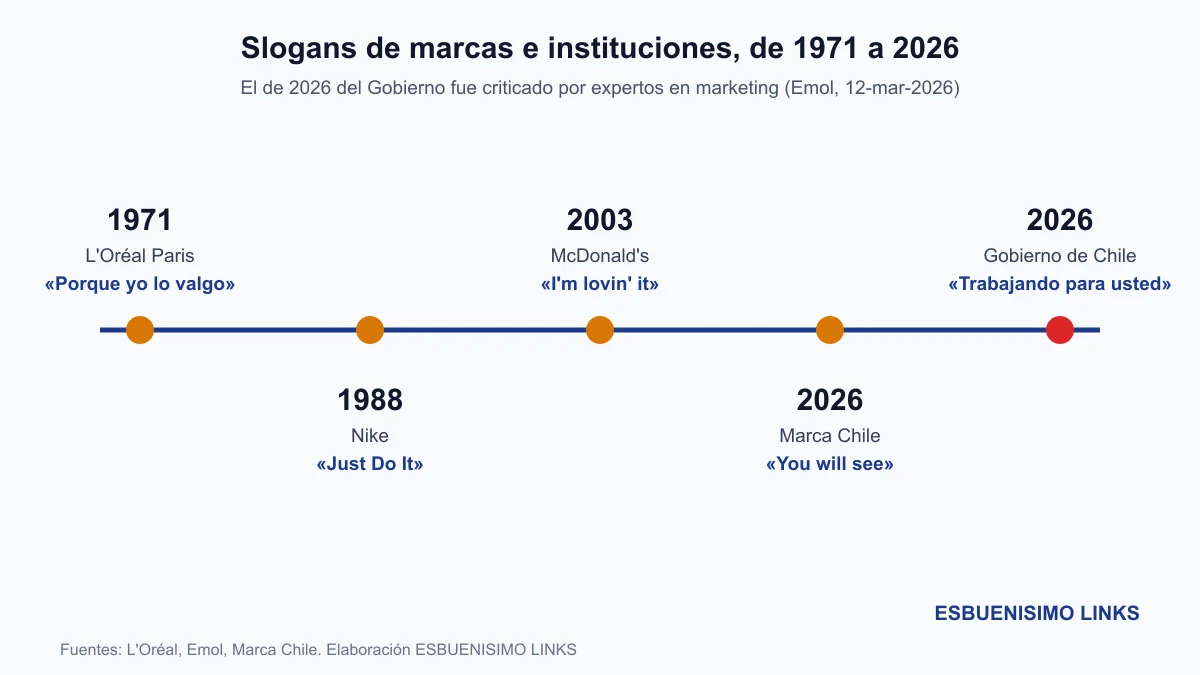
In Chile, slogans make news too. In September 2025, Evelyn Matthei relaunched her presidential campaign with «Chile, un solo equipo» (Chile, one team), and analysts quoted by Emol debated whether it spoke to voters or to her own campaign. In March 2026, José Antonio Kast's government debuted «Trabajando para usted» (Working for you) on its official accounts; a UAI academic told Emol that changing the institutional logo was «a strategic mistake». And in January 2026, Marca Chile launched «You will see», its international campaign for four markets.
- 1971L'Oréal Paris: «Because I'm worth it»Written by Ilon Specht, a 23-year-old McCann copywriter in New York. Today it is translated into 40 languages.
- September 2025Evelyn Matthei: «Chile, un solo equipo»Slogan for the relaunch of her presidential campaign. One analyst said it «speaks more inward than outward».
- January 2026Marca Chile: «You will see»New international country-brand campaign in Madrid, New York, São Paulo and London.
- March 2026Government of Chile: «Trabajando para usted» (Working for you)It appeared on official social accounts after the change of government. A UAI academic called it a «strategic mistake».
🚀 Digital PR & Link Building
Rank #1 on Google and Get Mentioned by AI
1,400+ media outlets in 8 countries. Backlinks that Google and ChatGPT recognize as trusted authority sources.
See plans and pricing →How to create a slogan for your brand in 6 steps
1. Start with strategy, not the phrase. Define what you want people to remember about you: a benefit, an attitude or a purpose. If that is unclear, no copywriter can fix it.
2. Write many options. Fifty bad lines lead to a good one. Play with verbs, the first person («I'm worth it») and the second («just do it»).
3. Cut. Lines that last have two to six words. Every extra word is one nobody will repeat.
4. Pass the competitor test. If your competitor could sign the same line, it does not set you apart.
5. Search it on Google and in AI. Type the slogan into Google and ask ChatGPT whose it is. If another brand or a different meaning shows up, you will have to fight for that phrase.
6. Register it and always use it the same way. A slogan can be registered as a trademark. It should appear with the same wording on the logo, website, social media and in your brand guidelines.
| Test | Question | Sign that it works |
|---|---|---|
| Brevity | Is it under seven words? | People remember it after hearing it once |
| Ownership | Could your competitor sign it? | If a competitor could use it too, it is not yours |
| Promise | Does it say what the customer gains or what makes you different? | Customers use it to explain why they chose you |
| Sound | Does it sound good out loud, with rhythm or rhyme? | People repeat it effortlessly |
| Durability | Will it still be true in five years? | It does not depend on an offer or a trend |
| Search | What shows up on Google and in AI when you type it? | Your brand, not another company or a different meaning |
The three most common mistakes: first, the generic line. «Quality and trust» or «your best choice» could belong to any company, so nobody links them to yours. Second, tying the slogan to an offer or a trend that expires within a year. Third, changing it too often: every change erases what people had already learned. If your brand operates in several countries, test how it sounds in each market; L'Oréal kept the same idea across 40 languages, not the same literal translation.
Why the press and AI decide which lines are remembered
A slogan does not become famous by sitting next to the logo. It becomes famous when others repeat it: journalists, customers, conversations. The lines above reached people because media quoted and debated them. And repetition works: according to the Imagen de Chile Foundation, 76% of Chileans remember seeing the Marca Chile logo in 2026, up from 55% in 2020.
View the data as a table
| years L'Oréal has used «Because I'm worth it» | 55 |
| languages that slogan has been translated into | 40 |
| of Chileans remember seeing the Marca Chile logo in 2026 | 76% |
| remembered it in 2020 | 55% |
Today there is one more reader repeating phrases: artificial intelligence. When someone asks ChatGPT or Gemini about a brand, the answer is built from what those tools have read in media and reference sites. If your slogan appears in press articles next to your name and your category, AI learns to associate them; it is the same mechanism we explain in our guide to top of mind.
There are two complementary ways to earn those mentions. The first is pitching your story to journalists through a press agency that secures editorial coverage. The second is publishing articles with links in authoritative outlets, which build visibility on Google and in AI; you can see how it works in Chile at esbuenisimolinks.com/link-building-chile. A good line deserves to be repeated more than your own logo.
Frequently Asked Questions
What is a slogan?+
It is a short, memorable phrase that sums up a brand's promise, personality or purpose. It accompanies the logo and is used for years, unlike a campaign claim.
What is the difference between a slogan and a tagline?+
In practice they are almost synonyms. Some marketers use tagline for the line that sits next to the logo and slogan for any brand or campaign line.
What is the difference between a slogan and a claim?+
A slogan represents the brand for years. A claim is the line of a campaign or product and changes when the campaign ends.
What are examples of famous slogans?+
L'Oréal's «Because I'm worth it» (1971), Nike's «Just Do It» (1988) and McDonald's «I'm lovin' it» (2003). In Chile, Marca Chile launched «You will see» in January 2026.
How do you create a good slogan?+
First define what you want people to remember, write many options, cut to fewer than seven words, check that a competitor could not sign it and search it on Google and in AI before using it.
Ready to rank #1 and get mentioned by AI?
Digital PR & Link Building in 1,400+ media outlets across 8 countries. Google and ChatGPT recognize you as an authority source.
See plans and pricing