By Felipe Morales, CEO of ESBUENISIMO LINKS
Market segmentation: what it is, types and examples with data from Chile
Market segmentation explained: what it is, its types with real examples, Chile's socioeconomic groups (AIM and CASEN 2022) and how to choose media for each segment.
Market segmentation means splitting potential customers into groups with similar needs and behaviors, so you can reach each one with the right product, price, message and channel. It is the difference between spending the budget on “all of Chile” and spending it where the people who can actually buy are.
In this guide we explain what market segmentation is, its types with real company examples, how to use Chile's socioeconomic groups and how to choose which media to appear in for each segment.
What market segmentation is
No company sells to everyone. Segmenting means accepting that and organizing it: identifying groups that resemble each other and differ from the rest, measuring what each is worth and deciding which to target. A good segment meets four conditions: it is measurable, big enough to be profitable, reachable through concrete channels and responds differently from other groups.
The starting point is usually the population. According to the INE 2024 Census, Chile has 18,480,432 people in 6,596,527 households, with an average of 2.8 people per household, and 40% of the population lives in the Metropolitan Region.
View the data as a table
| people counted in the 2024 census | 18,480,432 |
| of the population lives in the Santiago Metropolitan Region | 40% |
| of households are single-person (8.3% in 1992) | 21.8% |
| of the population is 65 or older | 14% |
Types of market segmentation, with examples
The four classic variables are geographic, demographic, psychographic and behavioral. In business-to-business (B2B) sales a fifth is added: firmographic.
| Type | Variables | Example in Chile |
|---|---|---|
| Geographic | Country, region, district, climate, urban or rural | Different campaigns for Santiago and the regions; 40% of people live in the Metropolitan Region |
| Demographic | Age, sex, income, socioeconomic group, household size | Smaller pack sizes for the 21.8% of single-person households |
| Psychographic | Values, lifestyle, interests, personality | Brands speaking to people who prioritize sustainability or local products |
| Behavioral | Purchase frequency, loyalty, benefit sought, usage occasion | Customers who only buy during Cyber or Black Friday |
| Firmographic (B2B) | Industry, size, revenue, headcount | Software for SMBs vs. software for large enterprises |
In practice they are combined. A food brand can target single-person households (demographic) in urban districts (geographic) who shop online (behavioral). Each filter shrinks the group but makes it easier to persuade.
🚀 Digital PR & Link Building
Rank #1 on Google and Get Mentioned by AI
1,400+ media outlets in 8 countries. Backlinks that Google and ChatGPT recognize as trusted authority sources.
See plans and pricing →Socioeconomic segmentation in Chile: the AIM groups
In Chile, the standard for socioeconomic segmentation is the set of socioeconomic groups (GSE) from the Association of Market and Public Opinion Researchers (AIM). They classify households by income per capita, education and occupation of the main earner into seven groups: AB, C1a, C1b, C2, C3, D and E.
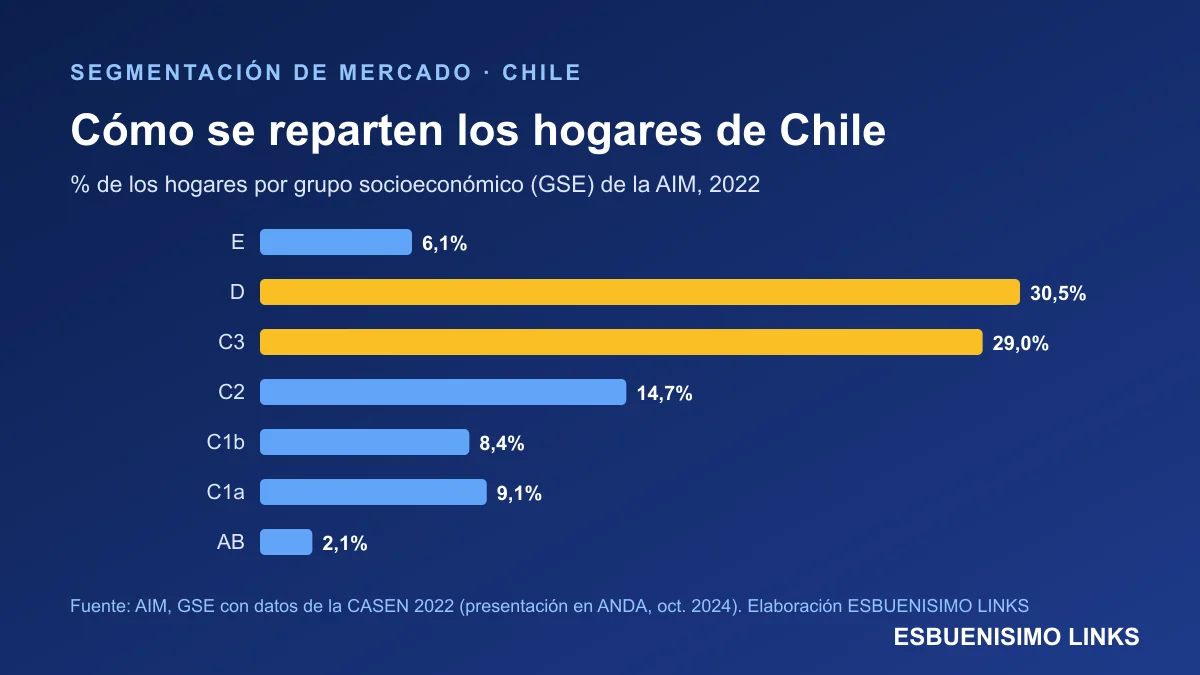
The AIM update based on CASEN 2022 data shows a big shift: the upper groups (AB, C1a and C1b) went from 15.3% to 19.6% of households, while groups D and E fell from 45.0% to 36.6%.
View the data as a table
| AB | C1a | C1b | C2 | C3 | D | E | |
|---|---|---|---|---|---|---|---|
| 2017 | 2 | 7 | 7 | 13 | 27 | 36 | 10 |
| 2022 | 2 | 9 | 8 | 15 | 29 | 31 | 6 |
| Group (GSE) | % of households 2017 | % of households 2022 | Income per capita 2022 |
|---|---|---|---|
| AB | 1.9% | 2.1% | $4,959,437 |
| C1a | 6.5% | 9.1% | $1,998,058 |
| C1b | 6.9% | 8.4% | $1,360,167 |
| C2 | 12.5% | 14.7% | $949,378 |
| C3 | 27.3% | 29.0% | $637,655 |
| D | 35.5% | 30.5% | $407,170 |
| E | 9.5% | 6.1% | $196,192 |
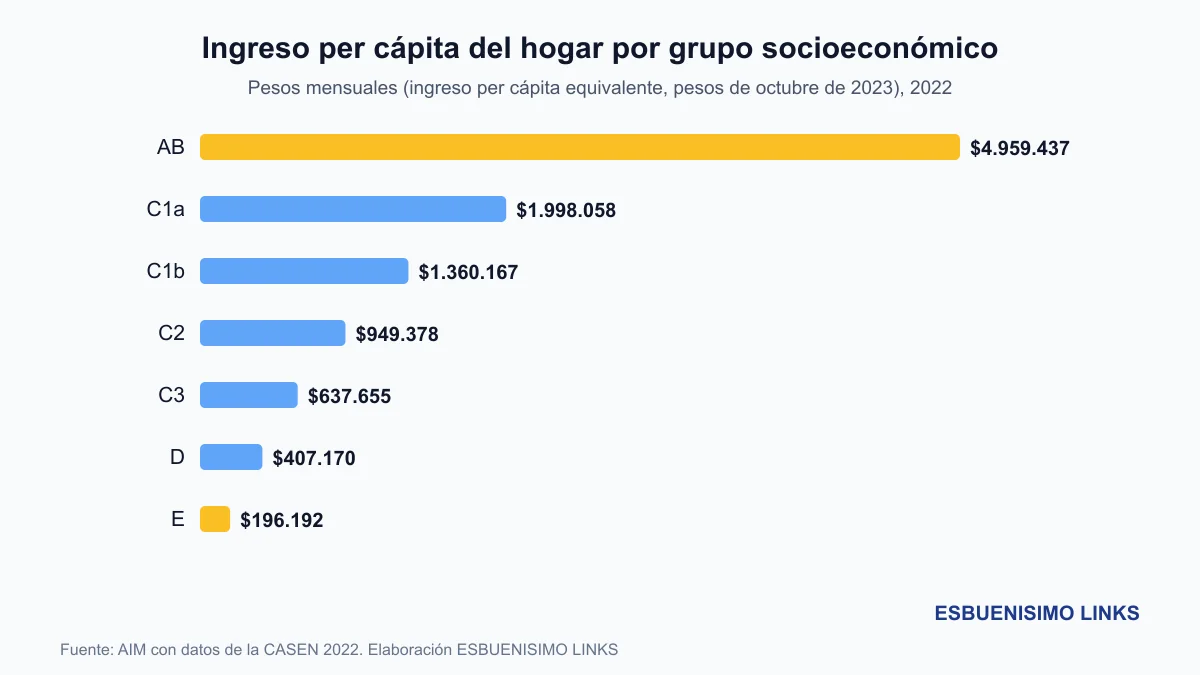
That gap is why the GSE remains useful: income per capita in group AB is 25 times that of group E. The same message, price or outlet rarely works for both.
A real example: Walmart Chile and its four formats
Walmart Chile is a good case of applied segmentation: instead of a single chain, it runs four formats for different customers. According to Walmart's Chile fact sheet, as of July 31, 2026 it had 102 Lider Hiper, 159 Lider Express, 128 SuperBodega aCuenta and 13 Central Mayorista stores.
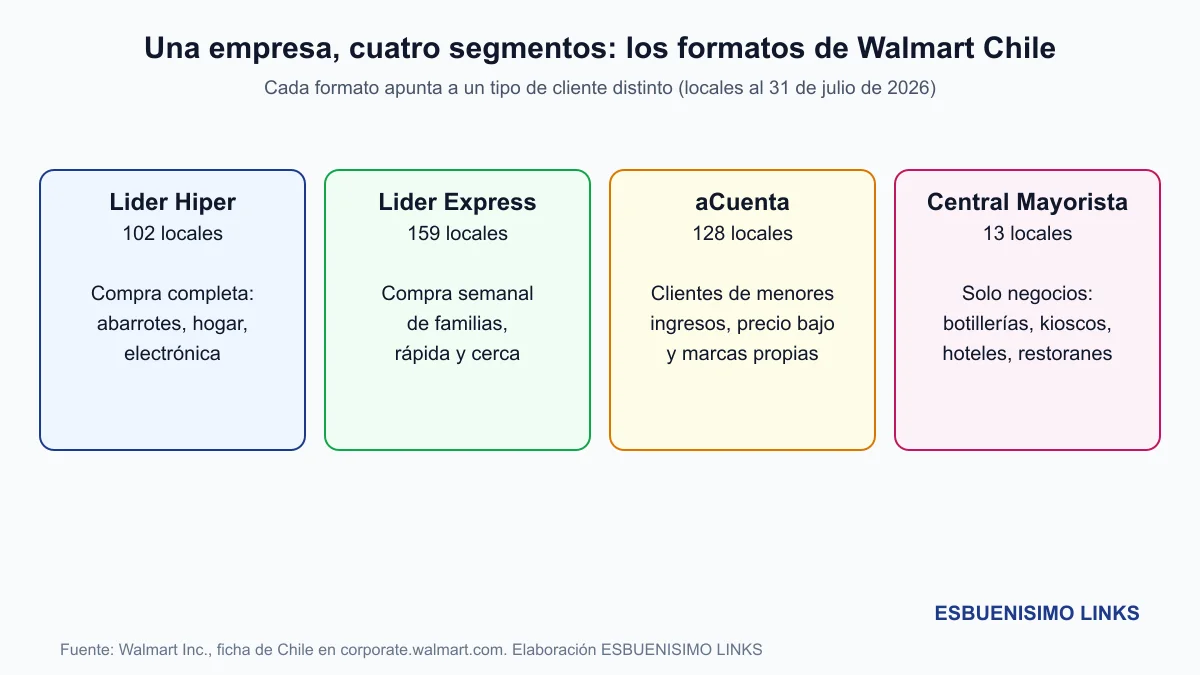
Lider Hiper is the one-stop shop; Lider Express, the quick weekly grocery run for families; aCuenta targets lower-income customers with low prices and private labels; and Central Mayorista serves only businesses such as liquor stores, kiosks, hotels and restaurants. One company, four value propositions.
How to do market segmentation in five steps
- Define the total market. How many people or companies could buy, using census, household survey or industry data. If you lack that data, start with market research.
- Choose the variables. The ones that actually change purchasing; age does not always matter, usage frequency almost always does.
- Measure each segment. Size, purchasing power and competition. Google searches help estimate demand.
- Pick the target segment(s). Two well served beat six half served.
- Adapt product, price, message and channel. This is where segmentation pays off: where the brand shows up.
Interest in learning to segment is high across the region: “segmentación de mercado” is searched 6,600 times a month in Mexico and 320 in Chile; in the United States, “market segmentation” gets 12,100.
View the data as a table
| Mexico | 6,600 |
| Peru | 2,400 |
| Colombia | 1,600 |
| Chile | 320 |
| Argentina | 320 |
Common segmentation mistakes
The most frequent is segmenting on data that does not change purchasing. Splitting by sex or age because it is easy, when what really separates customers is usage frequency or the problem they want solved, produces tidy but useless segments.
The second is creating segments too small to justify their own message. If a group does not pay for the cost of addressing it separately, merge it with another. The third is the opposite: sticking with “everyone” for fear of losing sales, and ending up with messages so general they persuade no one.
The fourth is using old data. Chile's socioeconomic distribution changed considerably between 2017 and 2022, and the 2024 Census showed smaller households and an older population. A plan built on decade-old figures targets a country that no longer exists.
The last is segmenting the product but not the channels: defining well who you sell to and then publishing in the same outlets as always.
From segment to media: where to show up for each audience
The last step is the most neglected. A well-defined segment is of little use if the brand appears in outlets that audience does not read. For communications and SEO, segmenting also means choosing where to publish.
| Segment | Where it looks for information | Where to show up |
|---|---|---|
| Executives and decision makers (AB, C1a) | Business press, LinkedIn, AI | Business and economic outlets |
| Middle-class families (C2, C3) | Google, news portals, social media | National newspapers and portals, lifestyle sites |
| Regional audiences | Newspapers and radio in their region | Regional news portals |
| Professional niches (health, mining, tech) | Trade and specialized media | Industry outlets |
| Buyers who ask AI | ChatGPT, Gemini, Perplexity | The sources those AIs cite |
For regional audiences, regional news portals reach where national outlets do not. For mass audiences, check which newspapers still hold their readers: our Chilean newspapers ranking 2026 shows how their traffic changed in a year.
That is the logic of industry-specific link building in Chile: publishing in the outlets each segment reads, with a link that also adds authority with Google. If you need it inside a complete SEO strategy, an SEO agency can align segments, keywords and media.
Frequently Asked Questions
What is market segmentation in marketing?+
It is dividing potential customers into groups with similar needs and behaviors to offer each one the right product, price, message and channel, instead of speaking to the whole market the same way.
What are the 4 market segmentation variables?+
Geographic (where customers live), demographic (age, income, socioeconomic group, household size), psychographic (values and lifestyle) and behavioral (purchase frequency, loyalty, benefit sought). In B2B, firmographic variables such as industry and company size are added.
What are Chile's socioeconomic groups AB, C1, C2, C3, D and E?+
They are AIM's classification for Chile based on income per capita, education and occupation of the household's main earner. With 2022 data, group C3 accounts for 29.0% of households and D for 30.5%; the upper groups AB, C1a and C1b add up to 19.6%.
Which company in Chile uses market segmentation well?+
Walmart Chile is a clear example: it runs Lider Hiper for one-stop shopping, Lider Express for weekly groceries, SuperBodega aCuenta for lower-income customers and Central Mayorista for businesses only.
How does segmentation relate to SEO and media?+
Each segment searches and reads in different places. Good segmentation lets you choose keywords and outlets where that audience is, such as business press for executives or regional portals for regional audiences.
Ready to rank #1 and get mentioned by AI?
Digital PR & Link Building in 1,400+ media outlets across 8 countries. Google and ChatGPT recognize you as an authority source.
See plans and pricing