By Felipe Morales, CEO of ESBUENISIMO LINKS
ROAS: what it is, how to calculate it and what a good ROAS is in 2026
ROAS explained: formula, break-even ROAS by margin, 2026 benchmarks by industry (Google Ads 3.16, Meta 1.88) and what ROAS misses about SEO.
ROAS is the most watched metric in a Google Ads or Meta campaign, and also the most misread. A ROAS of 3 can be a great result for a software brand and a loss for an electronics store. This guide explains what ROAS is, how to calculate it, what figures brands are getting in 2026 and what it leaves out: the value that builds up when a brand invests in SEO and links instead of only in ads.
What is ROAS
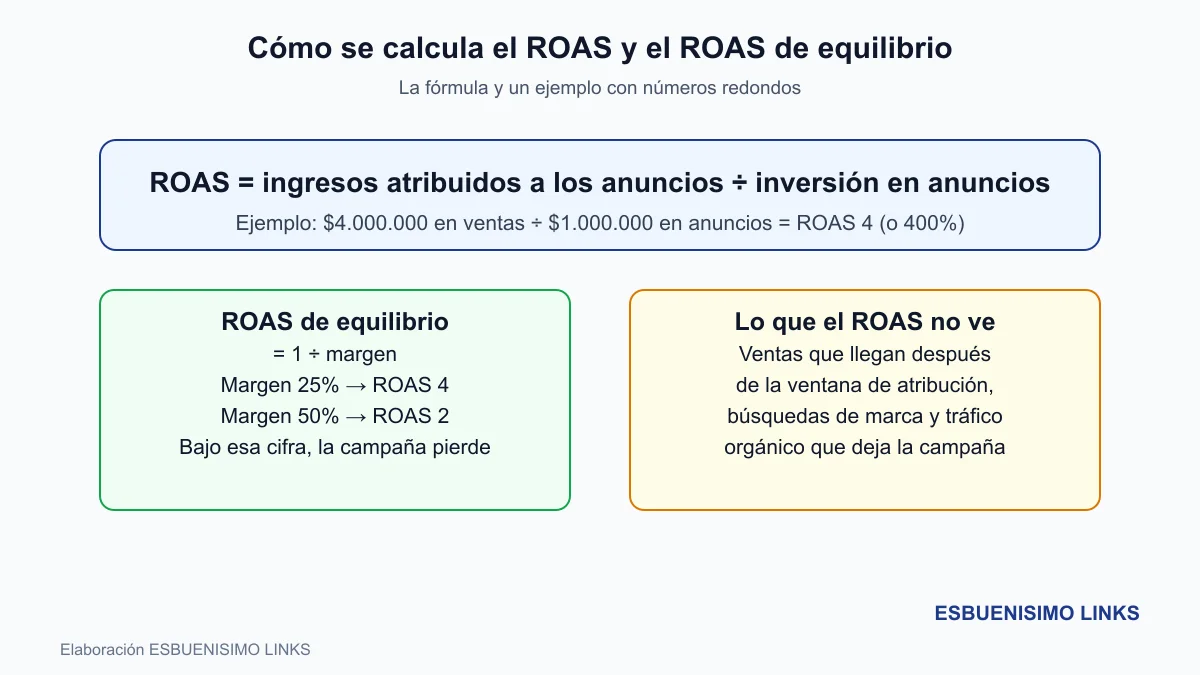
ROAS stands for return on ad spend. It answers one question: how much revenue does each dollar spent on ads bring in. If a campaign cost $10,000 and generated $40,000 in attributed sales, its ROAS is 4, also written 4:1 or 400%.
Google Ads uses it as a bidding goal: the Target ROAS strategy adjusts every bid to get the conversion value the advertiser asks for per dollar spent. To do that, the store must send the value of each sale, not just a count of conversions.
How to calculate ROAS and your break-even ROAS
The formula is simple: ROAS = revenue attributed to ads ÷ ad spend. Deciding what a good number is takes more work. That is what break-even ROAS is for: 1 divided by the product margin. With a 25% margin, each $100 sale leaves $25 to pay for the ad, so ROAS must be at least 4 to avoid losing money.
| Product margin | Break-even ROAS | What it means |
|---|---|---|
| 10% | 10 | Low margin: you need high sales per ad dollar |
| 20% | 5 | Low margin: you need high sales per ad dollar |
| 25% | 4 | Low margin: you need high sales per ad dollar |
| 33% | 3 | Typical retail zone |
| 40% | 2.50 | Typical retail zone |
| 50% | 2 | High margin: the campaign tolerates a lower ROAS |
| 60% | 1.67 | High margin: the campaign tolerates a lower ROAS |
This table is the first conversation to have with finance before setting a target ROAS. A campaign with a ROAS of 3 in a 25% margin category loses money on every sale, even if the Google Ads dashboard shows it in green.
🚀 Digital PR & Link Building
Rank #1 on Google and Get Mentioned by AI
1,400+ media outlets in 8 countries. Backlinks that Google and ChatGPT recognize as trusted authority sources.
See plans and pricing →ROAS vs. ROI: the difference
ROAS measures revenue over ad spend. ROI measures profit over total investment: it subtracts product cost, shipping, payment fees, returns and team salaries. That is why an ecommerce manager can report a ROAS of 5 while finance reports a negative ROI for the same campaign.
The rule of thumb: ROAS is for optimizing campaigns day to day; ROI is for deciding which channel gets the year's budget. Mixing the two leads to unfair comparisons between paid ads and channels like SEO, which have no cost per click. We cover this in the difference between SEO and SEM.
What is a good ROAS in 2026: figures by industry
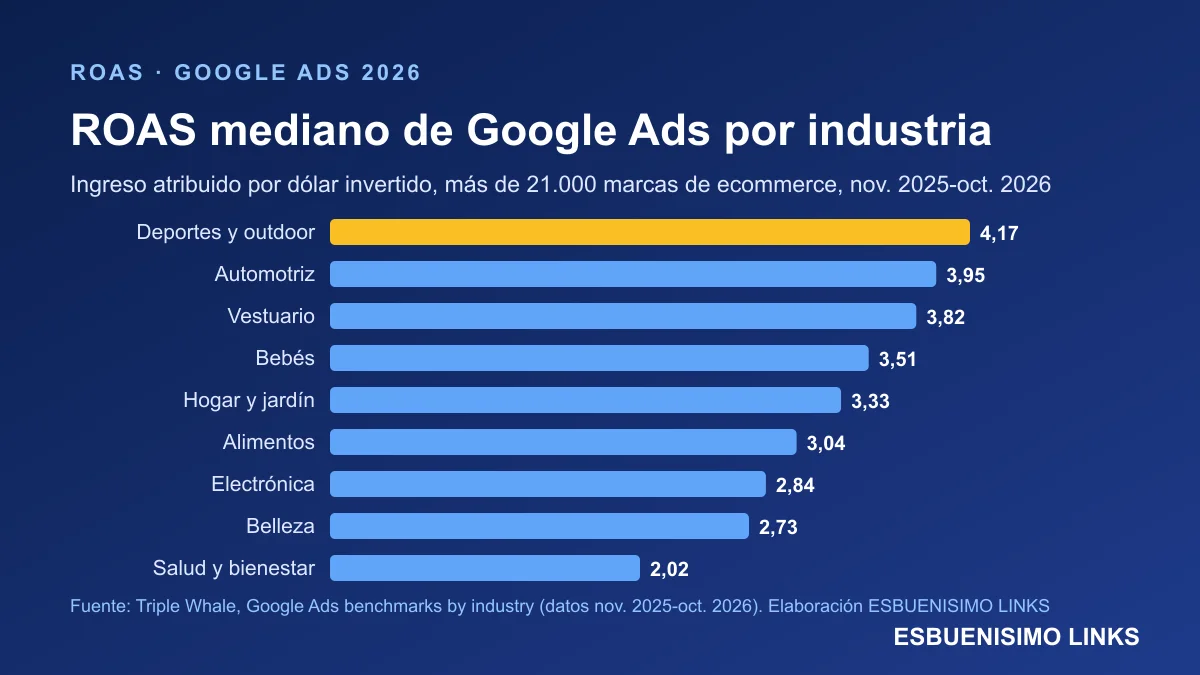
The most complete recent data comes from Triple Whale, an analytics platform for online stores, covering more than 21,000 ecommerce brands from November 2025 to October 2026. The Google Ads median was 3.16, down 7.4% from the previous year, while cost per thousand impressions rose 18.1% and cost per acquisition 14.6%. On Meta, the median was 1.88.
View the data as a table
| Google Ads median ROAS (-7.4% year on year) | 3.16 |
| Meta (Facebook and Instagram) median ROAS | 1.88 |
| rise in Google Ads cost per thousand impressions | +18.1% |
| rise in Google Ads cost per acquisition | +14.6% |
ROAS fell in 14 of the 15 industries Triple Whale tracks on Google Ads. Sports and outdoors leads at 4.17; health and wellness is last at 2.02. Google beats Meta in all 14 industries measured on both platforms, which is expected: people searching on Google already intend to buy, while Meta shows ads to people who are not searching yet.
| Industry | Google Ads ROAS | Meta ROAS | Gap |
|---|---|---|---|
| Sports and outdoors | 4.17 | 2.38 | +1.79 |
| Automotive | 3.95 | 2.75 | +1.20 |
| Apparel and accessories | 3.82 | 2.26 | +1.56 |
| Travel accessories | 3.82 | 2.21 | +1.61 |
| Baby | 3.51 | 2.27 | +1.24 |
| Home and garden | 3.33 | 2.29 | +1.04 |
| Toys and collectibles | 3.15 | 1.99 | +1.16 |
| Lifestyle and boutique | 3.05 | 2.07 | +0.98 |
| Food and beverage | 3.04 | 1.61 | +1.43 |
| Electronics | 2.84 | 1.98 | +0.86 |
| Books and music | 2.83 | 1.64 | +1.19 |
| Pets | 2.78 | 1.58 | +1.20 |
| Beauty | 2.73 | 1.53 | +1.20 |
| Health and wellness | 2.02 | 1.42 | +0.60 |
View the data as a table
| Meta ROAS | Google Ads ROAS | |
|---|---|---|
| Sports and outdoors | 2.4 | 4.2 |
| Automotive | 2.8 | 4.0 |
| Apparel and accessories | 2.3 | 3.8 |
| Travel accessories | 2.2 | 3.8 |
| Baby | 2.3 | 3.5 |
| Home and garden | 2.3 | 3.3 |
| Toys and collectibles | 2.0 | 3.2 |
| Lifestyle and boutique | 2.1 | 3.1 |
| Food and beverage | 1.6 | 3.0 |
| Electronics | 2.0 | 2.8 |
| Books and music | 1.6 | 2.8 |
| Pets | 1.6 | 2.8 |
| Beauty | 1.5 | 2.7 |
| Health and wellness | 1.4 | 2.0 |
Be careful about using these figures as targets: they are mostly US stores, with their own price levels and competition. In Chile, cost per click varies far more across categories: our study of the most expensive Google Ads keywords in Chile found B2B searches above US$20 per click and car searches below US$0.30.
What Google Ads ROAS does not measure
ROAS has three blind spots that matter when comparing advertising with other channels:
- The attribution window. It only counts sales within a set period after the click. The person who comes back two months later searching for the brand name does not count.
- The brand effect. A campaign that lifts brand searches improves every channel, but ROAS credits the last campaign that got the click.
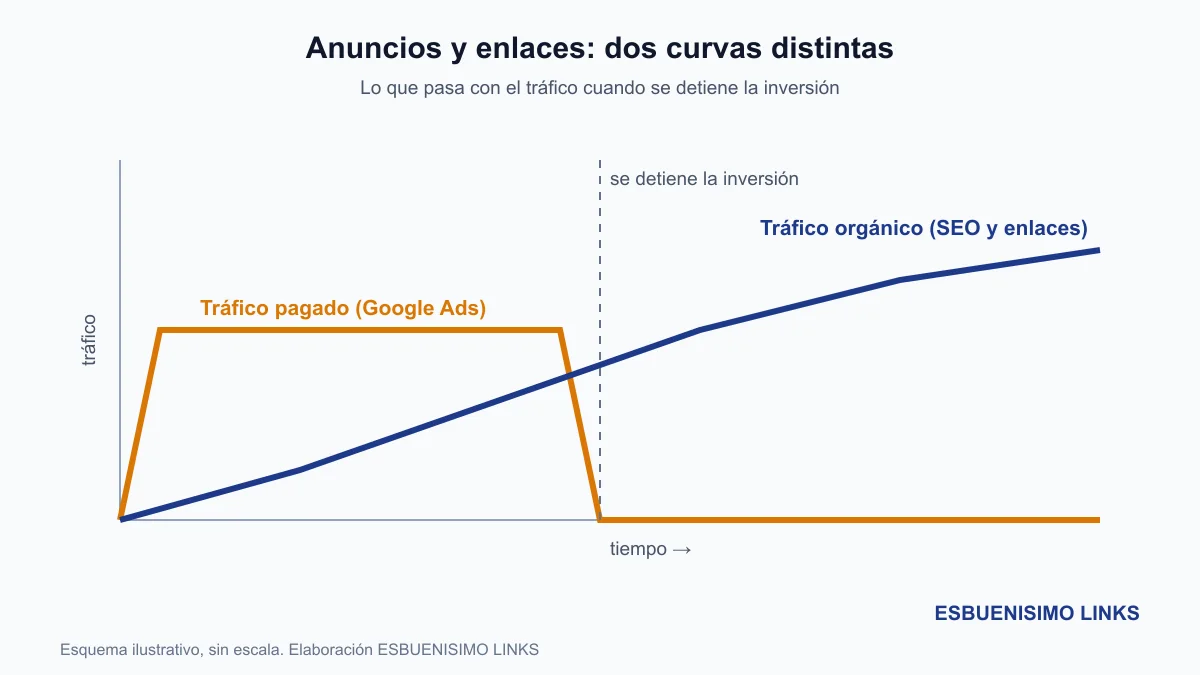
- Accumulation. When Google Ads is switched off, paid traffic drops to zero the next day. A link in an authoritative outlet keeps sending signals to Google, and now to ChatGPT and Gemini, for years.
| Google Ads | Link building and SEO | |
|---|---|---|
| When traffic arrives | From day one | Gradually, over months |
| What happens when you stop paying | Traffic drops to zero | Links and rankings remain |
| How it is measured | ROAS per campaign, inside an attribution window | Cumulative ROI: organic traffic, brand searches and mentions |
| Cost trend 2025-2026 | CPM +18.1% and CPA +14.6% (Triple Whale) | The cost of a link does not rise with auction competition |
That is why SEO should not be judged by a campaign's ROAS, but by cumulative ROI over 12 or 24 months. A link building plan for ecommerce in Chile is evaluated by how much organic traffic, brand searches and media mentions it adds each quarter, and by how much it reduces dependence on paid budget.
How to improve ROAS without raising the budget
- Send the real value of each sale to Google Ads, ideally the margin rather than the price, so bidding optimizes for profit.
- Split brand and generic campaigns. Brand search campaigns inflate average ROAS; analyzing them separately shows how generic campaigns really perform.
- Improve product pages. Photos, visible prices, clear shipping and reviews lift conversion rate, which fell 7% on Google Ads in the last year according to Triple Whale.
- Reduce dependence on paid clicks. Every keyword the store wins organically is one it can stop buying at auction. Ecommerce SEO techniques and links from news outlets are how to get there.
ROAS, SEO and links: how to split the budget
The useful question is not whether ads outperform SEO, but which part of growth you want to buy each month and which part you want to build. Ads buy demand that already exists; links in news outlets and mentions build authority and brand searches that lower the cost of everything else. With Google Ads CPM up 18% in a year, a brand that only buys clicks pays more and more for the same customer.
At ESBUENISIMO LINKS we help stores and brands earn links in more than 1,400 Latin American outlets and measure their effect on Google and AI. If you also need to sort out technical and content SEO, see our SEO agency.
Frequently Asked Questions
What is ROAS?+
ROAS stands for return on ad spend. It shows how much revenue each dollar of advertising generates: a ROAS of 4 means $4 in sales for every $1 spent.
How is ROAS calculated?+
Divide the revenue attributed to ads by the ad spend. If a campaign sold $40,000 and cost $10,000, ROAS is 4, or 400% as a percentage.
Is a ROAS of 4 good?+
It depends on margin. A ROAS of 4 breaks even at a 25% margin and is profitable above it. For reference, the Google Ads median for ecommerce was 3.16 from November 2025 to October 2026, according to Triple Whale.
Is 2.5 a good ROAS?+
Only if your margin is above 40%. Break-even ROAS is 1 divided by the margin, so 2.5 is the floor for a 40% margin business.
What is the difference between ROI and ROAS?+
ROAS measures revenue over ad spend; ROI measures profit over total investment, after product, shipping and fee costs. A campaign can show a ROAS of 3 and still have a negative ROI.
Ready to rank #1 and get mentioned by AI?
Digital PR & Link Building in 1,400+ media outlets across 8 countries. Google and ChatGPT recognize you as an authority source.
See plans and pricing